
Career profile

Air Traffic Controller

Air traffic controllers issue pilots clearances that keep planes safely apart while taxiing and flying.

Two planes' routes are set to bring them too close. The controller sees it coming, changes one clearance, then keeps watching as traffic shifts.
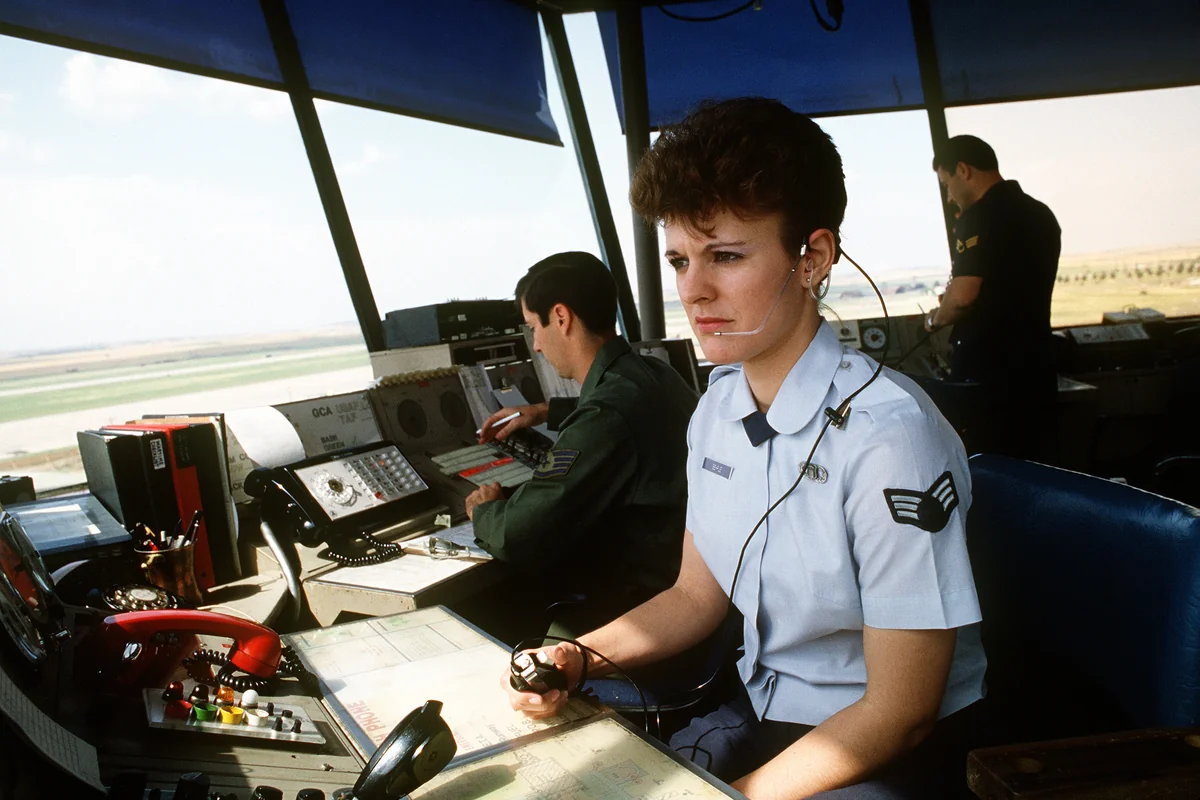
An air traffic controller wearing a headset sits at her console in a control tower, watching a small jet on the runway.

A day in the life

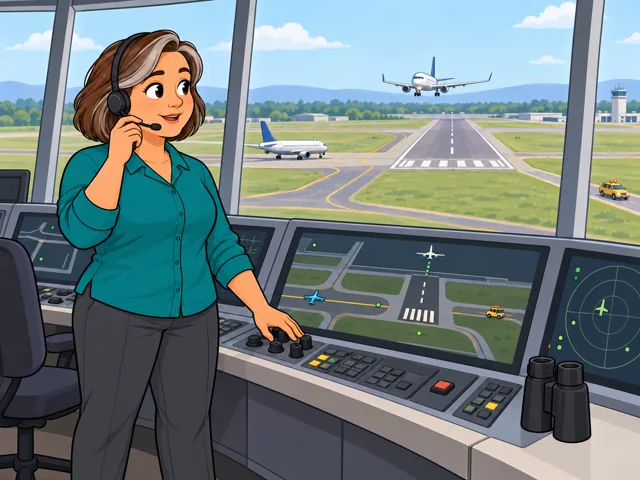
1An air traffic controller watches an approaching aircraft and another waiting beside the runway while giving instructions from the tower.

Sequence traffic from the tower

Watch planes and ground vehicles from the tower and say where and when each moves, keeping runways safe.
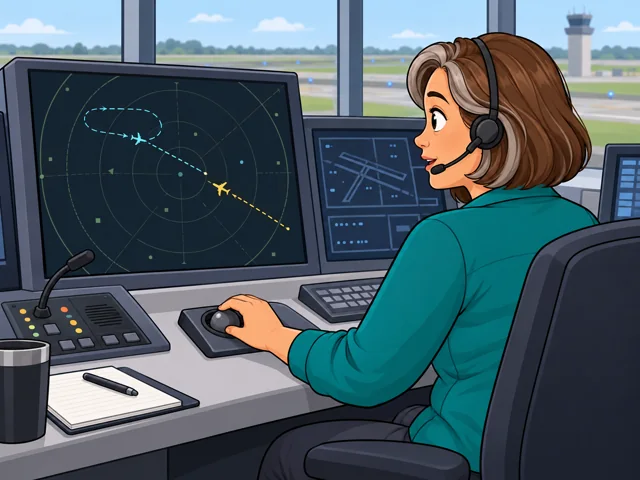
2A controller selects an aircraft on a radar display and speaks into her headset to revise its clearance before converging traffic loses safe separation.

Act before planes lose spacing

Give pilots a new altitude or a hold before their planes lose safe spacing.
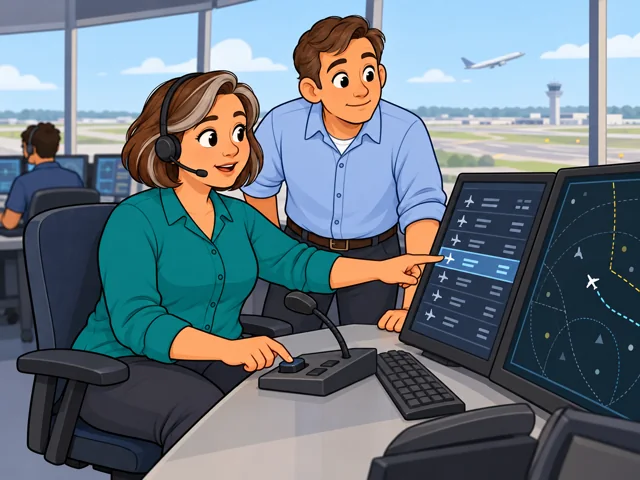
3A controller relays a flight's information over an intercom while pointing to its electronic record, with a coworker following the handoff.

Hand off a flight

Pass the next control center the flight's course, altitude and expected arrival so it can take over smoothly.
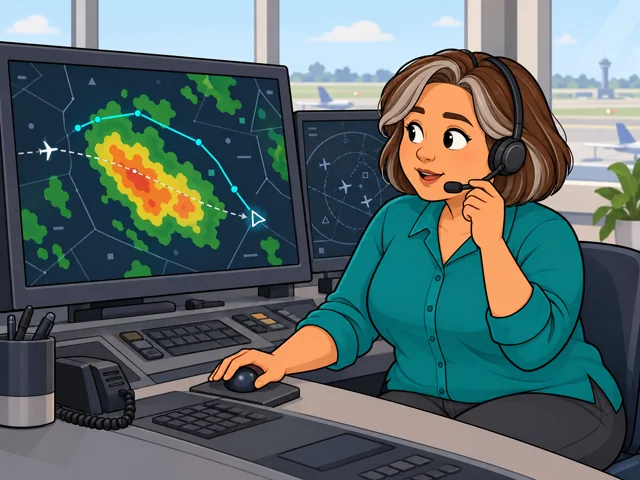
4A controller uses a weather display to route a departing aircraft around hazardous conditions while transmitting a revised clearance.

Warn pilots and reroute departures

Warn pilots about dangerous weather, and send a departing flight a new route clearance if weather affects it.

Quick facts

Preparation

Qualifying experience or education, then training

United States

Pay

$148,080 a year

United States · May 2025

Outlook

2% projected growth

United States · 2025–2035

Quick orientation

Preparation, pay & outlook

Preparation

Qualifying experience or education, then training

Federal Aviation Administration (FAA) entry includes screening and extensive training; approved college programs offer another route.

Geography
United States
Period
Not applicable

Pay

$148,080 a year

National median for May 2025, equivalent to about $71.19 an hour.

Geography
United States
Period
May 2025

Outlook

2% projected growth

About 2,100 openings a year, on average, during 2025–2035.

Geography
United States
Period
2025–2035

Fit, tradeoffs & changing tools

Things to weigh

  • Sustained concentration can be exhausting; nights, weekends, and rotating shifts are common.
  • FAA placement is nationwide, so training may lead to a move rather than a job near home.

Where AI may help

Where aircraft and facilities are equipped, Data Communications sends clearances as digital messages, reducing lengthy radio exchanges and readback errors.

What people still lead

You still decide when traffic needs a different clearance and respond when a pilot cannot follow the original plan.

What we can’t predict yet

How much routine coordination future systems can take over—and how that changes the traffic one controller handles—remains uncertain.

Pay in context

Earnings

The national median describes the occupation as a whole, not what you earn while learning.

Median and spread

The May 2025 median was $148,080 annually—about $71.19 per hour using 2,080 hours. The lowest 10% earned below $78,420; the highest 10% earned above $215,610. These are wage percentiles, not beginner and senior pay scales.

Geography
United States
Period
May 2025
Pay basis
Annual wages; hourly equivalent calculated using 2,080 hours

Employer and facility matter

Industry medians were $156,250 in federal government and $83,890 in air transportation support activities. FAA pay also changes with training progress, location, and facility complexity.

Geography
United States
Period
May 2025
Pay basis
Annual industry median wages; qualitative FAA pay factors

Openings exceed net growth

Most projected openings replace people who leave the occupation or retire. The projection is not a count of jobs accepting applications today.

Geography
United States
Period
2025–2035
Pay basis
Employment projection, not compensation

Getting started

Qualify through work or a degree

What the route involves
Build one year of progressively responsible work experience, earn a bachelor’s degree, or combine postsecondary education and work experience totaling one year under FAA requirements.
What it can lead to
You can compete for trainee selection. If hired, attend paid Academy training in Oklahoma City, then continue at a facility.

Study in an approved air traffic program

What the route involves
Complete an approved Air Traffic Collegiate Training Initiative (AT-CTI) program. Standard programs teach aviation foundations; Enhanced programs include Academy-equivalent controller training.
What it can lead to
Standard graduates can bypass the Academy’s Basics course. Enhanced graduates who are hired can proceed directly to local facility training.
What to check
Graduation does not guarantee hiring. Assessment, medical, and security requirements still apply; check whether the specific program is Standard or Enhanced before enrolling.

For ordinary FAA entry, you must be a U.S. citizen, apply before age 31, speak clear English, pass the Air Traffic Skills Assessment (ATSA), and clear medical and security screening.

After entry

Career paths

This starts where the entry routes leave off: early work, growing capability, and advancement or specialization. This path also has a credential or licensing boundary; see the requirements and limits.

  1. Learn your facility

    Build a detailed mental map of local airspace while practicing and receiving feedback from senior controllers.

  2. Keep your skills current

    After certification, continue proficiency training to maintain the knowledge and skills your position requires.

  3. Train for another specialty

    Additional training can let you move between specialties, such as from an en route center to a tower.

Where you can work

Airport control tower

Look out over runways and taxiways while handling nearby traffic. Tower operating hours vary by airport.

  • Indoors
  • Safety-sensitive

Approach control facility

Use radar to handle aircraft arriving at or leaving an airport area. Some facilities combine traffic from several airports.

  • Indoors
  • Safety-sensitive

En route center

Work in a secure building, usually away from airports, handling aircraft traveling between terminal areas.

  • Indoors
  • Safety-sensitive

Try it

See whether the job clicks before you commit to the path.

Draw two crossing runways and make four paper aircraft. Give each a starting point and destination. Explain a movement sequence to a friend, then close one runway and revise it. Notice whether tracking positions and giving clear instructions holds your interest.

Stay safe: This is a paper exercise, not air traffic control training or an aptitude test.

Explore more careers

Sources

  1. U.S. Bureau of Labor Statistics. Air Traffic Controllers — Occupational Outlook Handbook. Accessed 2026-10-05.
  2. O*NET OnLine / U.S. Bureau of Labor Statistics. National Wages: Air Traffic Controllers. Accessed 2026-10-05.
  3. O*NET OnLine. 53-2021.00 — Air Traffic Controllers. Accessed 2026-10-05.
  4. Federal Aviation Administration. Aeronautical Information Manual — ATC Clearances and Aircraft Separation. Accessed 2026-10-05.
  5. Federal Aviation Administration. Data Communications (Data Comm). Accessed 2026-10-05.
  6. Federal Aviation Administration. Safe Skies. Strong Careers. We're Hiring Air Traffic Controllers.. Accessed 2026-10-05.
  7. Federal Aviation Administration. Air Traffic Controller Qualifications. Accessed 2026-10-05.
  8. Federal Aviation Administration. Air Traffic Collegiate Training Initiatives. Accessed 2026-10-05.
  9. Federal Aviation Administration. OPSNET: Facility Classification. Accessed 2026-10-05.

Your message goes to the Great Jobs team. How we use your information