
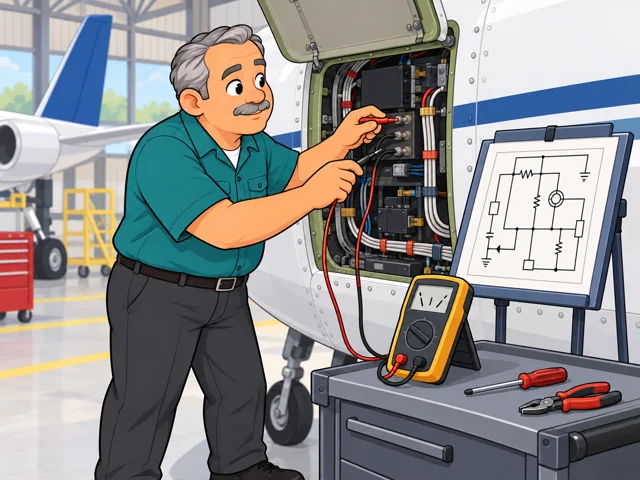
Find where a signal fails
Use a voltmeter with the wiring diagram to pin down where an airplane circuit loses its signal.
Career profile
Avionics technicians track down faults in airplane electronics that handle radio and navigation in flight.
Picture an airplane radio that has quit. The wiring diagram comes first, then readings on the circuit, then a decision on the repair.
Use a voltmeter with the wiring diagram to pin down where an airplane circuit loses its signal.
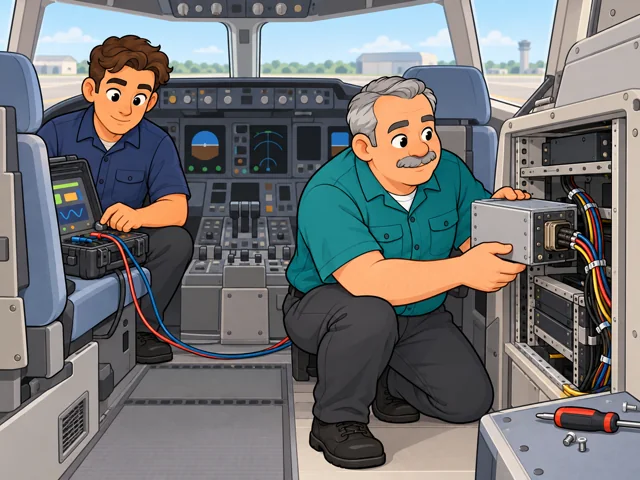
You mount the new avionics gear, hook up its wiring, and then confirm the install with test equipment.
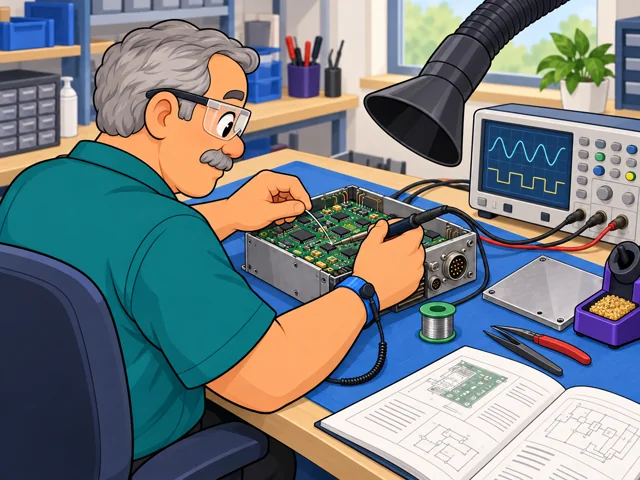
In component shops, you test a pulled unit, fix the fault, then measure it against the technical instructions.
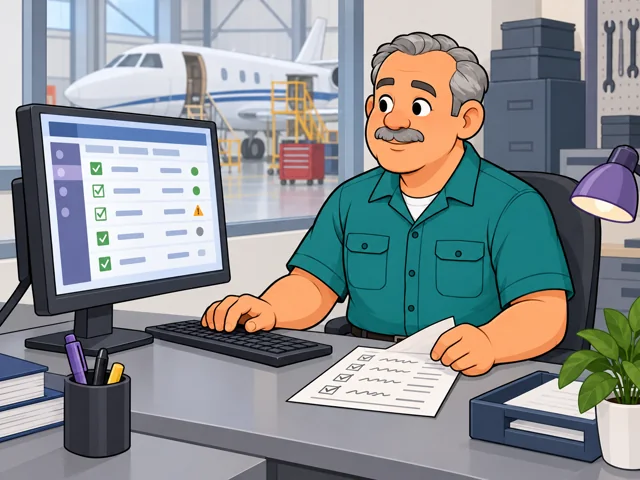
Write the fix and test results in the maintenance record so a later technician can continue the work.
United States · 2025–2035
United States · 2025
United States · 2025–2035
Quick orientation
A certificate after high school is typical entry preparation.
National median for avionics technicians; about $39.56 an hour.
About 1,700 openings a year are projected nationally, including replacement needs.
Computer diagnostic tools help test systems and interpret readings.
You still connect test equipment, repair hardware, and judge whether the results fit the fault.
How far automated testing will narrow a fault before you investigate remains uncertain, especially across different generations of aircraft electronics.
Pay in context
The national median was $82,280 a year in 2025, or $39.56 an hour. It is a midpoint, not a starting offer.
The lowest-paid 10% earned below $49,410; the highest-paid 10% earned above $113,680. These groups are not beginner and senior pay bands.
Annual medians were $99,620 in air transportation, $90,720 in aerospace manufacturing, and $72,790 in air-transportation support services. These compare different workforces, not identical jobs.
Employment is projected to grow 9.4% from 2025 to 2035, with about 1,700 openings annually from growth and replacement needs. Local hiring can differ.
You can build avionics skills in a technical program and apply them through a supervised workplace route.
After entry
This starts where the entry routes leave off: early work, growing capability, and advancement or specialization. This path also has a credential or licensing boundary; see the requirements and limits.
Learn your shop's manuals, test equipment, and repair records alongside experienced technicians.
Get better at separating wiring faults from failures inside electronic units, including systems that combine digital and analog electronics.
Work toward crew leadership, coordinating technicians across repairs and installations.
Work in a clean indoor setting on avionics units removed from aircraft, using technical publications to guide testing and repair.
Work on planned cockpit or cabin electronics changes, with engineering and sheet-metal specialists helping the new equipment fit the aircraft.
Handle aircraft faults and recurring checks near the flight line. Some crews take tools to customers' hangars or travel to aircraft grounded elsewhere.
Try it
On paper, draw a simple aircraft-radio system with a power supply, radio, antenna, and headset. Imagine the pilot hears nothing. Mark three possible fault locations and explain what evidence would help you choose between them. Notice whether you enjoy tracing connections and explaining your reasoning.
Stay safe: Keep this a paper exercise; do not test or alter aircraft equipment.