

Check the late balance first
Open the account system to see which balance is late and what's owed before you reach out.
Career profile
Bill collectors contact late payers, discuss repayment, and keep account records accurate and orderly.
Enjoy handling a tough conversation while keeping every detail straight? The role calls on both of those skills at once.

Open the account system to see which balance is late and what's owed before you reach out.

Ask why the payment was late, hear out the customer's situation, and walk through available repayment options.
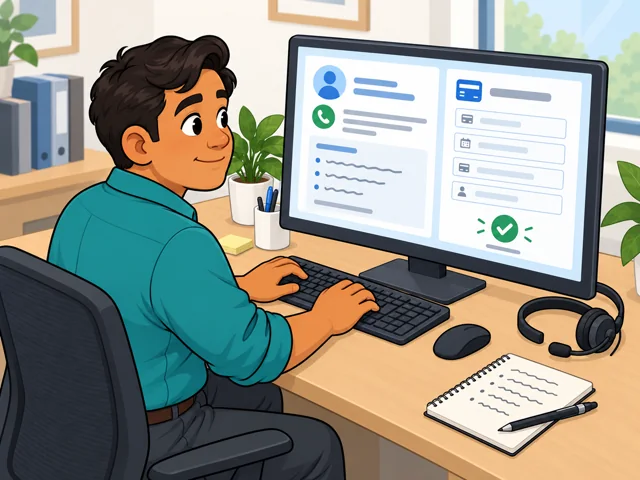
You save how the conversation ended and update payment details so whoever reaches out next has correct facts.

When a business customer disputes the amount, match bills against product orders and fix gaps with other departments.
United States
United States · May 2025
United States · 2025–2035
Quick orientation
A high school diploma or equivalent is typical; employers provide on-the-job training.
National median, equivalent to $22.61 an hour.
About 11,200 openings a year are projected despite shrinking employment.
Automated calling and account software let collectors handle more accounts.
You still need to understand why a payment was missed and explain the available options.
How much of the repayment conversation becomes automated—and how many accounts each person handles—will keep changing.
Pay in context
The national median is a reference point, not a starting offer.
May 2025 median pay was $47,030 a year, or $22.61 an hour. The 10th and 90th percentile annual wages were $34,400 and $65,580. These describe the wage distribution, not career stages.
Annual medians were $48,730 in credit intermediation and related activities and $38,020 in business support services.
Employment is projected to fall 10.4% during 2025–2035. About 11,200 annual openings are expected from replacing workers who leave, rather than job growth.
You can enter without a college degree. Experience requirements differ by employer.
After entry
This starts where the entry routes leave off: early work, growing capability, and advancement or specialization.
Build reliable habits for account notes, clear explanations, and repayment conversations.
Learn to trace disputed balances through bills and orders, and get the right department involved when records disagree.
With experience, pursue collections supervision: coach collectors, review results, and help resolve difficult accounts.
You work with borrowers and loan or credit-card accounts. Senior roles can add bankruptcy paperwork and recommendations about further recovery action.
Your contacts are business customers. You work with billing, operations, and payment-processing colleagues to resolve short payments, credits, and money not yet matched to invoices.
Try it
With a friend, invent an overdue bill and role-play a short call. Ask why payment was missed, discuss a possible payment date, then write a two-sentence account note. Notice whether you enjoy listening while keeping the details straight.
Stay safe: Use fictional names and amounts; do not contact anyone about a real debt.