
Career profile

Biologist

Biologists study how living things develop, work, and respond to their surroundings.

A biologist's project begins with something noticed and grows into a planned study. Then comes figuring out what the results actually mean.
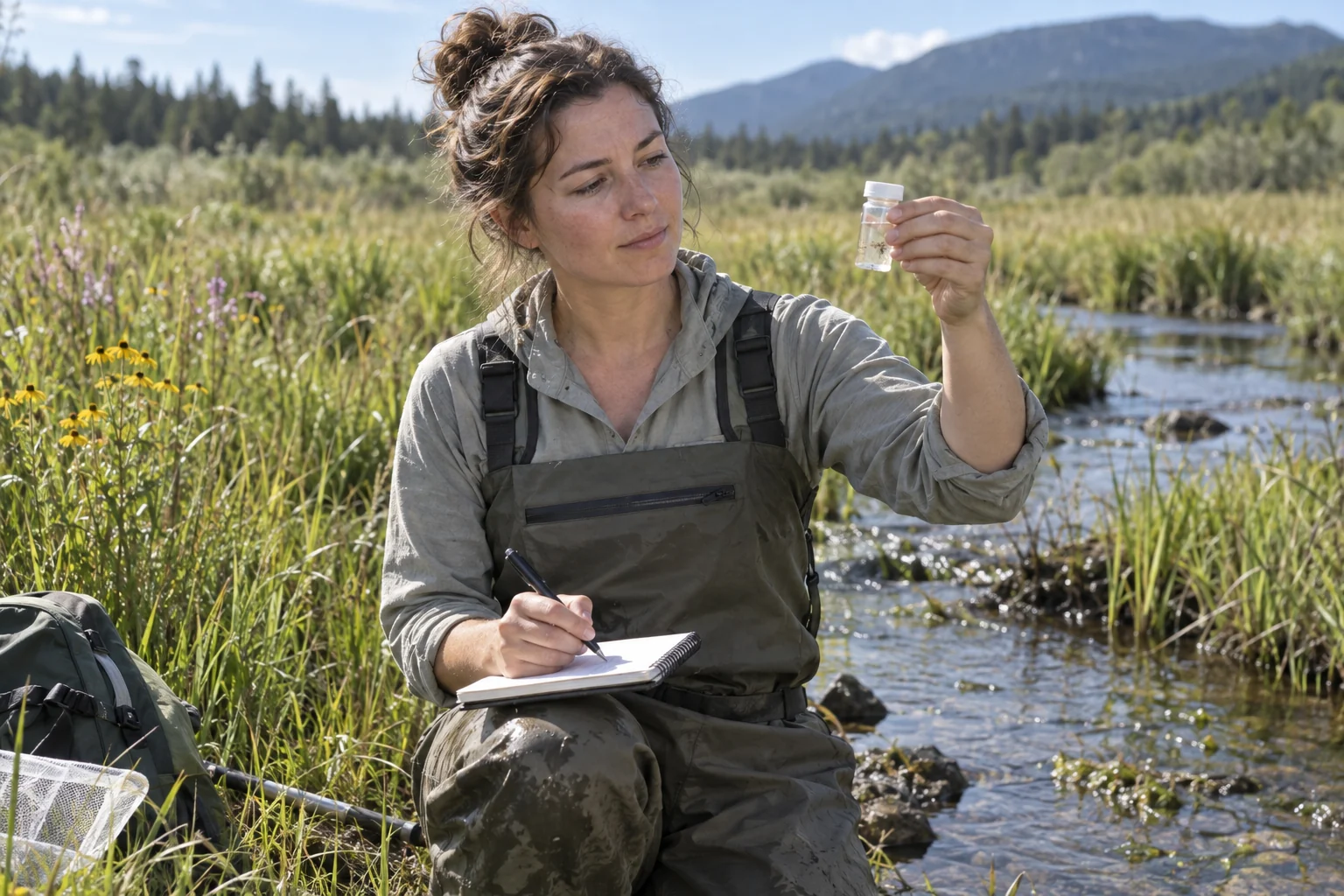
Field biologist examines a water sample and records observations in a notebook beside a stream.

A day in the life

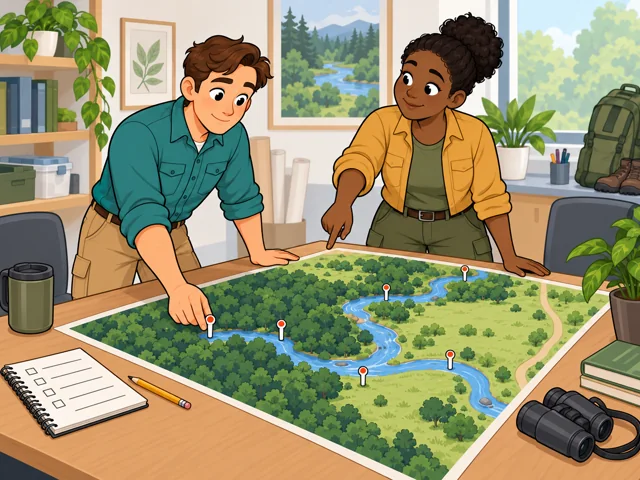
1A biologist and a coworker plan sampling sites across shaded and open stretches of a stream using a habitat map.

Choose where to take samples

Plan the study by picking sites that fit the research question, not the easiest spots to reach.
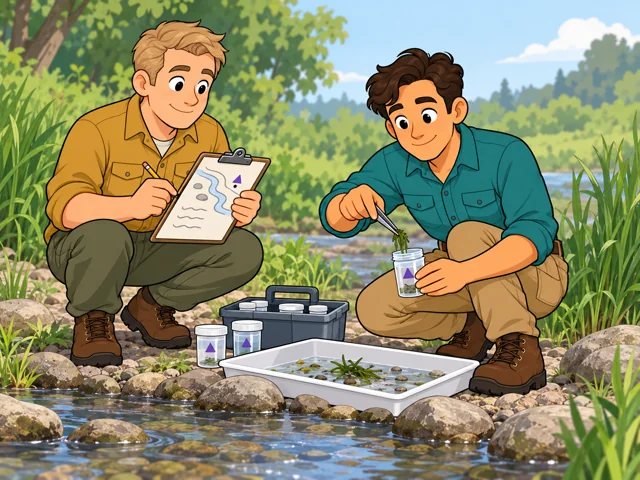
2At a stream bank, a biologist places an aquatic plant sample into a container while a coworker records its collection location.

Collect and label samples

Gather samples and record where each came from, so every result links to the right site and observation.
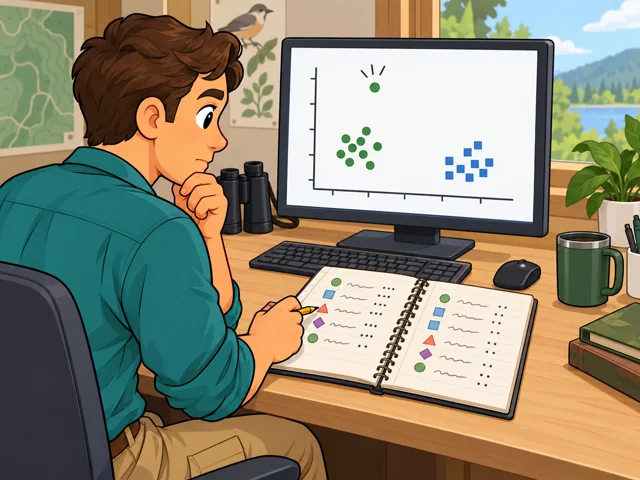
3A biologist checks an unusual point on a graph against the original sample records.

Graph groups and question surprises

Plot the measurements to compare groups, and return to the source records whenever a number looks off.

4A biologist writes a report while consulting a results graph and separate notes about questions the study could not answer.

Separate findings from open questions

Write a report that keeps the findings apart from the questions the study could not settle.

Quick facts

Preparation

Relevant degree; graduate study for some roles

United States

Pay

Not displayed

Pay depends on the position; see the federal salary example below.

Outlook

Not displayed

Explore openings by research area and location.

Quick orientation

Preparation, pay & outlook

Preparation

Relevant degree; graduate study for some roles

Your intended research area helps determine how much education you need.

Geography
United States
Period
Not applicable

Pay

Not displayed

Pay depends on the position; see the federal salary example below.

Geography
United States
Period
2025

Outlook

Not displayed

Explore openings by research area and location.

Geography
United States
Period
2025–2035

Fit, tradeoffs & changing tools

Things to weigh

  • Computer analysis and writing can take substantial time away from observing organisms.
  • Field roles can put you outdoors in uncomfortable weather.

Where AI may help

In some aquatic research, software learns from labeled microscope images to suggest which plankton appear in new samples.

What people still lead

People identify training images and decide which organisms can be identified confidently; those judgments shape what the software learns.

What we can’t predict yet

How much image review can be automated remains uncertain when samples contain unfamiliar organisms or images that are hard to identify.

Pay in context

Earnings

National pay figures cover the broader group Biological Scientists, All Other, which includes biologists and other biological specialties.

National pay and its spread

In 2025, this broader group's median was $98,920 a year, or $47.56 an hour. The lowest-paid 10% earned $60,430 or less annually; the highest-paid 10% earned $168,010 or more. These figures describe workers across the group, not starting salaries or a sequence of career stages.

Geography
United States
Period
2025
Pay basis
Annual and hourly median wages; annual 10th and 90th percentiles for Biological Scientists, All Other

A federal salary benchmark

In the 2026 Rest of U.S. locality area, General Schedule (GS) grade 5 pays $40,736–$52,957 annually across steps 1–10; grade 9 pays $61,722–$80,243. Federal biologist qualifications include entry at GS-5 and higher-grade routes. These are salary schedules, not typical starting offers or a national median. Check the vacancy's grade and locality before comparing pay.

Geography
United States: Rest of U.S. locality pay area
Period
2026
Pay basis
Annual General Schedule salary including Rest of U.S. locality payment; steps 1–10

Getting started

Build a relevant degree

What the route involves
Complete a degree in biological sciences or another field appropriate to your target position.
What it can lead to
This meets the basic education standard for federal biological-science positions in series 0401.
What to check
Equivalent major coursework plus appropriate experience or additional education is another accepted route. Individual vacancies can require further qualifications.

Train through a research master's

What the route involves
Pursue a thesis-based Master of Science in biology: conduct original research with a faculty mentor, then write and defend your thesis.
What it can lead to
You build research experience for scientific work or further doctoral study.

Choose coursework and research experience around the kind of biology you want to investigate.

After entry

Career paths

This starts where the entry routes leave off: early work, growing capability, and advancement or specialization.

  1. Get established

    Learn the study's sampling methods and produce reliable measurements and records.

  2. Own part of a study

    Plan a study component and carry its data through analysis.

  3. Lead investigations

    Develop methods, coordinate larger studies, or become a technical specialist colleagues consult.

Where you can work

University research groups

Work alongside faculty and students on shared research questions. Depending on the group, facilities may include tissue culture rooms and specialized microscopes.

  • Indoors
  • Lab

Federal conservation programs

At a military installation, biology work can connect habitat restoration with training activities and land-use decisions. You coordinate with installation leaders and conservation partners, review contractors' work, and sometimes travel.

  • Office
  • Field work
  • Travel

Try it

See whether the job clicks before you commit to the path.

Choose two small, accessible patches of vegetation—one sunny and one shaded. Photograph and count the visibly different plant types using the same method in each patch. Repeat once, then write what the comparison suggests and one reason it cannot prove that shade caused the difference. Notice whether you enjoy making a fair comparison as much as spotting plants.

Stay safe: Observe from permitted paths and leave plants undisturbed.

Explore more careers

Sources

  1. O*NET OnLine. 19-1029.04 — Biologists. Accessed 2026-10-04.
  2. U.S. Office of Personnel Management. General Natural Resources Management and Biological Sciences Series 0401. Accessed 2026-10-04.
  3. U.S. Geological Survey. Biologist, GS-0401. Accessed 2026-10-04.
  4. University of Northern Iowa. Biology M.S.. Accessed 2026-10-04.
  5. U.S. Geological Survey. Images of phytoplankton used in the development of a convolutional neural network to automate phytoplankton identification. Accessed 2026-10-04.
  6. O*NET OnLine / U.S. Bureau of Labor Statistics. National Wages: 19-1029.04 — Biologists. Accessed 2026-10-04.
  7. U.S. Bureau of Labor Statistics. Occupational projections and worker characteristics. Accessed 2026-10-04.
  8. U.S. Office of Personnel Management. Salary Table 2026-RUS. Accessed 2026-10-04.
  9. U.S. Fish and Wildlife Service. Biologist (Natural Resource Manager), announcement CBYM-26-13062129-MP-LAS. Accessed 2026-10-04.
  10. U.S. Bureau of Labor Statistics. May 2025 Occupational Employment and Wage Statistics profile: Biological Scientists, All Other. Accessed 2026-10-04.

Your message goes to the Great Jobs team. How we use your information