

Find out what cannot wait
Ask department heads how long processes can stop before serious harm, logging impacts and decision-makers in a spreadsheet.
Career profile
Business continuity planners prepare organizations to keep critical work going if computers or offices fail.
If the key system failed tomorrow, what would you restore first? This job means getting people to agree on one answer, then rehearse it.

Ask department heads how long processes can stop before serious harm, logging impacts and decision-makers in a spreadsheet.
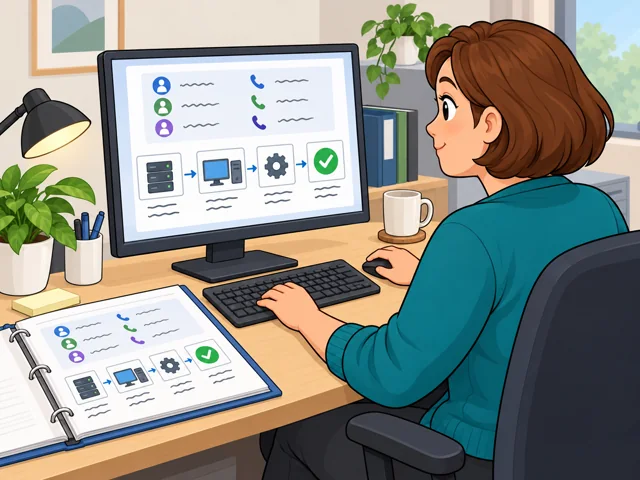
Revise the plan so, in a disruption, readers find who to call and how to restart key work.

Walk coworkers through a pretend outage aloud, asking what they'd do next when a needed system is unavailable.

If testing overruns the recovery goal, review holdups with the service owner and track fixes before retesting.
United States
Pay depends on the role's scope and experience requirements.
Look for openings under continuity, resilience, and disaster-recovery titles.
Quick orientation
Expect considerable preparation, commonly a bachelor's degree plus relevant work experience.
Pay depends on the role's scope and experience requirements.
Look for openings under continuity, resilience, and disaster-recovery titles.
Shared planning software helps keep recovery documents organized; notification tools help contact people.
You work with process owners to decide which delays are tolerable and whose decisions are needed.
How much planning can be automated depends partly on whether changing dependencies and business consequences can be captured reliably.
Pay in context
Experienced roles can pay well, but compare responsibilities and employment terms before comparing the numbers.
An advertised annual salary range is $78,200–$137,700 in Colorado, Illinois, and Washington, DC. Offers depend on experience, education, and skills; a discretionary incentive is separate.
A social-media continuity assignment advertises $70–$90 an hour for an estimated 13 months. It requires substantial experience, including at least five years in continuity.
This is often a move after related work experience. Employers differ in how they weigh education and previous responsibilities.
After entry
This starts where the entry routes leave off: early work, growing capability, and advancement or specialization.
Learn the processes in your area. Check who owns each one and what a prolonged interruption would affect.
Take responsibility for an exercise and coordinate follow-up when business teams uncover recovery gaps.
Move toward coordinating plans across services, setting the testing schedule, and reporting unresolved recovery problems to management.
You connect continuity plans with cyber-incident recovery and report readiness to senior managers. Understanding technology threats matters alongside organizing people.
You work across service owners and campus safety staff. Some roles include trips between campus locations and occasional after-hours systems support.
Try it
Imagine your club's event-registration system stops working the day before an event. Write a one-page plan: what must continue, who decides, and what temporary workaround could help. Ask a friend to challenge one assumption, then revise it. Notice whether you enjoy finding the missing dependencies.
Stay safe: Keep it fictional; do not interrupt a real system or collect private contact details.