

Trace a temperature drift
Compare live process readings with normal operation to find why output has drifted from its usual level.
Career profile
Chemical engineers make chemical reactions run properly in large industrial plants.
A reaction proven in a small container needs more planning before making tons of plastic or detergent: dependable ways to mix, heat and separate.

Compare live process readings with normal operation to find why output has drifted from its usual level.
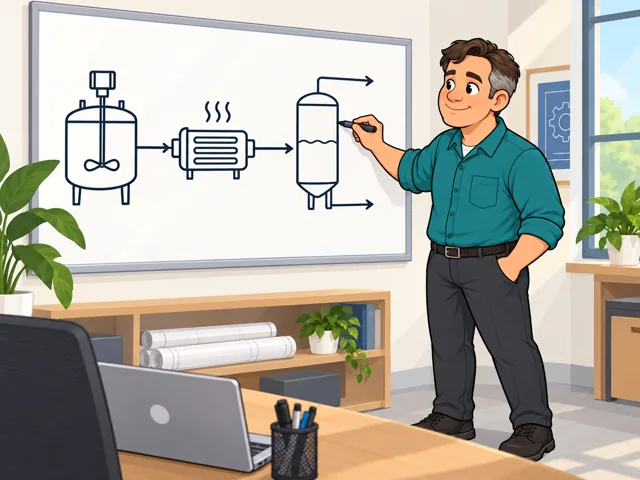
Draw how material flows between the mixing, heating and separating stages and the equipment that connects them.
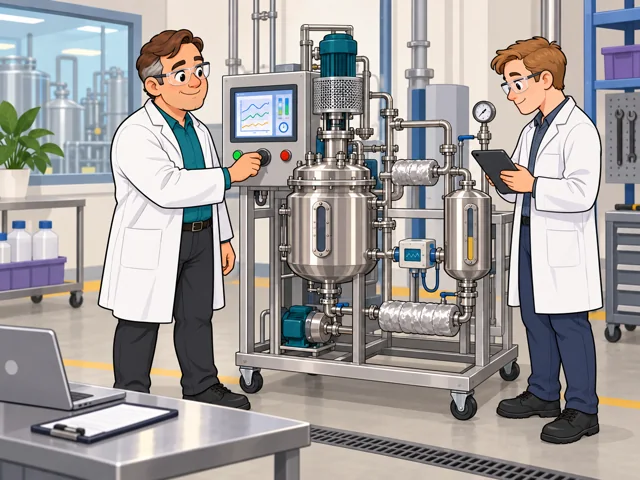
In development roles, you prove the process on a scaled-down pilot plant before planning production for sale.

Build a spreadsheet comparing production costs for two options, then talk a manager through the tradeoffs.
United States
United States · May 2025
United States · 2025–2035
Quick orientation
Chemical engineering or a related field is the usual preparation.
National median for chemical engineers; equivalent to $60.12/hour.
Projected national employment growth, with about 1,100 openings per year on average.
Process-simulation software lets you compare designs before changing equipment. Some tools used in refining combine physical equations with artificial intelligence to improve predictions from plant data.
You decide whether a model represents the real process and whether a proposed change makes sense for safety and production.
How much design software can take over depends partly on how well its model handles unfamiliar operating conditions. Checking those limits may remain a substantial part of the work.
Pay in context
Location, experience, and the responsibility you take on can affect pay. National figures give you a comparison point.
Chemical engineers had median wages of $125,040 a year, equivalent to $60.12 an hour. Half earned more and half earned less; this is not a starting salary.
The 10th-percentile wage was $79,420 and the 90th-percentile wage was $182,880 a year. These describe the wage distribution, not beginner and senior pay levels.
Employment is projected to grow 4.7% from 2025 to 2035. About 1,100 openings a year are projected from growth and the need to replace people who leave the occupation.
Build toward a bachelor's degree. Some employers also prefer internship or cooperative education experience.
After entry
This starts where the entry routes leave off: early work, growing capability, and advancement or specialization.
Work with an experienced engineer to learn the process and how your calculations support production decisions.
Follow a process improvement from test results through production checks.
With experience, you may lead engineers and technicians or specialize in a particular process or product.
You work close to large production equipment, sometimes outdoors. Product quality and operating costs shape decisions, and protective equipment is part of entering the plant.
You work with experimental equipment and smaller process runs. The focus is testing how a proposed manufacturing method behaves before committing to commercial scale.
Try it
On paper, sketch a process that receives 100 kilograms of a mixture containing 10% salt and removes only water until the product is 20% salt. Calculate how much water must leave, then mark where you would measure concentration. Notice whether tracking materials and checking the result interests you.
Stay safe: Keep this a paper or spreadsheet exercise; no heating or chemical handling is needed.