

Career profile

Chemical Plant Operator

Chemical plant operators keep production going by reading gauges, changing control settings and inspecting machinery.

A shifting tank level can send you from the screens onto the plant floor, matching instrument readings against what the pumps, piping and reactors do.

Chemical plant control room operator monitors process screens.
PEO ACWA / Wikimedia Commons, CC BY 2.0

A day in the life

1A chemical plant operator compares a flow trend with its operating limits while adjusting a control at the console.

Keep flow within its range

Compare the flowmeter numbers with the allowed operating ranges and change settings when a reading starts drifting.

2Beside process tanks, the operator checks a level indicator and radios an equipment concern.

Inspect tanks on foot

Walk past the tanks to look at fill levels and running machinery, and tell maintenance about anything broken.
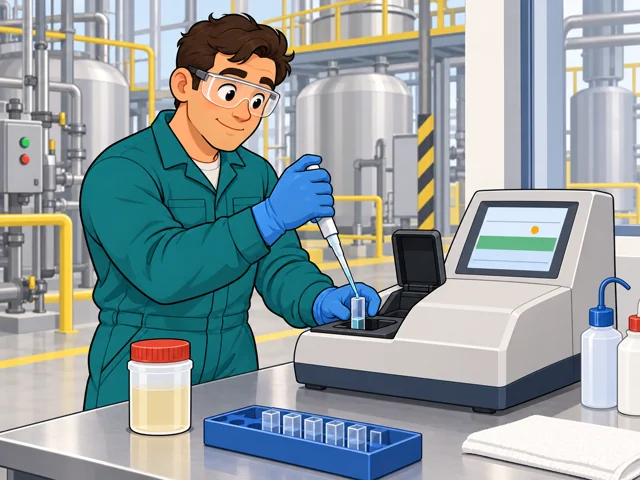
3The operator tests a production sample at a quality bench and checks the result against an acceptable range.

Test a sample mid-run

Pull some material while production is running, test it against quality standards and help correct an off-spec batch.
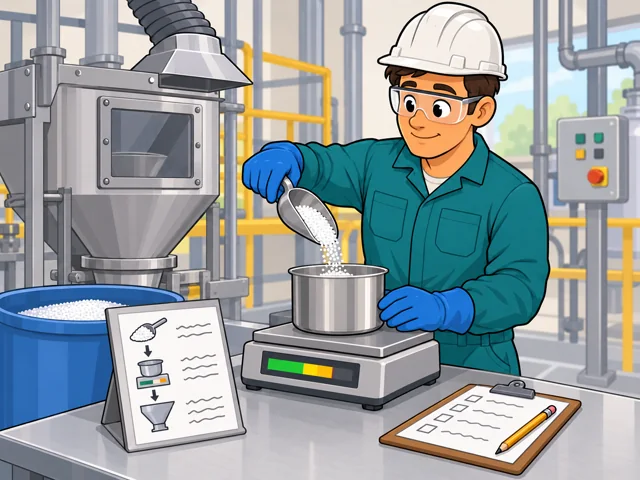
4The operator measures a batch ingredient on a scale beside production instructions and an addition record.

Load a batch by instructions

At batch plants, follow the written production instructions, add the stated amounts and log every addition.

5The operator updates the production log and explains an unresolved equipment issue to an incoming woman operator in her early 60s.

Hand off to the next shift

Update the production logs and tell the incoming shift about any equipment faults or quality problems still open.

Quick facts

Preparation

High school + workplace training

United States · 2025

Pay

$78,120 median

United States · 2025

Outlook

5.2% projected decline

United States · 2025–2035

Quick orientation

Preparation, pay & outlook

Preparation

High school + workplace training

Typical entry preparation is a high school diploma or equivalent, followed by moderate-term on-the-job training.

Geography
United States
Period
2025

Pay

$78,120 median

Annual median for chemical plant and system operators; equivalent to about $37.56 an hour over 2,080 hours.

Geography
United States
Period
2025

Outlook

5.2% projected decline

About 1,300 openings a year are projected despite shrinking employment.

Geography
United States
Period
2025–2035

Fit, tradeoffs & changing tools

Things to weigh

  • Some plants require rotating shifts, weekends, and overtime, which can complicate sleep and plans.
  • Plant rounds can mean noise, weather, and protective equipment.
  • Hazardous chemicals make operating limits and emergency procedures consequential parts of the job.

Where AI may help

Computer controls and alarms help you track process conditions; automatic shutdown systems can respond to specified hazards.

What people still lead

You investigate equipment problems and connect screen information with physical checks.

What we can’t predict yet

How much troubleshooting becomes automated will depend on whether tools can handle unusual conditions reliably.

Pay in context

Earnings

Use the national wage distribution as a reference when comparing actual plant offers.

The median and spread

In 2025, the median was $78,120 a year—about $37.56 an hour using 2,080 hours. The lowest-paid 10% earned $48,400 or less; the highest-paid 10% earned $111,930 or more. These are wage percentiles, not starting and senior pay grades.

Geography
United States
Period
2025
Pay basis
Annual wages for chemical plant and system operators; calculated hourly equivalent

Openings in a shrinking occupation

Employment is projected to fall 5.2% from 2025 to 2035, with about 1,300 openings annually. Openings can occur as workers leave even when the total number of jobs falls; they are not a count of vacancies today.

Geography
United States
Period
2025–2035
Pay basis
Employment projection; annual average occupational openings

Getting started

Apply for a process-operations apprenticeship

Paid
What the route involves
BASF's process-operations apprentices learn to run pumps and compressors, monitor conditions, and adjust processes while working alongside experienced staff.
What it can lead to
The program combines work with education toward a degree or certificate. Completers are considered for full-time positions.
What to check
Apply to a specific opening and check its entry requirements. Program completion does not guarantee a permanent job.

Study process technology

What the route involves
In a program such as Lee College's Associate of Applied Science in Process Technology, study pumps, reactors, instruments, safety, and troubleshooting.
What it can lead to
You build technical preparation for entry-level process technician and chemical operator applications.
What to check
A college degree is one route, not the national minimum for every operator job.

You can combine work with training or study process technology first. You still need to learn the plant's equipment and procedures with experienced operators before taking on its operating responsibilities.

After entry

Career paths

This starts where the entry routes leave off: early work, growing capability, and advancement or specialization.

  1. Get established

    Learn your unit's flow, safe operating limits, and response procedures. Practice explaining what you would do when a reading leaves its normal range.

  2. Handle more of the process

    Deepen your troubleshooting skills and learn how equipment behaves during startups and shutdowns.

  3. Lead or teach

    With experience, pursue shift supervision or process training, helping other operators learn equipment and resolve production problems.

Where you can work

Resin and specialty-chemical plants

Some sites combine continuous production with separate batches. Work can span control systems, material transfers, and equipment startups or shutdowns, with rotating shifts and climbing around equipment.

  • Shift work
  • Physical demands
  • Safety-sensitive

Chemical synthesis facilities

Batch work puts close attention on measured additions, reactors, filters, and records showing that each batch meets its criteria. Some positions run through weekend nights.

  • Indoors
  • Shift work
  • Safety-sensitive

Try it

See whether the job clicks before you commit to the path.

On paper, draw a tank with an inlet and outlet. Start at 100 liters; for three one-minute intervals, add 10 liters and remove 8, then 8, then 4. Log the levels and write a two-sentence handoff explaining when the trend changed and what you would want checked. Notice whether tracking the process interests you.

Stay safe: Keep this a paper exercise; it is not an instruction for operating real equipment.

Explore more careers

Sources

  1. O*NET OnLine. Chemical Plant and System Operators — 51-8091.00. Accessed 2026-10-04.
  2. O*NET OnLine / U.S. Bureau of Labor Statistics. National Wages: Chemical Plant and System Operators. Accessed 2026-10-04.
  3. U.S. Bureau of Labor Statistics. Occupational projections and worker characteristics, 2025–2035. Accessed 2026-10-04.
  4. Lee College. Process Technology. Accessed 2026-10-04.
  5. BASF. Early Career — Process Operations Technician Apprenticeships. Accessed 2026-10-04.
  6. BASF. North American Apprenticeship Development Program. Accessed 2026-10-04.
  7. Hexion. Chemical Operator — Sheboygan, Wisconsin. Accessed 2026-10-04.
  8. Waters Corporation. Chemical Operator — Taunton, Massachusetts, requisition 25426. Accessed 2026-10-04.
  9. Occupational Safety and Health Administration. 1910.119 — Process safety management of highly hazardous chemicals. Accessed 2026-10-04.

Your message goes to the Great Jobs team. How we use your information