
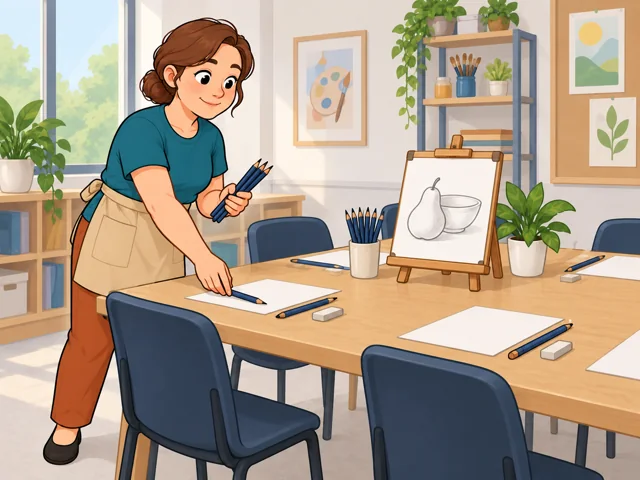
Set out drawing supplies early
Lay out paper, pencils and an example piece for the drawing session before any learners arrive.
Career profile
Community enrichment instructors teach skills that people choose to learn for fun.
You might help a beginner shape a clay bowl or frame a photo. Then you step back and let them practice on their own.

Lay out paper, pencils and an example piece for the drawing session before any learners arrive.

Slowly show one shaping move while standing where every learner can clearly see your hands.

Watch one learner try it, and if your explanation doesn't land, show it again or simplify the task.

Send the program coordinator your course outline, supply costs and suggested dates to weigh for an upcoming schedule.
United States · 2025
United States · 2025
United States · 2025–2035
Quick orientation
Typical preparation is a high school diploma or equivalent plus related experience. Individual programs set their own requirements.
The 2025 national median for Self-Enrichment Teachers is $46,800 annually. A short course does not provide a full year's teaching hours.
Self-Enrichment Teachers have about 50,000 projected openings annually across the United States during 2025–35.
Online systems handle registration; video tools let instructors demonstrate skills beyond a classroom.
You watch attempts and choose the next explanation.
How much recorded instruction can replace live help will depend on the skill and the learner.
Pay in context
Look at the pay arrangement and the number of classes you can actually teach. A good hourly rate can still produce limited annual income.
Self-Enrichment Teachers had a 2025 median wage of $22.50 an hour, or $46,800 annually. Half earned more and half earned less.
The 10th and 90th percentiles were $14.45 and $44.63 hourly, or $30,050 and $92,840 annually. These describe the wage distribution, not beginner and experienced pay levels.
Portland Community College pays $27.55 per instructional hour. Rancho Palos Verdes' municipal contract program pays instructors 70% of primary class fees collected, before their expenses. These are local arrangements, not national workplace averages.
Employment is projected to grow 3.5% from 2025 to 2035, with 50,000 openings per year on average. Openings include replacement needs as well as growth; they are not all new jobs.
Build a skill you can demonstrate and explain. Programs may accept subject experience, formal education, or teaching experience in different combinations.
After entry
This starts where the entry routes leave off: early work, growing capability, and advancement or specialization.
Build a reliable setup routine and a lesson that leaves time for practice.
Use learner feedback to revise demonstrations and pacing.
Propose a focused follow-on course for returning learners, such as moving from basic photography to portrait lighting. The coordinator still decides whether it fits the program.
You may teach in a campus classroom or online, with program staff handling registration, room reservations, and materials purchasing. Classes fit the college's proposal and scheduling cycle.
The city can provide a room and manage enrollment while you organize the course. As an independent contractor, you may also carry insurance and invoice for payment.
Try it
Teach a friend a simple paper fold in ten minutes. Demonstrate it, let them try, and notice where they pause. Change your explanation once. Did you enjoy helping them learn as much as making the finished object?