
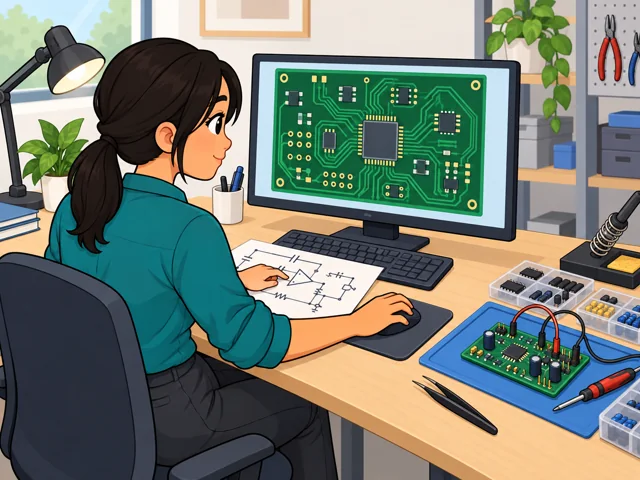
Design a board to test chips
Plan a board for testing a new processor, then build lab circuits to study how it behaves.
Career profile
Computer hardware engineers design and test circuit boards and chips that make computers work.
Failed prototype boards are yours to figure out and redesign. The draw is turning an idea of how a computer should behave into passing hardware.
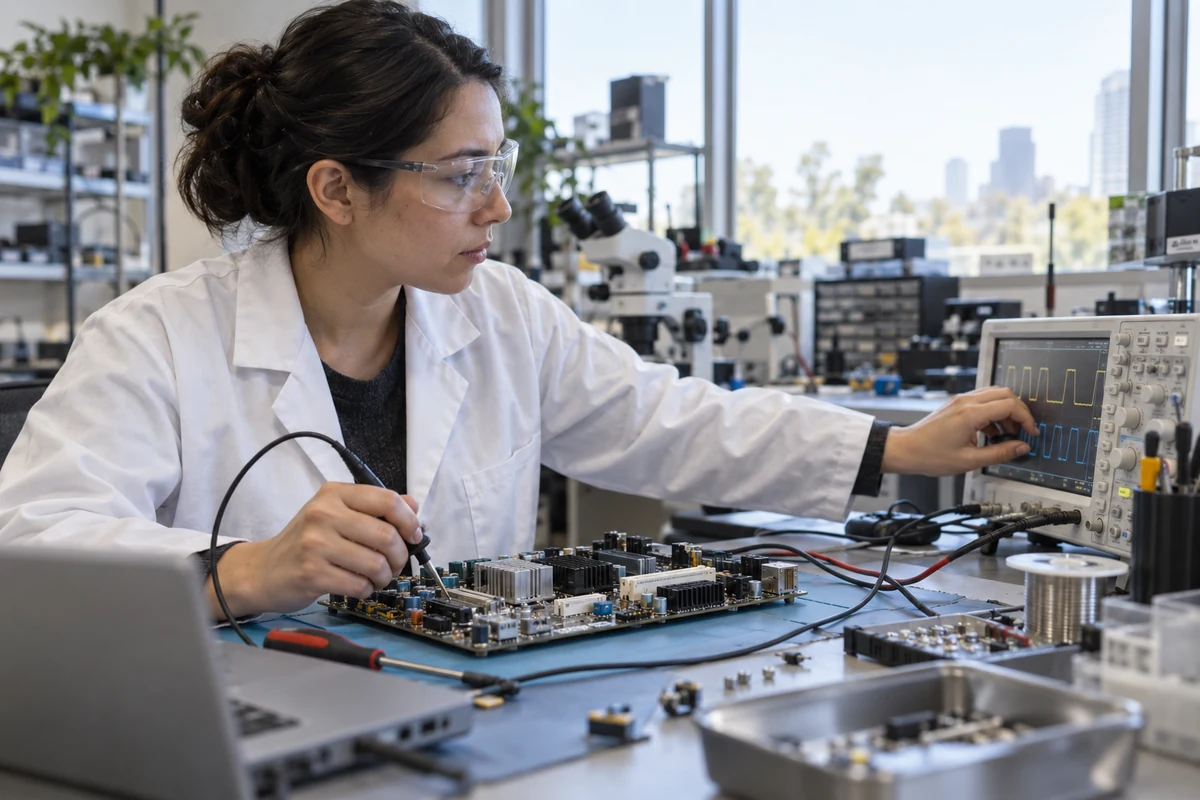
Plan a board for testing a new processor, then build lab circuits to study how it behaves.

Run a system that copies the planned chip and see if one processor unit behaves as designed.

Line up test logs with requirements, alter the prototype, then rerun the check to see if it helped.

Step through the interface specification with fellow engineers to settle how board and software trade data.
United States
United States · May 2025
United States · 2025–2035
Quick orientation
Usually computer engineering or a related field.
National median; hourly equivalent $77.76.
About 4,100 openings annually, including replacements.
Some chip verification teams are bringing artificial intelligence (AI) into writing test code and investigating failures.
Engineers still decide which behavior needs checking and work with chip designers to close gaps in the tests.
How much checking and debugging these tools can take over reliably remains unsettled, especially when a design introduces unfamiliar behavior.
Pay in context
These national wages describe the occupation, not a starting offer.
The median was $161,740 a year, equivalent to $77.76 an hour. The 10th and 90th percentiles were $92,940 and $225,330. Those percentiles are not beginner and senior pay grades.
Annual medians were $171,820 in scientific research and development, $166,150 in semiconductor and other electronic component manufacturing, and $155,470 in computer systems design and related services.
The projected 4,100 annual openings include people leaving the occupation. They are not all newly created positions or current vacancies.
A relevant bachelor’s degree is the usual starting point.
After entry
This starts where the entry routes leave off: early work, growing capability, and advancement or specialization.
Learn one hardware unit well enough to explain its expected behavior and investigate a failing test.
Develop tests for a whole unit, identify behavior the tests miss, and discuss failures with its designers.
One technical path is leading chip verification: decide the testing scope and coordinate checks across design teams.
Board-focused roles combine design work with physical test circuits and debugging early versions of hardware. You deal with how a processor behaves inside a working system.
Much of the work happens through computer models and systems that imitate chip behavior. You work closely with designers to find problems before the design becomes a manufactured chip.
Try it
On paper, design a one-bit selector: two inputs each hold 0 or 1, and a third input chooses which value becomes the output. List all eight input combinations and the expected outputs. Ask someone to check your table. Notice whether you enjoy defining behavior precisely and hunting for missed cases.