
Career profile

Crane Operator

Crane operators use crane controls to lift heavy loads into the spot a crew needs.

Picture lowering a steel beam into place while a signal person gives directions by radio. The crane lifts, and you decide how it moves.

An adult crane operator seated at the controls in a construction crane cab while lifting a steel load.

A day in the life

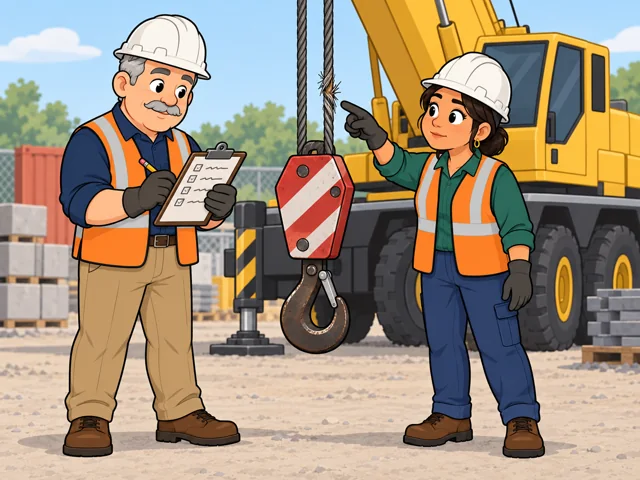
1A crane operator examines a lowered hook assembly and records cable wear while a coworker looks at the area needing attention.

Inspect cables before lifting

Inspect cables and hoist parts for wear and note repairs for maintenance and the next operator.
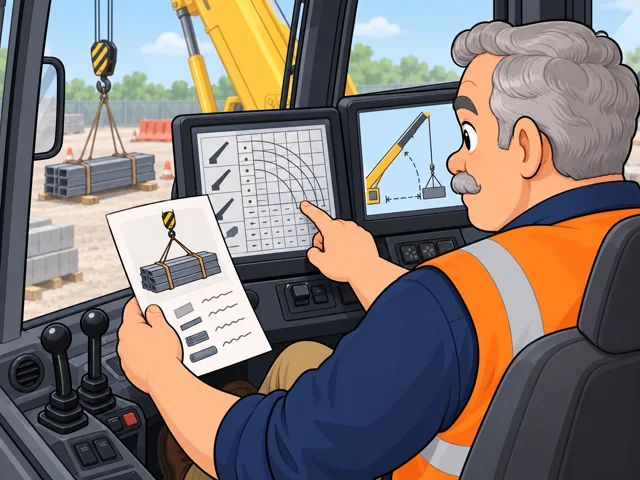
2Seated in the cab, the operator compares load information with a capacity chart and the crane’s boom setup display.

Check load weight against capacity chart

Match the chart to this crane setup and reach, since moving the boom changes what it can lift.
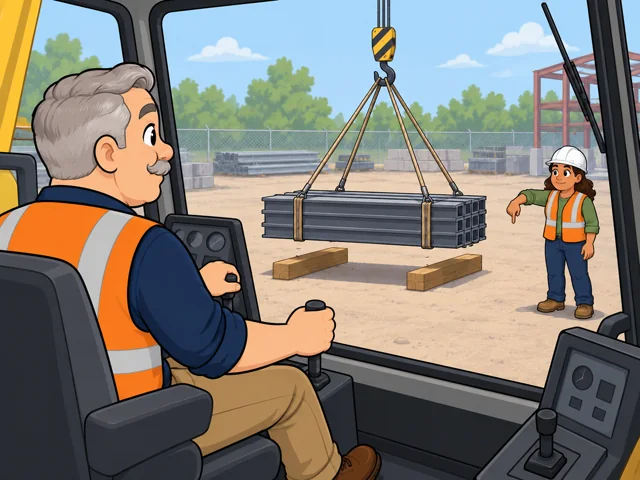
3The operator moves the crane controls as a signal person directs a suspended steel bundle down toward timber supports.

Lower the load onto its spot

Move levers or foot pedals as the signal person directs, keeping the load's swing under control.

4With the lift stopped and controls neutral, the operator listens to the radio and attempts to restore contact before continuing.

Stop when signals break down

Halt signaled construction lifts safely if communication fails, resuming only after it returns and you understand the signal.

Quick facts

Preparation

High school + practical training

United States · 2025

Pay

$68,080/year

United States · May 2025

Outlook

3.8% projected growth

United States · 2025–2035

Quick orientation

Preparation, pay & outlook

Preparation

High school + practical training

A diploma or equivalent is typical. Related work experience commonly comes before crane-specific workplace training.

Geography
United States
Period
2025

Pay

$68,080/year

National median for crane and tower operators, equivalent to $32.73 an hour.

Geography
United States
Period
May 2025

Outlook

3.8% projected growth

About 3,500 openings a year are projected nationwide, including replacement openings.

Geography
United States
Period
2025–2035

Fit, tradeoffs & changing tools

Things to weigh

  • Many jobs expose you to heat, cold, and outdoor weather, and workweeks can run beyond 40 hours.
  • A control mistake can seriously hurt someone nearby. Carrying that responsibility is part of the work.

Where AI may help

Electronic indicators help you monitor loading limits. Some container-yard cranes also support automated movements and control from a remote operating station.

What people still lead

You still judge the lift and changing conditions. On construction cranes, electronic aids do not replace the operator’s judgment.

What we can’t predict yet

How much work shifts from moving controls to monitoring automated movements will depend on the cranes and systems each workplace adopts.

Pay in context

Earnings

Use the national median as a reference point. The wage spread is wide, and workplace type matters.

The middle and the spread

In May 2025, the median was $68,080 a year, or $32.73 an hour. The lowest-paid 10% earned $42,640 or less; the highest-paid 10% earned $103,570 or more. These are wage percentiles, not starting and senior pay grades.

Geography
United States
Period
May 2025
Pay basis
Employee annual and hourly wages; median and annual 10th/90th percentiles for crane and tower operators

Workplace pay differs

A historical comparison shows annual averages of $84,740 at other specialty trade contractors and $68,550 in water-transportation support activities. These May 2023 figures are industry averages for crane and tower operators, not current offers or medians.

Geography
United States
Period
May 2023
Pay basis
Annual mean employee wages within named industries for SOC 53-7021

Openings include replacement hiring

Employment is projected to grow 3.8% from 2025 to 2035, with about 3,500 openings annually. Openings include replacing workers who leave the occupation, so they exceed the number of newly created positions.

Geography
United States
Period
2025–2035
Pay basis
Employment projection and annual-average occupational openings; not compensation

Getting started

Build experience on a lifting crew

What the route involves
Work as a rigger, signaler, or construction equipment operator, then move into crane training with an experienced operator.
What it can lead to
You bring relevant crew experience to an operator-in-training position; crane training can take several months.
What to check
During construction crane training, a qualified trainer must monitor your operation. Related experience alone does not authorize you to run the crane.

Take structured mobile-crane training

What the route involves
Study load charts, rigging, controls, and lift planning through a program using the National Center for Construction Education and Research mobile-crane curriculum.
What it can lead to
You build the technical knowledge and operating skills needed to prepare for separate certification testing.
What to check
Passing a course is not operator certification. Certification requires written and practical exams and does not replace employer evaluation.

A high school diploma or equivalent is the usual starting point. Build practical experience through related work or structured crane training.

After entry

Career paths

This starts where the entry routes leave off: early work, growing capability, and advancement or specialization. This path also has a credential or licensing boundary; see the requirements and limits.

  1. Get consistent

    Make inspections and smooth load placement reliable habits on the crane you operate.

  2. Handle more configurations

    Learn how different boom setups change capacity, and get better at reading charts and working through lift plans.

  3. Specialize in complex lifts

    Develop toward blind lifts, where you cannot see the landing area, or lifts using multiple cranes. These require additional capability and employer evaluation for the work.

Where you can work

Building sites

On a high-rise project, you may supply materials to crews far above ground. A signal person guides movements when you cannot see the landing area.

  • Outdoors
  • Field work
  • Safety-sensitive

Ports and container yards

Cargo handling shapes the work. Some container-yard systems let you operate cranes from an office-based station and switch between cranes, changing how you watch and control each move.

  • Outdoors
  • Safety-sensitive

Try it

See whether the job clicks before you commit to the path.

Draw a crane, a load, obstacles, and a landing spot on paper. Ask a partner to guide your pencil along a clear route using spoken directions while covering the drawing from your view. Notice how much precise wording and clarification matter.

Stay safe: Keep this a tabletop communication exercise; it does not qualify you to operate lifting equipment.

Explore more careers

Sources

  1. O*NET OnLine. Crane and Tower Operators — 53-7021.00. Accessed 2026-10-03.
  2. O*NET OnLine / U.S. Bureau of Labor Statistics. National Wages: Crane and Tower Operators. Accessed 2026-10-03.
  3. U.S. Bureau of Labor Statistics. Table 1.2 Occupational projections, 2025–35, and worker characteristics, 2025. Accessed 2026-10-03.
  4. U.S. Bureau of Labor Statistics. May 2023 Occupational Employment and Wage Estimates: Crane and Tower Operators. Accessed 2026-10-03.
  5. U.S. Bureau of Labor Statistics. Material Moving Machine Operators. Accessed 2026-10-03.
  6. Occupational Safety and Health Administration. 1926.1417 — Operation. Accessed 2026-10-03.
  7. Occupational Safety and Health Administration. 1926.1419 — Signals: general requirements. Accessed 2026-10-03.
  8. Occupational Safety and Health Administration. 1926.1427 — Operator training, certification, and evaluation. Accessed 2026-10-03.
  9. National Center for Construction Education and Research. Mobile Crane Operations. Accessed 2026-10-03.
  10. National Center for Construction Education and Research. Crane Operator Certifications. Accessed 2026-10-03.
  11. Konecranes. Automation Retrofits: Remote Operation Retrofit. Accessed 2026-10-03.

Your message goes to the Great Jobs team. How we use your information