
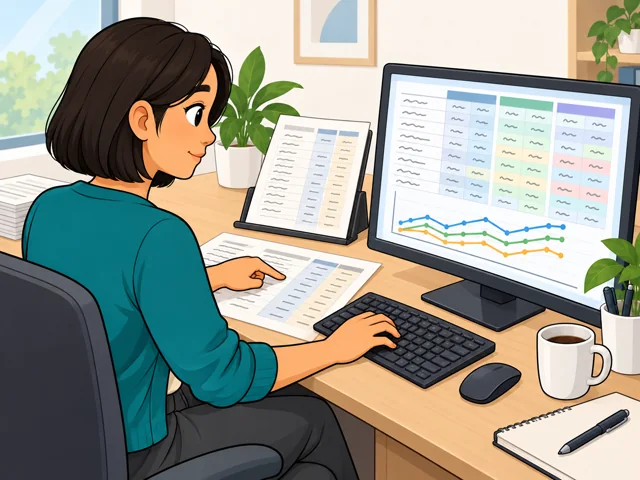
Enter statements into analysis software
Type each year's financial statements into the analysis software so cash-flow shifts between years stand out.
Career profile
Credit analysts read borrowers' financial records to judge repayment and explain the risk to lenders.
Sales can climb while a company's cash on hand shrinks. Your job is working out whether that gap threatens a loan getting paid back.

Type each year's financial statements into the analysis software so cash-flow shifts between years stand out.

Put cash flow next to debt payments, since a thin margin is a specific risk you can explain.

Contact the customer when a record raises a question, and confirm the transaction before you rely on it.

Turn your numbers into a loan write-up on strengths, weaknesses and repayment risks, with a recommendation.

Once a loan is out, check newer figures against the agreement's financial terms and flag any missed requirement.
United States · 2025
United States · 2025
United States · 2025–2035
Quick orientation
Employers set their own subject, coursework, and experience requirements.
National median for credit analysts in 2025; equivalent to $40.15 an hour.
Employment is projected to shrink during 2025–2035, with about 3,100 openings annually on average.
Spreadsheets and credit software calculate ratios and organize financial records, reducing manual arithmetic.
You still investigate questionable inputs and explain why the evidence supports a recommendation.
How much review artificial intelligence takes over will depend partly on whether its results are accurate and explainable. Some lenders may automate more of the assessment; others may keep substantial manual review.
Pay in context
The national median is a useful reference point, but it is not an entry-level offer.
In 2025, the median was $83,510 annually, or $40.15 hourly. The 10th percentile was $56,250 and the 90th was $169,230. Those percentiles describe the wage distribution, not beginner and senior salaries.
Banking: $47,000–$63,000 annual base pay at Busey in Illinois/Missouri. Distribution: $29–$31 an hour at Uline in Pleasant Prairie, Wisconsin. These advertised ranges cover specific credit analyst roles, not industry averages.
Responsibilities, relevant experience, and local markets can affect offers. Nationally, about 3,100 openings a year are projected for 2025–2035 despite a 4.3% employment decline. Openings also arise when workers leave the occupation.
In bank lending, your analysis can go to authorized officers or a loan committee for approval. The analyst title alone does not grant final lending authority.
After entry
This starts where the entry routes leave off: early work, growing capability, and advancement or specialization.
Learn the bank’s financial tools and practice explaining your analysis with feedback from experienced colleagues.
Build from individual loan write-ups to renewals and portfolio reviews, tracking how a borrower’s finances change.
A senior analyst may examine trends across the loan portfolio and mentor junior analysts.
You work closely with lenders, preparing borrower files for loan committee review. The mix can include customer calls and continuing reviews of existing loans.
Credit work can move at the pace of customer orders. You review payment histories and credit limits, with frequent phone and email contact about customer accounts.
Try it
Try a fictional repayment review: a business collects $20,000 monthly, pays $15,000 in operating costs, and owes $3,000 in loan payments. Calculate the cash left, then reduce collections by 15%. Write two sentences explaining the repayment risk and one question you would ask before recommending a loan. Notice whether you enjoy explaining the numbers as much as calculating them.
Stay safe: Use invented figures; this simplified exercise is not a real credit decision.