

Call an applicant about a blank
Phone the applicant about a blank on the form, then enter the financial details that complete the file.
Career profile
Credit clerks review the documents behind credit requests and use set standards to judge approval.
One missing detail leaves an application incomplete. Tracking it down, checking it against account history, and helping the request toward a decision is your job.

Phone the applicant about a blank on the form, then enter the financial details that complete the file.
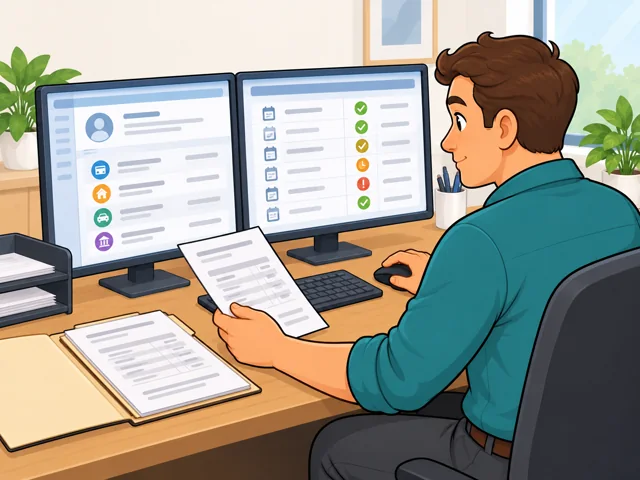
Open credit records and gather payment history from banks and outside credit services before you review the request.

Weigh the customer's file against the credit standards to determine whether new credit should be granted.

Line up an account entry with its paperwork, figure out why the two disagree, then update the file.
United States · 2025–2035
United States · May 2025
United States · 2025–2035
Quick orientation
Typical entry preparation, followed by learning the employer’s procedures on the job.
$24.08 an hour; national median for credit authorizers, checkers, and clerks.
Projected employment change for credit authorizers, checkers, and clerks, with about 900 openings a year.
Computerized credit records put account information in front of you for review. Online tools also let customers complete some tasks themselves.
Clerks ask follow-up questions, investigate discrepancies, and explain account information when a customer needs help.
How much routine checking will remain with clerks depends on how far employers automate applications and decisions. Customer self-service is expected to reduce demand for this work.
Pay in context
Use these figures as a national reference for credit authorizers, checkers, and clerks. Pay is not reported separately for the title Credit Authorization Clerk.
The median was $50,080 a year, equivalent to $24.08 an hour. Half of workers earned more and half earned less.
The 10th percentile was $30,260 a year ($14.55 an hour), and the 90th was $72,700 ($34.95 an hour). These describe the wage distribution, not starting pay and a later promotion salary.
Employment is projected to fall 7.4% from 2025 to 2035. About 900 openings a year are still projected across the occupation as workers leave or move to other work.
A high school diploma or equivalent is the usual starting point. Employer training and experience with customer records are two ways to build toward the work.
After entry
This starts where the entry routes leave off: early work, growing capability, and advancement or specialization.
Learn where account information lives and how the employer’s approval rules apply to routine requests.
Get better at tracing discrepancies and writing findings that another clerk can follow without repeating your investigation.
Senior credit-associate roles can involve larger or more complex accounts, monitoring credit risks, and reviewing incomplete files.
Your work centers on requests awaiting a decision. You move between applicant conversations, credit records, and the standards used to approve credit.
Some roles support business customers buying supplies. You work with internal colleagues as well as customers, checking account documents and maintaining records of money owed.
Try it
Make three fictional account records with a credit limit, current balance, and proposed purchase. Use one practice rule: the purchase must fit within the unused limit. Leave one balance blank. Calculate what you can, then write the question needed to finish the incomplete case. Notice whether you enjoy both the checking and the follow-up.
Stay safe: Use invented information only. This simplified exercise is not a real credit decision.