
Set the slitter knives
Read the job's work order first, then space the roll slitter's knives to its required widths.
Career profile
Cutting machine operators prepare machines cutting stone, glass, rubber, paper and more to required sizes.
During a run, you keep output on target by checking cuts, catching faults and fixing them early, before more stock is ruined.
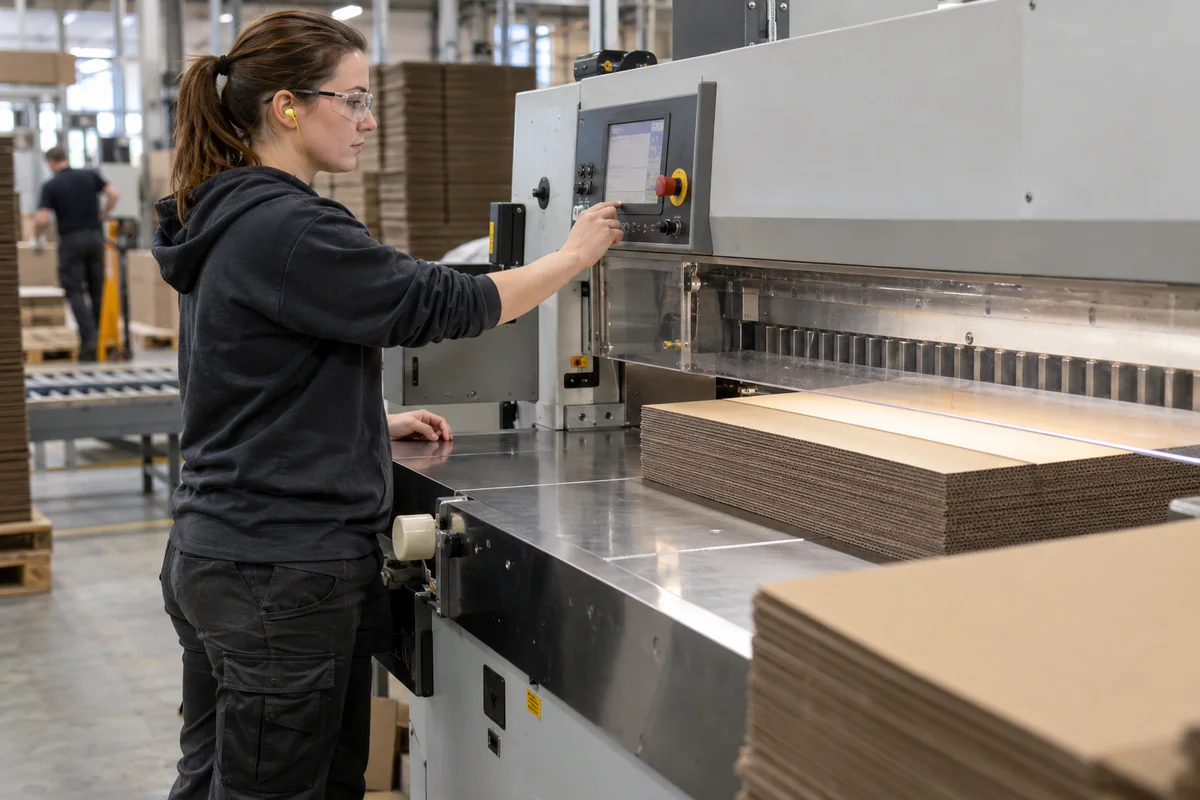
Read the job's work order first, then space the roll slitter's knives to its required widths.
Feed the stock into the slitter and square it up so it runs along the planned cutting path.
Check cut pieces with a caliper or ruler, and if a width is off, adjust the machine settings.
Count the finished rolls, then enter output totals, waste and down time on the computer.
United States · 2025
United States · 2025
United States · 2025–2035
Quick orientation
A high school diploma or equivalent is typical, followed by on-the-job training.
Annual pay in 2025 for cutting and slicing machine setters, operators, and tenders nationwide.
Employment is projected to decline 0.9% from 2025 to 2035.
In some paper-cutting shops, software turns a digital sheet layout into instructions for the cutter, reducing manual programming.
You still judge the material. Curled or damp paper can require adjustments that a saved cutting program does not settle.
How much setup becomes automatic will depend on the equipment and mix of jobs. Your balance of programming, handling material, and checking cuts may change.
Pay in context
The national median gives you a starting point for comparing offers across cutting and slicing jobs.
Median annual pay was $46,570 in 2025—about $22.39 an hour when divided across 2,080 working hours. It is not a starting-pay guarantee.
In May 2025, the 10th-percentile annual wage was $35,930 and the 90th-percentile wage was $61,120. These are wage percentiles, not starting and senior salaries.
In May 2023, average annual pay for this occupation was $49,410 in converted paper product manufacturing and $44,880 in printing and related support activities. These are historical industry averages, not current offers.
About 5,400 openings per year are projected nationally for 2025–2035, even as total employment edges down. Openings are not the same as newly created jobs.
Workplace training is the usual starting point. Look closely at whether a vacancy trains beginners or expects an operator who already knows the machine.
After entry
This starts where the entry routes leave off: early work, growing capability, and advancement or specialization.
Learn one machine's routine runs and make accurate measurement checks a habit.
In paper cutting, learn how different weights and curled sheets affect the adjustments you make.
A next step can be coordinating other workers on a cutting team.
Cutting connects with folding and binding. Paper weight, moisture, and curling affect how smoothly a job runs.
Wide rolls become narrower rolls of material such as adhesive tape. Handling rolls with lifting equipment and packing the output are part of the workflow.
Try it
With a ruler and pencil, plan how to fit six equal rectangles onto scrap paper. Mark every dimension, then check each rectangle and estimate the leftover area. Notice whether you enjoy catching measurement errors and reducing waste.
Stay safe: Keep this a drawing exercise; no cutting machine is needed.