
Career profile

Dancer

Learn movement, rehearse it with other dancers, and bring it to an audience or camera.

A small change in timing can make a scene feel different. You keep working until the movement says what you intend.
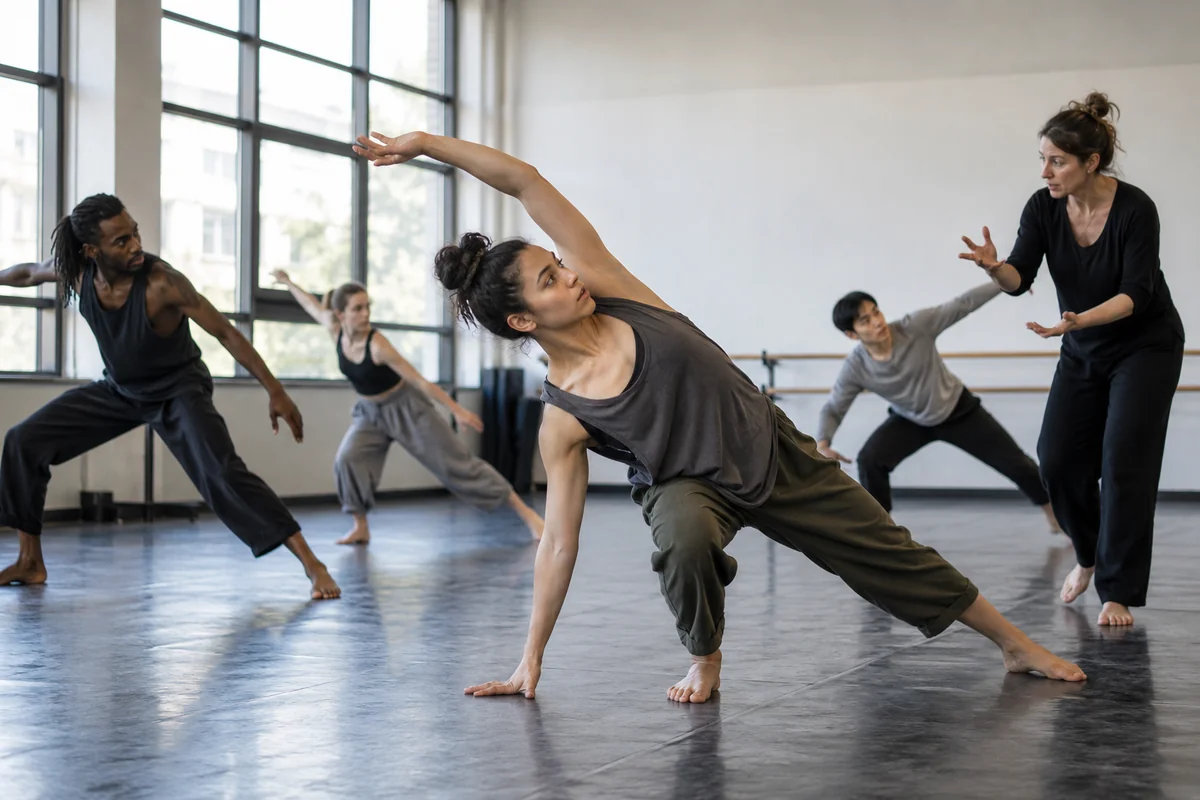
Dancer rehearses a movement in a studio.

A day in the life

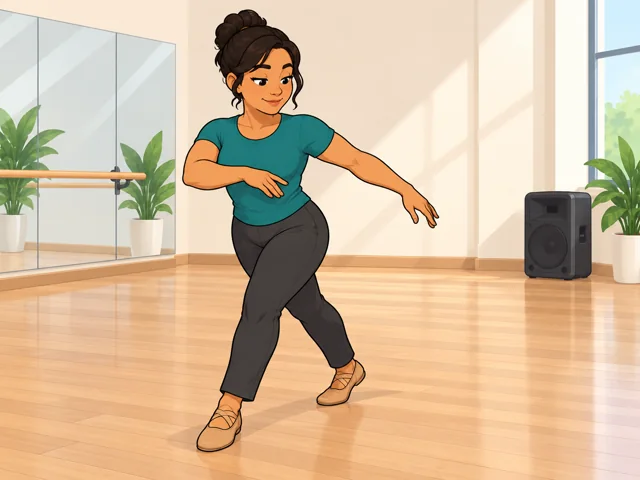
1A dancer concentrates on a forward weight transfer and crossing arm gesture while practicing a sequence beside a music speaker.

Learn a new sequence

Practice the steps until you can remember their order and match the music.
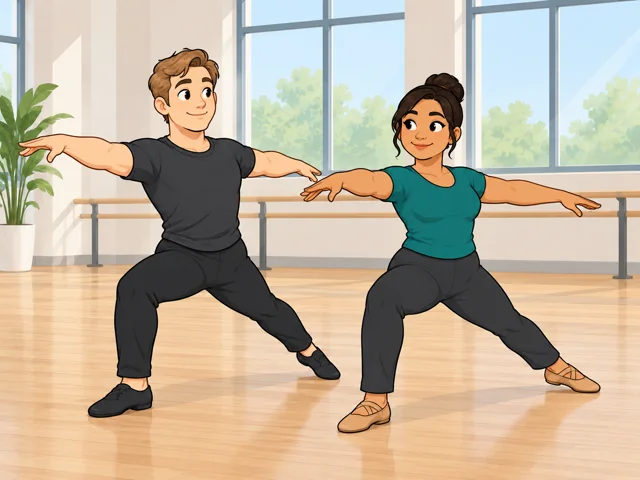
2Two dancers arrive in matching lunges side by side, checking their timing and the space between them.

Match your partner’s timing

Repeat a passage together, adjusting your spacing so you arrive in position together.
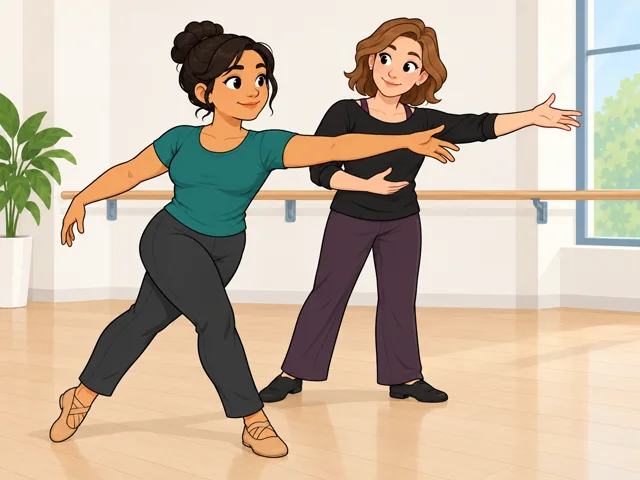
3A dancer tries a revised reaching gesture as her choreographer demonstrates the corrected arm pathway beside her.

Try the choreographer’s correction

Change a gesture or transition, then run the passage again to see how it reads.
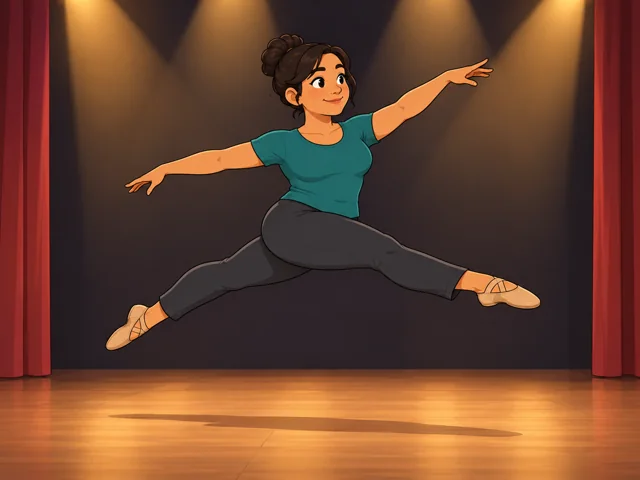
4Under warm theater lights, a dancer performs a traveling leap with an open chest and an arm reaching toward the audience.

Perform the piece

Use movement and expression to carry the rhythm or story through the performance.

Quick facts

Preparation

Years of dance training

United States

Pay

$24.80/hour median

United States · 2025

Outlook

2.2% projected growth

United States · 2025–2035

Quick orientation

Preparation, pay & outlook

Preparation

Years of dance training

A degree is not always required; developed technique and practice are central.

Geography
United States
Period
Not applicable

Pay

$24.80/hour median

National dancer employee wages, 2025.

Geography
United States
Period
2025

Outlook

2.2% projected growth

About 1,600 dancer openings per year, on average, during 2025–2035.

Geography
United States
Period
2025–2035

Fit, tradeoffs & changing tools

Things to weigh

  • Repeated rehearsals are physically demanding, and auditions can end in rejection.
  • Part-time work is common; evenings, weekends, and travel can affect your plans.

Where AI may help

Video lets you replay a rehearsal. Research tools can also flag moments when dancers move out of sync, helping a group choose what to practice.

What people still lead

Dancers and choreographers still decide whether a difference is a mistake or an expressive choice.

What we can’t predict yet

How far automated feedback will move beyond timing into useful artistic coaching remains uncertain. These research tools are not standard equipment in every rehearsal room.

Pay in context

Earnings

The hourly rate matters, but so does how much paid work you book.

The national range

The 2025 median was $24.80 an hour. The 10th percentile was $14.88 and the 90th was $52.30. These describe the wage spread, not starting and senior rates.

Geography
United States
Period
2025
Pay basis
Hourly employee wages

Pay by workplace type

Median hourly pay was $27.00 in educational services, $25.18 in performing arts, spectator sports, and related industries, and $22.67 in other amusement and recreation industries.

Geography
United States
Period
May 2025
Pay basis
Industry medians for dancer employee wages

Read the offer beyond its rate

Part-time work is common. Compare paid hours as well as the rate; these national wage figures exclude self-employed dancers.

Geography
United States
Period
Not stated
Pay basis
Hours and employee-wage coverage

Openings include replacements

Dancer employment is projected to grow 2.2% from 2025 to 2035, with about 1,600 openings annually from growth and replacement needs. That is a forecast, not a count of current vacancies.

Geography
United States
Period
2025–2035
Pay basis
Employment projection; not a pay measure

Getting started

Train through a ballet school

What the route involves
Develop classical technique through structured classes and stage experience in a school preparing dancers for professional ballet.
What it can lead to
Advanced training prepares you to pursue ballet-company auditions and professional placement.
What to check
This is a ballet-specific route. Completing training does not guarantee a professional career.

Study dance in college

What the route involves
Combine technique classes with rehearsals, performances, choreography, and academic study in a Bachelor of Fine Arts program.
What it can lead to
Earn a degree while developing performance experience across ballet, modern, and contemporary dance.
What to check
Selective programs may expect substantial prior training and an admission audition. Check each program’s requirements before treating it as a place to begin.

Build technique, then audition for work. A degree is one route; it does not replace the audition.

After entry

Career paths

This starts where the entry routes leave off: early work, growing capability, and advancement or specialization.

  1. Become dependable in rehearsal

    Learn your roles and keep corrections consistent from one run to the next.

  2. Expand what you can perform

    Keep taking class and develop unfamiliar styles so you can handle a wider range of choreography.

  3. Lead rehearsals

    Some dancers advance to dance captain, helping lead rehearsals and support less experienced performers.

Where you can work

Theaters and dance companies

You rehearse for live audiences, where the whole performance unfolds in front of them.

  • Indoors
  • Physical demands

Television and music-video productions

You perform for a camera. Some productions also call for singing or acting.

  • Physical demands

Try it

See whether the job clicks before you commit to the path.

Make an eight-count sequence using comfortable seated hand and arm movements. Record it to music, watch your timing, then repeat it with one deliberate change. Notice whether you enjoy refining the same short passage.

Stay safe: Keep the movements gentle and within your comfortable range; no jumps, lifts, or advanced technique are needed.

Explore more careers

Sources

  1. O*NET OnLine. 27-2031.00 — Dancers. Accessed 2026-10-04.
  2. O*NET OnLine / U.S. Bureau of Labor Statistics. National Wages: Dancers. Accessed 2026-10-04.
  3. U.S. Bureau of Labor Statistics. Occupational projections and worker characteristics. Accessed 2026-10-04.
  4. U.S. Bureau of Labor Statistics. Dancers and Choreographers — Occupational Outlook Handbook. Accessed 2026-10-04.
  5. Yuxuan Feng and coauthors / arXiv. SyncUp: Vision-based Practice Support for Synchronized Dancing. Accessed 2026-10-04.
  6. School of American Ballet. Artistic Programs. Accessed 2026-10-04.
  7. School of American Ballet. Professional Placement. Accessed 2026-10-04.
  8. School of American Ballet. Our Approach. Accessed 2026-10-04.
  9. The Juilliard School. Dance — Bachelor of Fine Arts. Accessed 2026-10-04.
  10. The Juilliard School. Dance — Bachelor of Fine Arts Application & Audition Requirements. Accessed 2026-10-04.

Your message goes to the Great Jobs team. How we use your information