
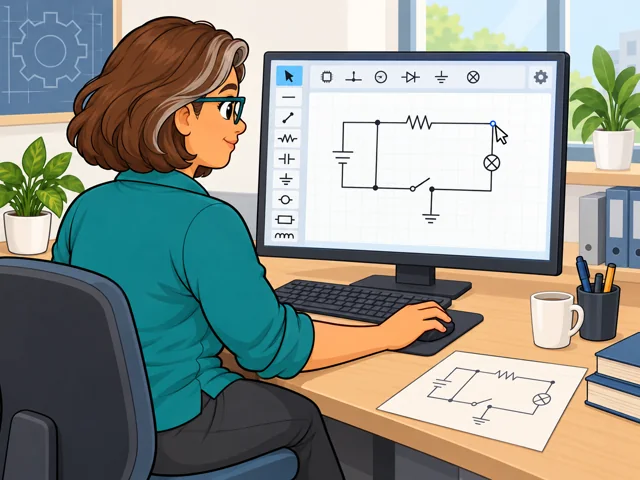
Draw the wiring diagram
In CAD (computer-aided design) software, you turn engineering's information into a diagram showing how wires connect.
Career profile
Electrical drafters turn engineers' plans into wiring diagrams and circuit board drawings others build from.
Could someone else work from your drawing? Your job is to make every wire link, measurement and assembly note plain enough to follow.

In CAD (computer-aided design) software, you turn engineering's information into a diagram showing how wires connect.

Settle any unclear connection or missing detail with the engineer before you draw it.
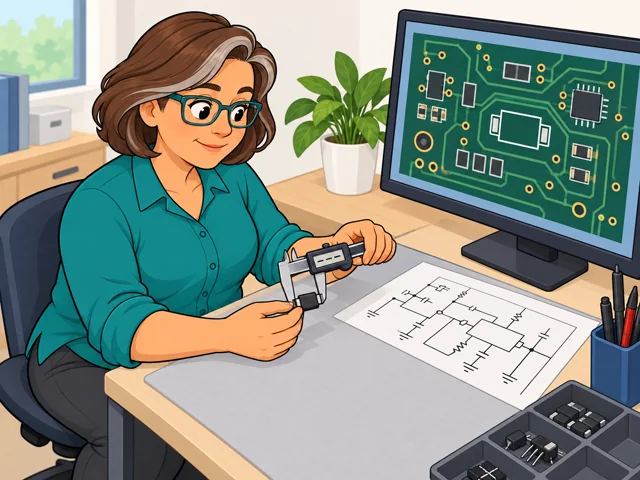
In electronics roles, you check that part sizes and positions on the board layout match the schematic.
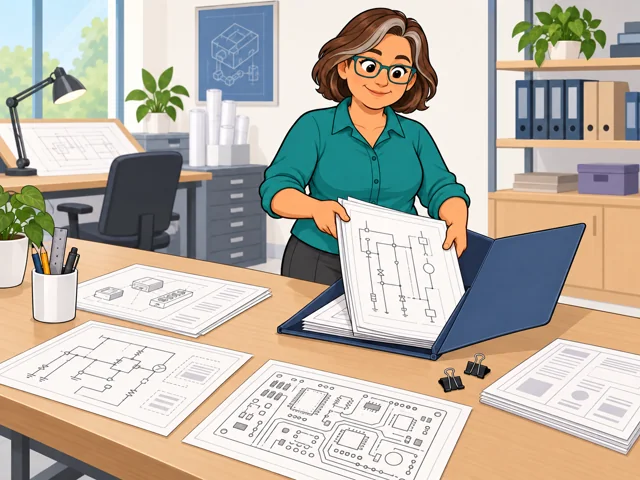
You gather the drawings and their backup paperwork into one set so engineering can review it.
United States
United States · May 2025
United States · 2025–2035
Quick orientation
Drafting certificates are another route.
National median for electrical and electronics drafters; about $36.96 an hour.
About 1,400 openings a year are projected despite shrinking employment.
Electrical drawing software can turn drawing data into connection lists. AutoCAD Electrical, for example, generates reports showing where wires start and end.
You still clarify requirements and resolve drawing problems with engineers.
How much drawing work stays with drafters may change as software lets engineers complete more of it themselves.
Pay in context
The national median is a useful comparison point, not a starting-pay offer.
Electrical and electronics drafters had a May 2025 median wage of $76,870 a year, or $36.96 an hour. Half earned more and half earned less.
In May 2025, the 10th-percentile annual wage was $50,040 and the 90th-percentile wage was $120,290. These are wage percentiles, not starting and senior salaries.
In May 2023, annual averages were $72,070 in architectural, engineering, and related services; $82,740 in semiconductor and other electronic-component manufacturing; and $89,450 in electric power generation, transmission, and distribution. These historical averages describe different workforces, not a guaranteed raise for changing industries.
Employment is projected to fall 3.4% from 2025 to 2035, with about 1,400 openings annually on average. Openings and net job growth measure different things.
Prepare for drafting work under engineers’ supervision. Choose training that includes electrical drawings, and compare its coursework with employers’ requirements.
After entry
This starts where the entry routes leave off: early work, growing capability, and advancement or specialization.
Learn to carry an engineer’s concept through to a detailed drawing package, asking for clarification when information is incomplete.
In power-system drafting, develop three-dimensional drawing skills and learn to bring site observations into the plans.
With experience, you may train newer drafters or coordinate drafting work.
Work closely with electrical designers on substation drawing packages. Some roles include site walkdowns to record existing conditions, so the plans must fit equipment already in place.
Work on circuit-board assembly drawings and layouts. Questions from assemblers connect your screen work to how a product goes together.
Try it
On paper, draw a pretend battery, switch, and lamp connected in a loop. Label both ends of every connection, then make a separate connection list. Ask someone to trace the loop using only your documents. Notice whether finding and fixing ambiguity appeals to you.
Stay safe: Keep this a drawing exercise; no electrical assembly is needed.