
Career profile

Electrician Helper

Electrician helpers ready supplies, form conduit, run wire, inspect gear, and keep work areas orderly.

On an electrical crew, plans and measurements turn into real paths for wire. Could you handle the pace, precision, and physical demands?

An electrical systems apprentice assists a journeyman in securing a repaired airfield light.
Photo by Airman 1st Class Adisen Smith, U.S. Air Force. Public domain U.S. government photo; DVIDS page. No Department of Defense endorsement implied.

A day in the life

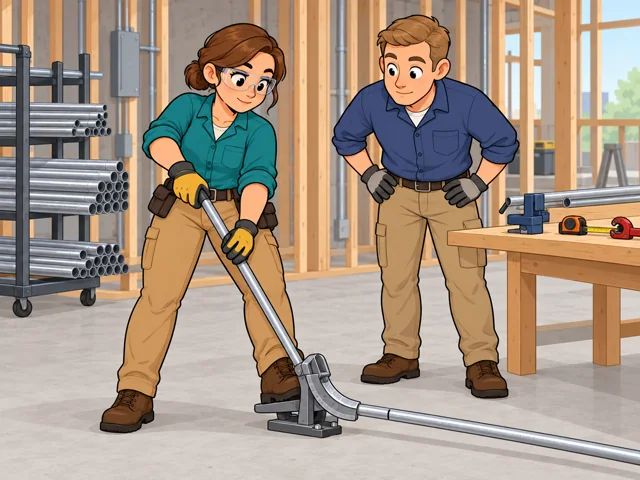
1An electrician helper bends a measured length of conduit with a hand bender while an electrician checks the work beside a fabrication bench.

Bend conduit to the electrician's sizes

Measure first, then cut and bend wire or conduit to the sizes the electrician gives you.
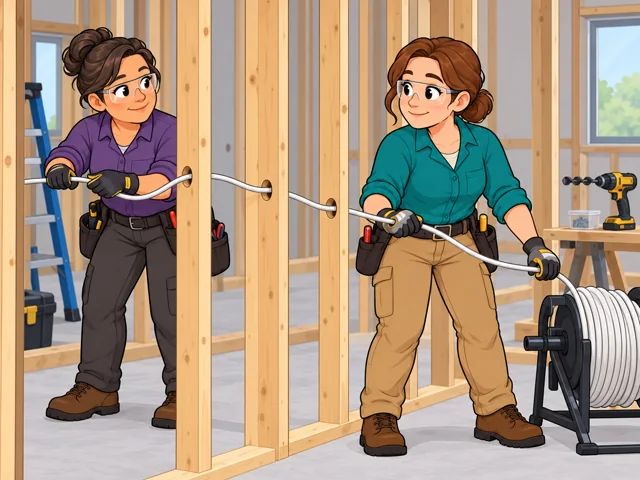
2An electrician helper feeds cable through drilled openings in exposed wall studs as an electrician guides the leading end.

Drill holes and pull wire

You drill the holes first, then pull or push wire through walls, ducts, or conduit following directions.
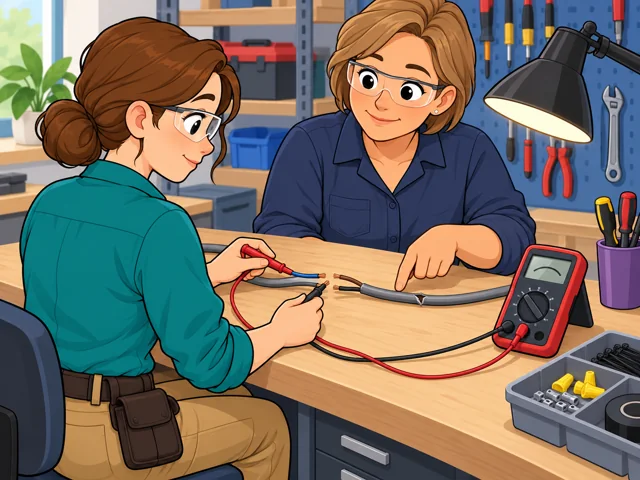
3An electrician helper uses a test meter on a disconnected cable while an electrician points out damaged insulation.

Trace a short with a meter

Use a test meter to find shorts, or spot loose connections and damaged insulation within your duties.
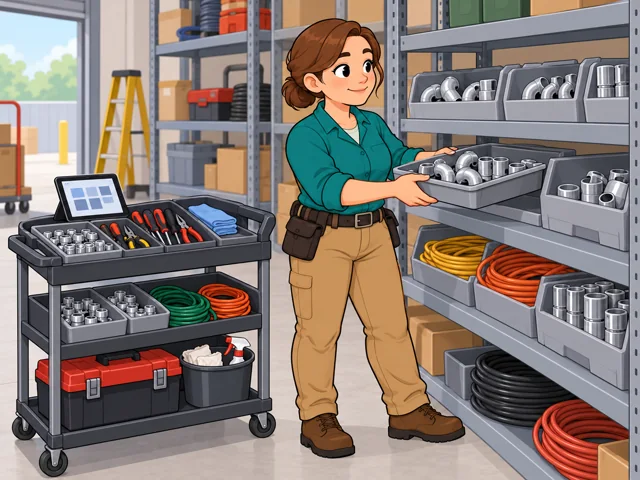
4An electrician helper restocks conduit fittings from a rolling cart beside shelves of organized tools and materials.

Keep tools and supplies in order

Move, clean, maintain, and organize tools and materials, and some crews track supplies with spreadsheets or recordkeeping software.

Quick facts

Preparation

Learn on the job

United States

Pay

$20.51/hr median

United States · May 2025

Outlook

1% projected growth

United States · 2025–2035

Quick orientation

Preparation, pay & outlook

Preparation

Learn on the job

Formal education is not typically required, but an employer may prefer or require a high school diploma or equivalent. New helpers usually learn under experienced workers.

Geography
United States
Period
Not applicable

Pay

$20.51/hr median

The May 2025 national median for Helpers—Electricians was $20.51 an hour, or $42,670 annually.

Geography
United States
Period
May 2025

Outlook

1% projected growth

BLS projects employment from 65,000 jobs in 2025 to 65,400 in 2035. That is a forecast, not a hiring guarantee.

Geography
United States
Period
2025–2035

Fit, tradeoffs & changing tools

Things to weigh

  • Expect standing, climbing, crouching, lifting, noise, awkward spaces, and regular use of protective equipment.
  • Some jobs are outdoors in poor weather or involve heights, hazardous equipment, variable schedules, or travel between sites.

Where AI may help

Digital drawings, recordkeeping systems, and spreadsheets can help a crew organize layouts, materials, and job records.

What people still lead

People still position tools, move materials, drill, pull wire, observe site conditions, and coordinate face to face.

What we can’t predict yet

The tools a helper actually uses depend on the employer and project.

Pay in context

Earnings

Use the national median as a reference point, not as a starting wage or promised offer.

National median

Helpers—Electricians had a median wage of $20.51 per hour and $42,670 per year. Half earned more and half earned less.

Geography
United States
Period
May 2025
Pay basis
Median hourly and annual wage for Helpers—Electricians in BLS wage-and-salary data

The national spread

In May 2025, the 10th-percentile annual wage was $33,020 and the 90th-percentile wage was $58,340. These are wage percentiles, not starting and senior salaries.

Geography
United States
Period
May 2025
Pay basis
National annual wage percentiles

Getting started

Take a helper job

Paid
What the route involves
Apply for helper positions, then shadow experienced workers and perform assigned support tasks under their guidance.
What it can lead to
You gain jobsite experience assisting electricians, handling materials, and using trade tools; some helpers later pursue a skilled construction trade.

Apply for an electrician apprenticeship

Typically 4–5 years, with about 2,000 hours of paid on-the-job training each year plus technical instruction.Paid
What the route involves
The electrician pathway generally requires a high school diploma or equivalent. Apply to a sponsor; if accepted, you combine paid work with technical instruction.
What it can lead to
Completion leads to journey-worker status and a nationally recognized credential.
What to check
Requirements vary by state and locality. Confirm the sponsor's admission rules and whether it will credit prior helper experience.

A helper job gives supervised support experience. An electrician Registered Apprenticeship is a separate, structured path toward journey-worker status.

After entry

Career paths

This starts where the entry routes leave off: early work, growing capability, and advancement or specialization.

  1. Get established

    Learn the crew's safety routines, keep materials organized, and complete assigned support work reliably under guidance.

  2. Build capability

    Become consistent at measuring and preparing conduit, pulling wire, checking work, and clearly reporting what you observe.

  3. Choose your next move

    If becoming an electrician is your goal, apply to an electrician apprenticeship and ask the sponsor how it treats prior helper experience.

    • Where useful to the job, pursue task-specific training or optional certifications such as rigging or scaffolding.

Where you can work

Building and renovation sites

Work may happen in unfinished interiors or around existing structures, where the crew drills openings, installs pathways, and routes wire through tight spaces.

  • Indoors
  • Field work
  • Physical demands
  • Safety-sensitive

Outdoor and infrastructure sites

Projects may involve trenches, underground conduit, cables, poles, or equipment outdoors, with weather, heights, and travel between jobsites.

  • Outdoors
  • Field work
  • Travel
  • Physical demands
  • Safety-sensitive

Try it

See whether the job clicks before you commit to the path.

On a simple room sketch, mark a route from a switch to a light. Use string to estimate the path, note each turn or opening, and list the tools and materials you think the crew would need. Then ask an electrician or construction teacher what you missed. Notice whether you enjoy the measuring, sequencing, and checking.

Stay safe: Keep this as a paper-and-string exercise. Do not open panels, outlets, switches, or energized equipment.

Explore more careers

Sources

  1. O*NET OnLine. 47-3013.00 — Helpers—Electricians. Accessed 2026-09-23.
  2. U.S. Bureau of Labor Statistics. Table 1. National employment and wage data from the Occupational Employment and Wage Statistics survey by occupation, May 2025. Accessed 2026-09-23.
  3. U.S. Bureau of Labor Statistics. Construction Laborers and Helpers. Accessed 2026-09-23.
  4. Apprenticeship.gov. Career Seekers. Accessed 2026-09-23.
  5. U.S. Bureau of Labor Statistics. Electricians. Accessed 2026-09-23.

Your message goes to the Great Jobs team. How we use your information