
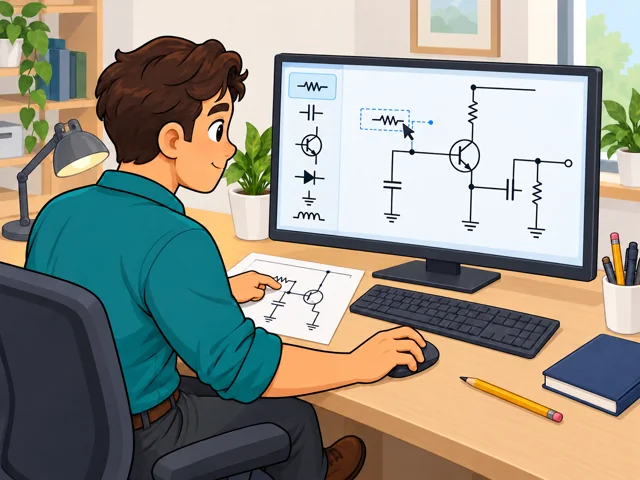
Draw the circuit's schematic
Pick parts and link them in a schematic, a diagram of how the planned circuit should work.
Career profile
Electronics engineers design circuits that let devices sense, communicate, and react.
If a sensor puts out the wrong signal, you trace it through the circuit first, then change the design and check whether the fix worked.

Pick parts and link them in a schematic, a diagram of how the planned circuit should work.

Run a simulation, change one component's value, and see what voltage it predicts before building a prototype.
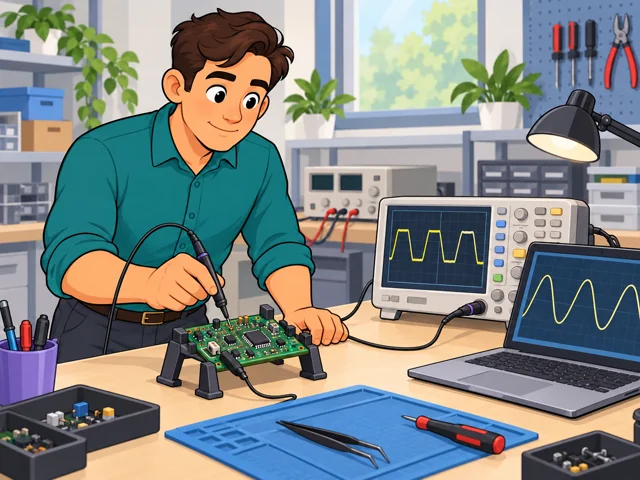
On an oscilloscope, which plots voltage over time, check the prototype's signal against the simulation, digging into gaps.

You revise the schematic and the test notes so a technician can build and check the changed circuit.
United States
United States · May 2025
United States · 2025–2035
Quick orientation
Usually in electrical engineering, electronics engineering, or a related engineering field.
National median, equivalent to $62.60/hour, for electronics engineers excluding computer hardware engineers.
Projected employment growth for electronics engineers, except computer.
Circuit simulators let you inspect predicted signals and compare changes before making hardware.
You decide what performance is needed and whether the evidence supports a design change.
How much physical testing simulation can replace depends on how well the model captures the real circuit and its surroundings.
Pay in context
These national figures cover electronics engineers, excluding computer hardware engineers.
The median was $130,220 a year, or $62.60 an hour. Half earned more and half less; this is not a starting salary.
The 10th-percentile wage was $81,840; the 90th was $206,960. These describe the workforce’s wage distribution, not beginner and senior pay steps.
Annual medians were $146,700 in semiconductor and electronic component manufacturing, $125,150 in engineering services, and $109,040 in telecommunications. These are different workforces, not a promised raise for switching industries.
About 4,900 openings are projected each year on average, including positions created when workers leave the occupation. Employment is projected to grow 3.7% over the decade.
A related engineering degree is the usual starting point. Entry-level positions do not require an engineering license.
After entry
This starts where the entry routes leave off: early work, growing capability, and advancement or specialization.
Learn the product’s requirements and record tests another engineer can reproduce.
Carry a revision through design, testing, and updated drawings.
Deepen your expertise in radio communications or control systems, or move into leading engineers and technicians.
In product-test roles, your work centers on test programs that check memory cells and high-speed connections. Debugging the test itself is part of deciding whether a chip performs correctly.
In radiation-assurance work, you collaborate with instrument and reliability engineers to assess parts for a particular mission. Specialized testing helps the group decide whether to change a component, circuit, or shielding.
Try it
Use a beginner LTspice tutorial to simulate a resistor-capacitor circuit. Predict what doubling the resistor will do to the capacitor’s charging curve, then run it. Notice whether explaining the difference interests you.
Stay safe: LTspice is free. Keep this exercise on screen; no physical circuit is needed.