
Career profile

Embalmer

Embalmers preserve, restore and carefully present bodies for viewing by mourners and for burial.

In one preparation room, you might run an embalming pump, then mold wax to rebuild part of a face. It joins anatomy with fine handwork.
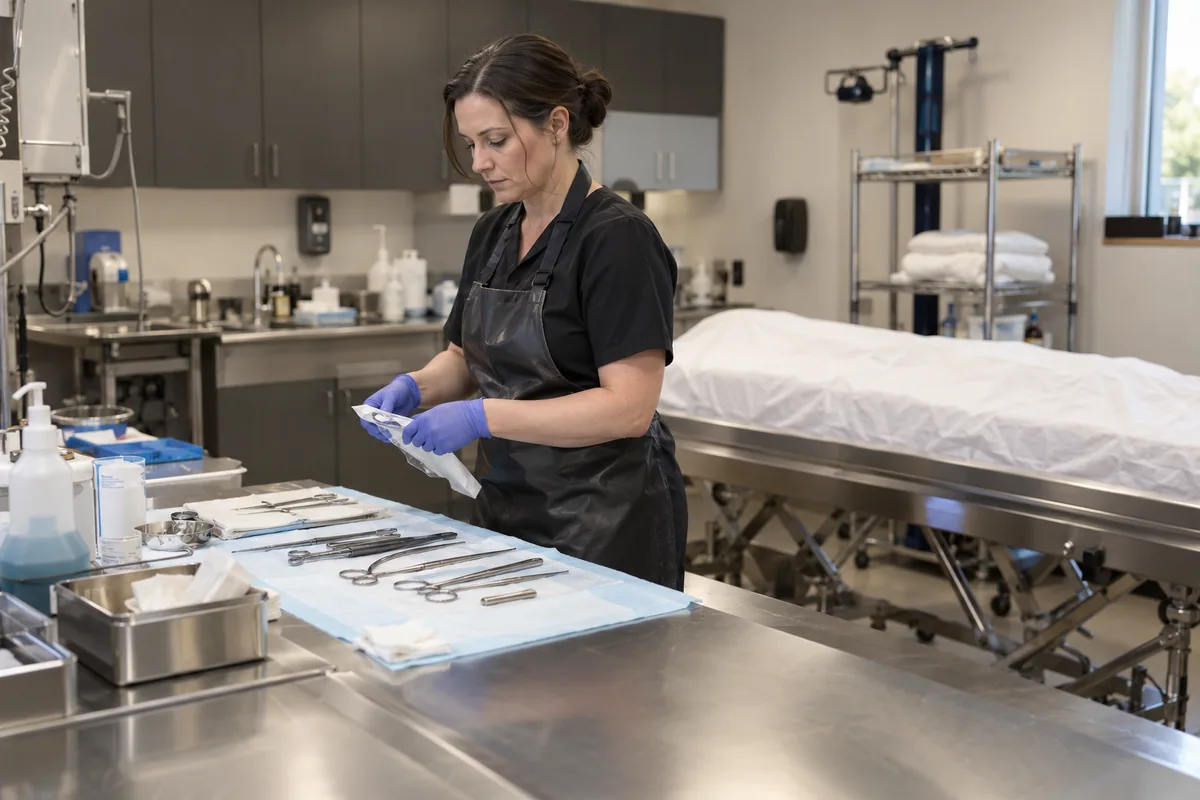
An embalmer preparing instruments and supplies in a clean funeral home preparation room, respectful and non-graphic.

A day in the life

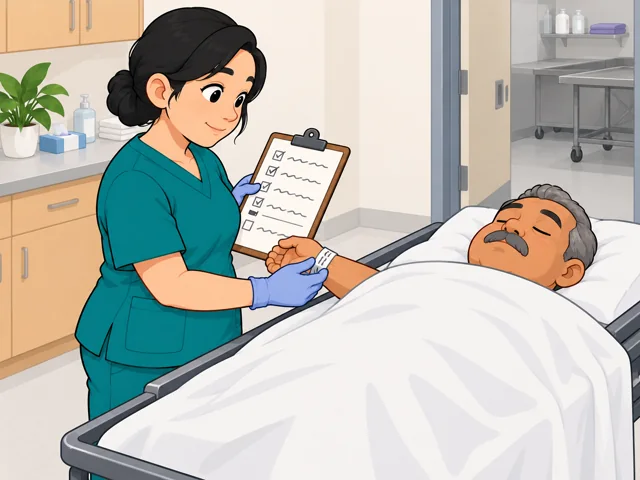
1An embalmer compares a covered deceased man's wrist identification band with identity and authorization paperwork.

Confirm identity and embalming permission

Confirm who the person is and that embalming permission exists before any prep work starts.
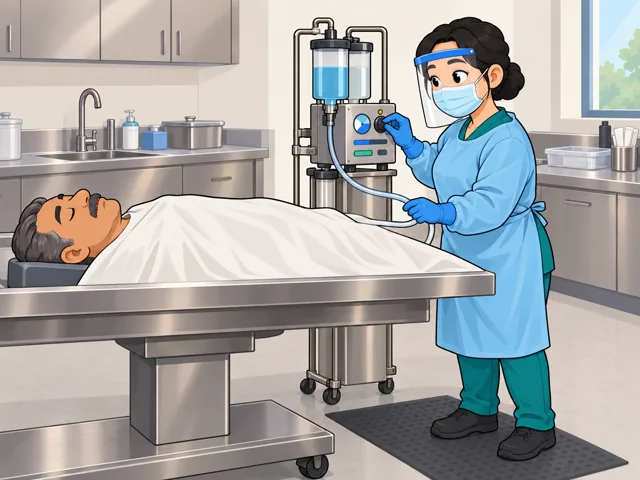
2An embalmer operates a preservation pump and monitors tubing connected beneath a drape covering the deceased man.

Pump in preserving fluid

You operate the embalming pump to push preserving fluid into the body, handling the deceased directly.

3An embalmer carefully shapes restorative wax on a deceased man's cheek, with cosmetics ready beside the table.

Restore a damaged appearance

When damage changes how the person looks, mold restorative wax and apply makeup for mourners to see.
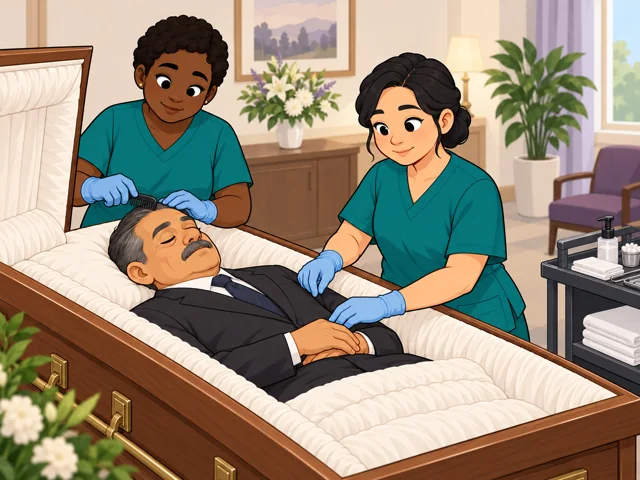
4An embalmer arranges a deceased man's jacket and hands in an open casket while a coworker finishes styling his hair.

Dress and casket the person

Dress the person, style their hair, and lay them in the casket.
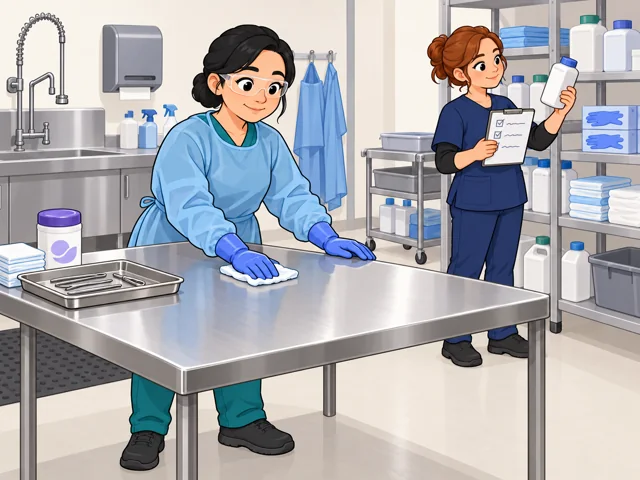
5An embalmer cleans the empty preparation table and equipment while a coworker checks chemical and supply stocks.

Clean tools and count supplies

Clean your tools and check remaining chemicals and supplies, so the room is ready for another case.

Quick facts

Preparation

Associate's degree

United States

Pay

$58,780/year

United States · May 2025

Outlook

0.7% growth

United States · 2025–2035

Quick orientation

Preparation, pay & outlook

Preparation

Associate's degree

A typical educational starting point is a funeral-service or mortuary-science program.

Geography
United States
Period
Not applicable

Pay

$58,780/year

National median for embalmers, equivalent to $28.26 an hour.

Geography
United States
Period
May 2025

Outlook

0.7% growth

Employment is projected to change little, with about 700 openings annually.

Geography
United States
Period
2025–2035

Fit, tradeoffs & changing tools

Things to weigh

  • Preservative chemicals can expose you to formaldehyde. Ventilation, exposure monitoring and protective equipment are part of the workplace.
  • Moving bodies is physically demanding; lifting equipment and safe handling practices matter.
  • Working closely with death can be emotionally difficult, even when you find the work worthwhile.

Where AI may help

Some embalming pumps automatically shut off when their fluid runs out, taking over a narrow equipment check.

What people still lead

You still handle the body and judge the result of restoration and cosmetic work.

What we can’t predict yet

How much future equipment can adapt preparation to an individual body's condition remains uncertain.

Pay in context

Earnings

The national median is $58,780 a year, or $28.26 an hour. It is a midpoint across employed embalmers, not a starting offer.

See the national spread

The 10th-percentile annual wage is $38,310 and the 90th-percentile wage is $77,570. These describe lower and upper portions of the wage distribution, not career stages.

Geography
United States
Period
May 2025
Pay basis
Annual employee wages for embalmers, SOC 39-4011

Read an offer in hours as well as dollars

The annual and hourly medians describe the occupation nationally. Your actual annual earnings depend on the rate and hours in your job.

Geography
United States
Period
May 2025
Pay basis
National annual and hourly employee wage estimates

Look beyond growth alone

Employment is projected to grow 0.7% over 2025–2035, with about 700 openings per year on average. Openings include replacing workers who leave the occupation.

Geography
United States
Period
2025–2035
Pay basis
Employment projection and average annual openings, not compensation

Getting started

Complete qualifying mortuary-science study

What the route involves
Choose a program accredited by the American Board of Funeral Service Education (ABFSE). Study anatomy, chemistry, embalming, restorative art and funeral-service law.
What it can lead to
Graduation from an accredited program provides a route to eligibility for the National Board Examination (NBE).
What to check
Confirm that the specific program meets the licensing requirements of the state where you want to work.

Enter a registered apprenticeship

What the route involves
In California, apply for apprentice registration with an approved funeral establishment and a qualified licensed supervisor. The application requires high-school completion, age eligibility and a background review.
What it can lead to
The work builds qualifying experience: California requires at least two years of apprenticeship and assistance with at least 100 embalmings.
What to check
This is a California example. Time attending mortuary college counts toward California's apprenticeship only if you are also a full-time funeral-establishment employee.

School and supervised experience are connected parts of entry. Check your intended state's embalmer rules before choosing a program or apprenticeship.

After entry

Career paths

This starts where the entry routes leave off: early work, growing capability, and advancement or specialization. This path also has a credential or licensing boundary; see the requirements and limits.

  1. Get established

    Make identity checks, room upkeep and preparation routines dependable.

  2. Build restorative skill

    Develop your ability to restore damaged features and judge cosmetic results across different cases.

  3. Specialize in anatomical embalming

    An experienced embalmer can pursue work preparing donated bodies for medical study, learning the preservation, storage and laboratory routines that setting requires.

Where you can work

Funeral-home preparation room

Your work prepares someone for viewing and casketing. Some roles also include transporting the deceased and receiving funeral-home supplies, so the day extends beyond the preparation table.

  • Indoors
  • Vehicle
  • Physical demands
  • Safety-sensitive

Medical-school anatomy program

You preserve and store donated bodies for teaching laboratories. Donor records, tracking remains and preparing lab materials become central parts of the work.

  • Indoors
  • Lab
  • Safety-sensitive

Try it

See whether the job clicks before you commit to the path.

Using ordinary modeling clay and a non-graphic reference photo, shape an ear or nose, then compare its contours with the photo. Notice whether you enjoy slow, precise corrections—one small part of restorative work.

Stay safe: Use craft materials only. This explores visual patience, not readiness to handle human remains.

Explore more careers

Sources

  1. O*NET OnLine. Embalmers — 39-4011.00. Accessed 2026-10-10.
  2. U.S. Bureau of Labor Statistics. May 2025 Occupational Employment and Wage Statistics — national estimates, SOC 39-4011. Accessed 2026-09-29.
  3. U.S. Bureau of Labor Statistics. Employment Projections Table 1.2 — 2025–2035, SOC 39-4011. Accessed 2026-09-29.
  4. California Cemetery and Funeral Bureau. Information and Instructions for Embalmer Licensure. Accessed 2026-10-10.
  5. California Cemetery and Funeral Bureau. Application for Certificate of Registration as an Apprentice Embalmer. Accessed 2026-10-10.
  6. American Board of Funeral Service Education. Directory of Accredited Programs. Accessed 2026-10-10.
  7. American Board of Funeral Service Education. Frequently Asked Questions — Funeral Service Curriculum. Accessed 2026-10-10.
  8. Service Corporation International. Embalmer Apprentice — Smith & Williams Funeral Home/Kempsville. Accessed 2026-10-10.
  9. Occupational Safety and Health Administration. Formaldehyde Exposure and Ergonomic Hazards in the Embalming/Funeral Home Industry. Accessed 2026-10-10.
  10. Mopec. Porti-Boy Embalming Machines. Accessed 2026-10-10.
  11. University of Washington. Embalmer — Job Classification. Accessed 2026-10-10.
  12. McGovern Medical School. Human Structure Facility. Accessed 2026-10-10.

Your message goes to the Great Jobs team. How we use your information