

Career profile

Energy Efficiency Engineer

Energy efficiency engineers find where buildings and plants lose or waste power, then pick fixes.

Tie meter numbers to machines on site, work out whether an upgrade pays for itself, and later confirm the predicted savings really showed up.
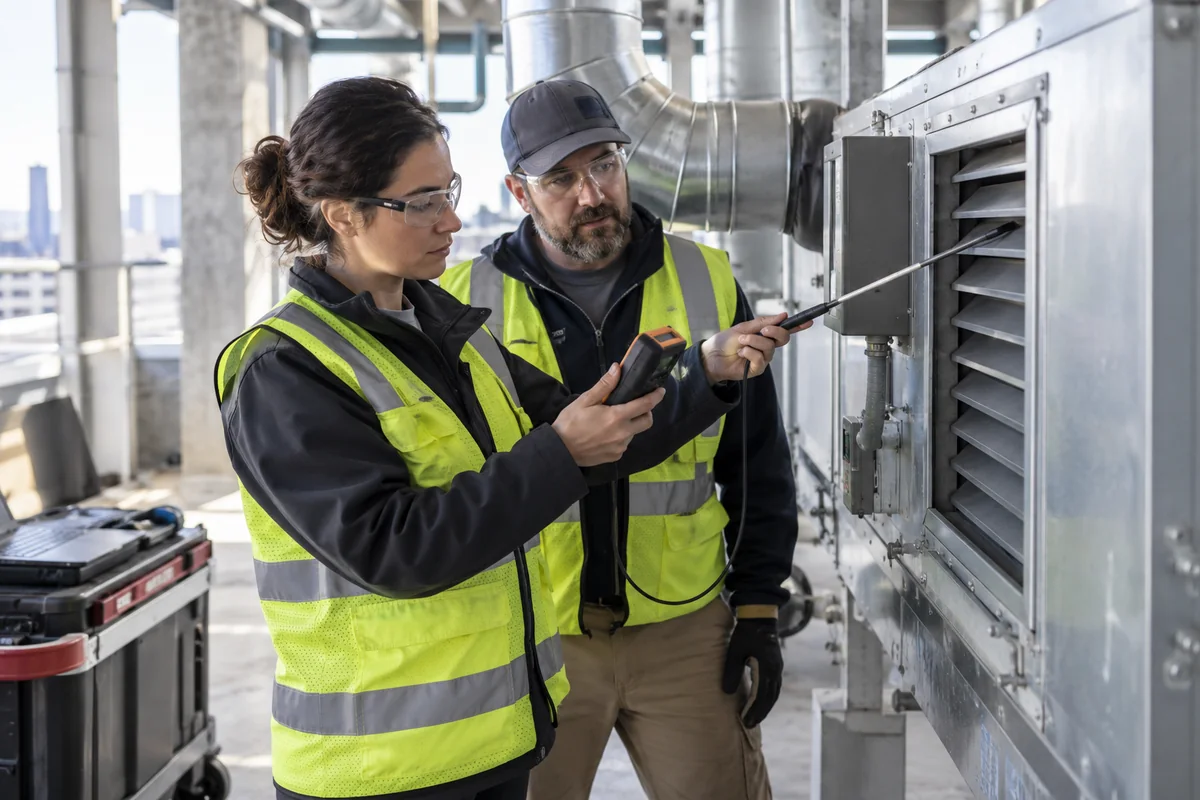
An adult energy efficiency engineer using a handheld measurement device while inspecting a building ventilation system with a facilities technician.

A day in the life

1An energy efficiency engineer compares electricity readings with operating hours, noticing that consumption stays high overnight.

Chart power use after closing

Graph meter data against operating hours, and if use stays high overnight, pick systems for a closer look.

2The engineer reviews meter records with a building operator while inspecting heating, cooling, and lighting equipment.

Walk the site with an operator

Compare running lights and heating or cooling units with meter records, then ask how people use the building.

3The engineer explains a proposed improvement’s installation cost, estimated energy savings, and assumptions to the facilities manager.

Price out an upgrade

Set install cost against projected energy savings on a spreadsheet, afterward explaining the assumptions to the facilities manager.
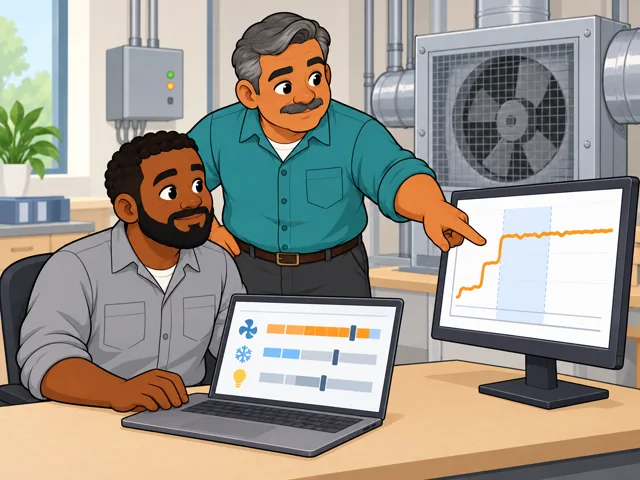
4The engineer and a controls technician investigate schedule settings after energy data shows a fan still running outside its intended hours.

Confirm a controls change worked

If data after the change shows a fan running off schedule, probe its settings with a controls technician.

Quick facts

Preparation

Usually a bachelor's degree

United States

Pay

Not displayed

There is no separate national median for this specialty.

Outlook

Not displayed

A national growth rate and annual openings estimate are not available for this specialty.

Quick orientation

Preparation, pay & outlook

Preparation

Usually a bachelor's degree

Engineering study provides the usual foundation; practical assessment experience helps you apply it.

Geography
United States
Period
Not applicable

Pay

Not displayed

There is no separate national median for this specialty.

Geography
United States
Period
2025

Outlook

Not displayed

A national growth rate and annual openings estimate are not available for this specialty.

Geography
United States
Period
2025–2035

Fit, tradeoffs & changing tools

Things to weigh

  • A technically sound improvement may wait for budget approval. Part of your work is making the cost and benefit understandable.
  • Some roles combine long stretches of spreadsheet review with travel to offices or project locations.

Where AI may help

Building software can combine meter readings, flag equipment problems, and sometimes adjust controls automatically.

What people still lead

You check whether a flagged problem is real and work with operators to turn the finding into a usable improvement.

What we can’t predict yet

How much troubleshooting and control adjustment becomes automatic will depend on the building's sensors, connected equipment, and reliability of the software.

Pay in context

Earnings

Use these broader engineering wages as a comparison point, not an estimate of energy efficiency engineers' pay. Your experience, qualifications, and project responsibilities can affect an offer.

A broader national pay benchmark

In 2025, the broader Engineers, All Other group had a U.S. median of $122,930 a year, or $59.10 an hour. The lowest-paid 10% earned $66,810 or less; the highest-paid 10% earned $189,950 or more. These figures cover several engineering specialties and experience levels, not starting and senior salary steps.

Geography
United States
Period
2025
Pay basis
National annual and hourly median wages and annual 10th and 90th percentiles for Engineers, All Other; not specialty estimates or total compensation

Workplace pay context

For that same broader group, older national figures show average annual wages of $107,360 in architectural, engineering, and related services and $134,050 in scientific research and development services in May 2023. These are historical industry averages across specialties and experience levels; they do not predict what an energy-efficiency role in either setting would pay today.

Geography
United States
Period
May 2023
Pay basis
Historical industry mean annual wages for Engineers, All Other; not medians, current offers, or energy-efficiency specialty averages

Getting started

Combine engineering study with plant assessments

What the route involves
At a participating university, pair your engineering degree with Industrial Training and Assessment Center work: visit plants with faculty, take measurements, and help calculate improvement costs.
What it can lead to
You build experience using diagnostic instruments and presenting recommendations to clients—skills you can bring to energy-efficiency work.
What to check
University assessment teams include upper-level and graduate students. Participation depends on the school and supplements the degree.

Transfer into mechanical engineering

What the route involves
Start with transferable mathematics, physics, and engineering courses at a community college, then complete a mechanical engineering bachelor's degree. Elgin Community College and Southern Illinois University Carbondale publish such a pathway.
What it can lead to
The degree adds heat transfer, thermodynamics, and design study for careers that include energy engineering.
What to check
Have both schools check your course plan. A transfer guide does not guarantee admission, and current catalog requirements take priority.

Build an engineering foundation and look for experience measuring real systems. You can begin at a university or use a planned community-college transfer route.

After entry

Career paths

This starts where the entry routes leave off: early work, growing capability, and advancement or specialization.

  1. Get established

    Make your measurements and calculations easy to check. Learn to turn field notes into a clear assessment report.

  2. Own an improvement

    Follow a problem from diagnosis through implementation and verification, including explaining the new operation to building staff.

  3. Lead larger projects

    Move toward managing energy upgrades across several buildings, coordinating contractors, budgets, schedules, and performance checks.

Where you can work

University facilities departments

You work with the same campus buildings and central heating or cooling plants over time. Operations staff and contractors help carry projects from analysis into daily use.

  • Office
  • Field work
  • Indoors

Utility-program consulting teams

You review customers' proposed upgrades and savings calculations against rebate requirements. Work spans different businesses and equipment, with technical reviews and conversations with contractors.

  • Office
  • Travel

Try it

See whether the job clicks before you commit to the path.

Try a paper lighting estimate: assume ten 20-watt lights run for eight hours a day. Calculate daily kilowatt-hours as watts × hours ÷ 1,000, then estimate the savings from running them for six hours. List what you would need to check before recommending that change. Notice whether you enjoy both the arithmetic and questioning the assumptions.

Stay safe: Use the imagined setup; do not change real lighting or building controls.

Explore more careers

Sources

  1. O*NET OnLine. Energy Engineers, Except Wind and Solar — 17-2199.03. Accessed 2026-10-03.
  2. U.S. Bureau of Labor Statistics. Occupational projections and worker characteristics. Accessed 2026-10-04.
  3. O*NET OnLine / U.S. Bureau of Labor Statistics. National Wages: Energy Engineers, Except Wind and Solar. Accessed 2026-10-04.
  4. U.S. Department of Energy. Energy Management Information System Capabilities. Accessed 2026-10-03.
  5. U.S. Department of Energy. Operations That Support Energy Management Information Systems. Accessed 2026-10-03.
  6. U.S. Department of Energy. Industrial Training and Assessment Centers. Accessed 2026-10-03.
  7. Southern Illinois University Carbondale. Elgin Community College to Mechanical Engineering Transfer Guide. Accessed 2026-10-03.
  8. Leidos. Senior Energy Engineer — Effingham, Illinois. Accessed 2026-10-04.
  9. Columbia University. Senior Energy Engineer — Job 557900. Accessed 2026-10-04.
  10. U.S. Bureau of Labor Statistics. Occupational Employment and Wages, May 2023 — Engineers, All Other. Accessed 2026-10-04.

Your message goes to the Great Jobs team. How we use your information