
Career profile

Fine Artist

Fine artists make original art of their own, such as illustrations, paintings, or sculptures.

An idea in your head becomes something other people can see. The colors, shapes, and materials you pick are where your own style shows.
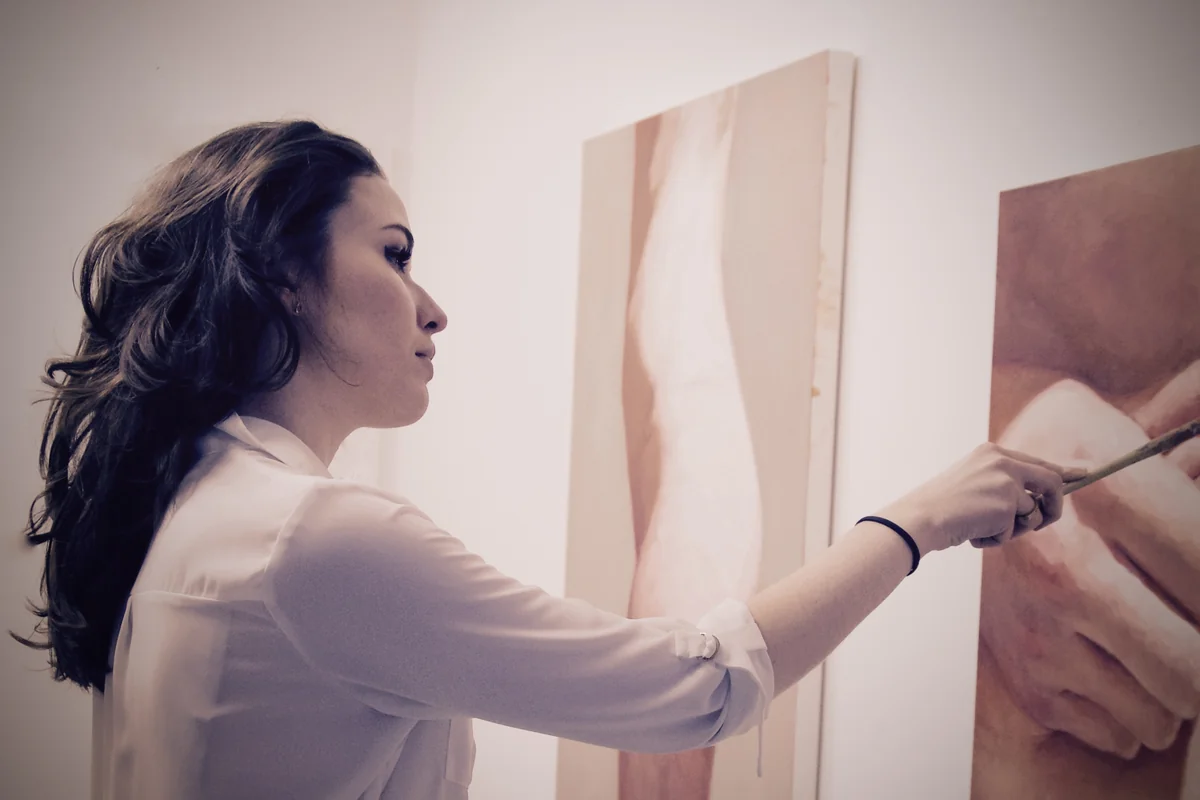
A painter with gray hair works on a large landscape canvas at an easel in a sunlit studio, holding her palette.

A day in the life

1

Sketch a layout before starting

Sketch the layout on paper first, moving any figure that pulls the eye away from your main point.

2

Paint or shape the piece

For a painting you brush on paint, and for sculpture you work clay with hands and small tools.

3

Rework a sketch with a client

On paid work, show the client an early sketch, discuss changes, then fold them into the final picture.

4

Get work before possible buyers

Since making art is only part of it, update your portfolio and submit to galleries and exhibitions.

Quick facts

Preparation

Bachelor’s degree typical

United States · 2025–2035

Pay

$55,490 median

United States · 2025

Outlook

2.9% projected decline

United States · 2025–2035

Quick orientation

Preparation, pay & outlook

Preparation

Bachelor’s degree typical

Entry requirements vary; your artwork demonstrates your skills.

Geography
United States
Period
2025–2035

Pay

$55,490 median

2025 employee pay for fine artists, including painters, sculptors, and illustrators; excludes self-employment.

Geography
United States
Period
2025

Outlook

2.9% projected decline

About 2,200 openings annually despite declining employment, 2025–2035, for painters, sculptors, and illustrators combined.

Geography
United States
Period
2025–2035

Fit, tradeoffs & changing tools

Things to weigh

  • Many artists need another job to support their art.
  • Paint, solvents, and sculpture materials can bring fumes or dust into your workspace.

Where AI may help

Drawing software lets illustrators add color to scanned sketches.

What people still lead

You decide what a piece expresses and judge whether its visual choices work together.

What we can’t predict yet

Artificial intelligence can imitate parts of an illustrator’s style. How much clients will substitute generated images for commissioned work remains uncertain.

Pay in context

Earnings

Employee wages and income from selling your own art are different pictures.

The employee pay range

The 2025 median was $55,490 a year, or $26.68 an hour. The bottom 10% earned $31,630 or less; the top 10% earned $144,210 or more. These are wage percentiles, not starting and senior salaries.

Geography
United States
Period
2025
Pay basis
Employee wages; fine artists, including painters, sculptors, and illustrators; excludes self-employment

Selling through a gallery

You and the gallery agree how to split sale proceeds. A sale’s price is not all yours to keep.

Geography
United States
Period
Not stated
Pay basis
Artwork sale proceeds, not salary

Openings still occur

About 2,200 openings a year are projected for 2025–2035, alongside a 2.9% employment decline. Openings are a national projection, not a count of advertised jobs.

Geography
United States
Period
2025–2035
Pay basis
Employment projection for fine artists, including painters, sculptors, and illustrators

Getting started

Study painting in a degree program

What the route involves
In Rhode Island School of Design’s Bachelor of Fine Arts program, study painting techniques, discuss work with peers and faculty, and complete an independent final project.
What it can lead to
You graduate with developed studio and critique skills and a body of original work.

Train through a studio certificate

The four-year option requires at least 22 class hours weekly.
What the route involves
At the Art Students League of New York, concentrate on a medium such as painting or sculpture while studying a second discipline.
What it can lead to
Completing the program earns a Certificate of Fine Art and participation in a final-project exhibition.
What to check
The four-year option requires previous studio study and an application portfolio. The two-year option requires two academic years of prior postsecondary fine-arts study.

Degree programs and intensive studio programs offer different ways to develop your work.

After entry

Career paths

This starts where the entry routes leave off: early work, growing capability, and advancement or specialization.

  1. Get established

    Build a portfolio that helps buyers understand your work.

  2. Develop your work

    Make a related series of pieces. Seek critique, then test changes in technique or subject across the series.

  3. Build a specialty

    Develop repeat clients or become known for a specialty such as children’s-book illustration.

Where you can work

Your own studio

A private or home studio can let you set your schedule around making and selling work.

  • Indoors

A shared studio

You work alongside other artists; some shared spaces also provide a place to exhibit finished pieces.

  • Indoors

Try it

See whether the job clicks before you commit to the path.

Draw an ordinary object in pencil, then redraw it to convey a different mood through shadows and placement. Ask someone what changed. Notice whether you enjoy revising visual choices as much as making the first drawing.

Explore more careers

Sources

  1. O*NET OnLine. Fine Artists, Including Painters, Sculptors, and Illustrators. Accessed 2026-10-04.
  2. O*NET OnLine / U.S. Bureau of Labor Statistics. National Wages: Fine Artists, Including Painters, Sculptors, and Illustrators. Accessed 2026-10-04.
  3. U.S. Bureau of Labor Statistics. Occupational projections and worker characteristics. Accessed 2026-10-04.
  4. U.S. Bureau of Labor Statistics. Craft and Fine Artists. Accessed 2026-10-04.
  5. Rhode Island School of Design. Painting Bachelor’s Program. Accessed 2026-10-04.
  6. Art Students League of New York. Certificate Program. Accessed 2026-10-04.
  7. Julien Porquet, Sitong Wang, and Lydia B. Chilton / arXiv. Copying style, Extracting value: Illustrators' Perception of AI Style Transfer and its Impact on Creative Labor. Accessed 2026-10-04.
  8. U.S. Bureau of Labor Statistics. Occupational Employment and Wage Statistics Tables. Accessed 2026-10-04.

Your message goes to the Great Jobs team. How we use your information