
Career profile

Food Scientist

Food scientists run experiments that improve food at every stage, from raw ingredients to meals.

Say a sauce tastes fine but separates in its container. Find what changed, then test whether swapping one ingredient or changing the process fixes it.
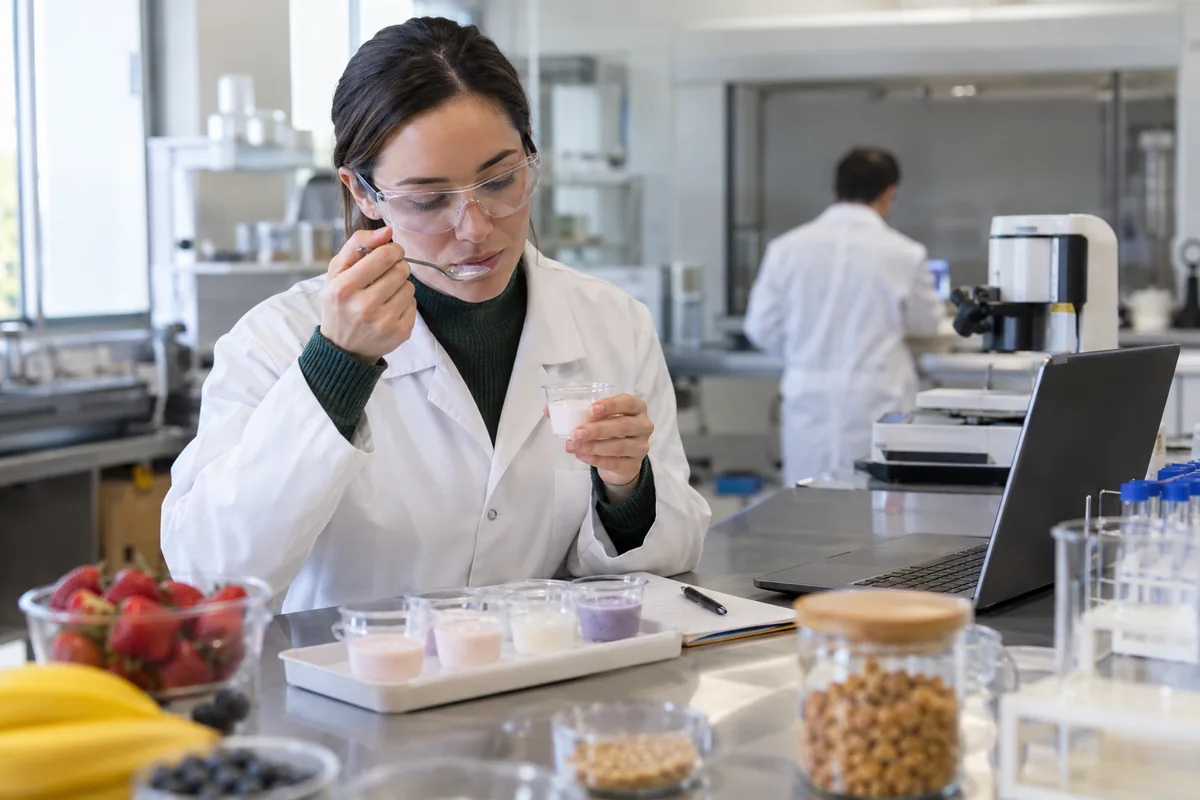
food scientist testing a food sample at a laboratory bench.

A day in the life

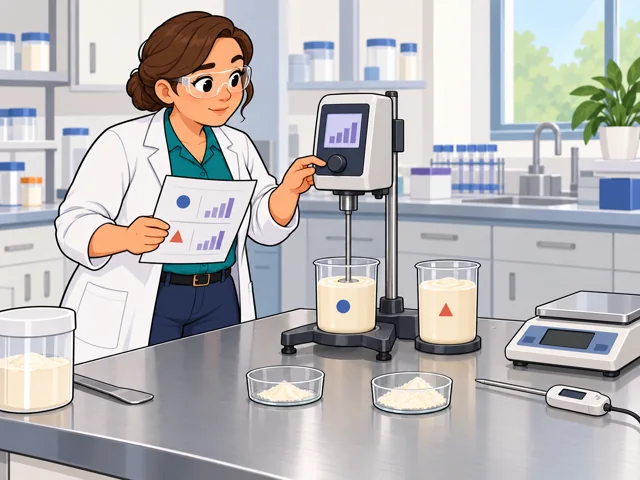
1A food scientist compares two trial mixtures, measuring the thickness of one with a viscometer beside the other sample and its recorded result.

Test two batches side by side

Change how much of one ingredient goes in, keep all else steady, and judge if it truly thickened.
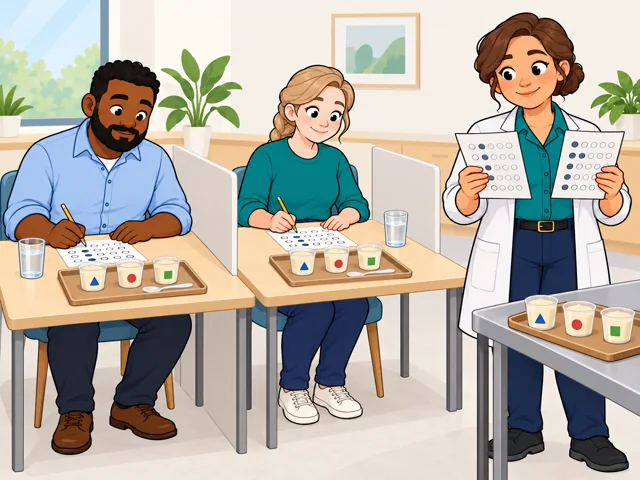
2Two adult tasters independently rate food samples while the food scientist prepares equal portions and compares returned rating sheets.

Collect scores from taste testers

Put out labeled samples, collect tasters' texture or flavor scores, and compare them rather than trusting your favorite.
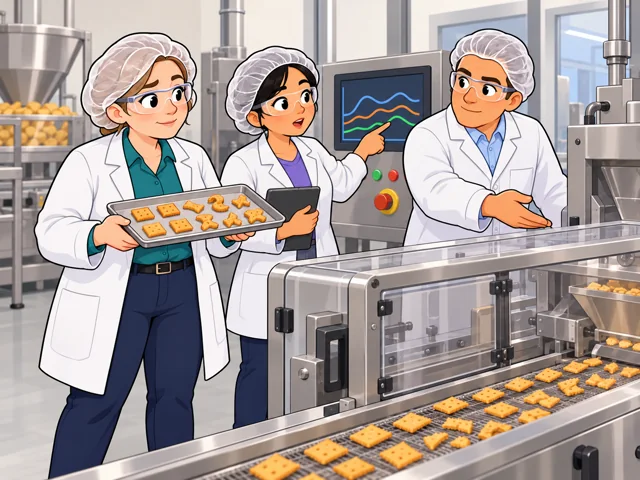
3The food scientist examines inconsistent snack pieces as an engineer and plant operator help her trace the problem through processing conditions.

Trace a snack's factory trial problem

Review the processing with engineers and plant operators before you pick what to test next.
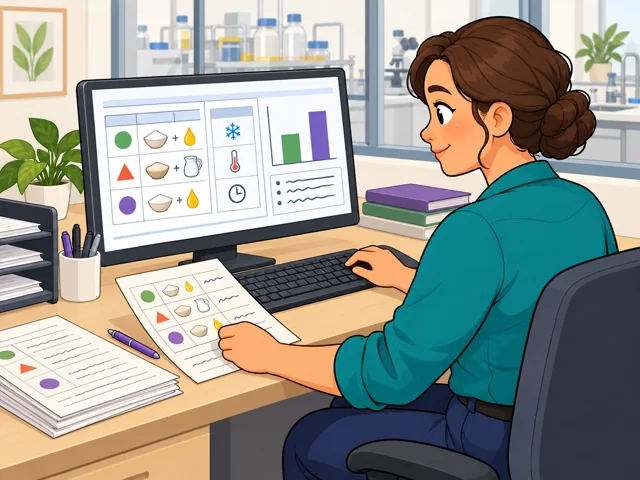
4The food scientist checks trial records while documenting the formula, test conditions, results and conclusion in an electronic laboratory notebook.

Write up results for coworkers

Enter the formula, test conditions and results in the digital lab record, plus why you reached your conclusion.

Quick facts

Preparation

Bachelor's degree

United States · 2025–2035

Pay

$88,720/year

United States · May 2025

Outlook

6.2% growth

United States · 2025–2035

Quick orientation

Preparation, pay & outlook

Preparation

Bachelor's degree

Typical entry education for food scientists and technologists.

Geography
United States
Period
2025–2035

Pay

$88,720/year

National median for food scientists and technologists; equivalent to $42.65/hour.

Geography
United States
Period
May 2025

Outlook

6.2% growth

Projected employment growth for food scientists and technologists from 2025 to 2035.

Geography
United States
Period
2025–2035

Fit, tradeoffs & changing tools

Things to weigh

  • Factory visits can mean loud machinery, hot or cold areas, and protective clothing.
  • Deadlines can interrupt the pace of careful testing, and some jobs involve weeks longer than 40 hours.

Where AI may help

Some product-development tools use artificial intelligence (AI) to retrieve food research and suggest formulation considerations, giving you ideas to investigate.

What people still lead

You still design physical trials, interpret results and work with production colleagues to decide what a product needs.

What we can’t predict yet

How much early research and formula development moves into software remains uncertain; generating a suggestion and proving it works are separate tasks.

Pay in context

Earnings

Location, relevant experience and technical skills can affect an offer. National figures give you a reference point, not a promised starting salary.

The national midpoint

Food scientists and technologists had median wages of $88,720 a year, equivalent to $42.65 an hour. Half earned more and half earned less.

Geography
United States
Period
May 2025
Pay basis
National occupational employee wages; annual and hourly medians.

The national spread

The 10th-percentile annual wage was $52,920 and the 90th-percentile wage was $145,280. These mark the lower and upper ends of the middle 80%, not beginner and senior pay levels.

Geography
United States
Period
May 2025
Pay basis
Annual employee wage percentiles for food scientists and technologists.

Openings include replacement needs

Employment is projected to grow 6.2%, with about 1,000 openings a year on average. Openings include replacing people who leave the occupation, as well as new positions.

Geography
United States
Period
2025–2035
Pay basis
Employment projection, not compensation; food scientists and technologists.

Getting started

Study food science as an undergraduate

What the route involves
Study food chemistry, microbiology and processing, then apply them in laboratory work and product-development projects.
What it can lead to
Build the scientific foundation for entry roles in food development, analysis or safety.

Add food science after another degree

What the route involves
Complete graduate food-science coursework and an applied project. Cornell's Master of Food Science accepts students entering from other undergraduate fields.
What it can lead to
Connect your earlier education to food-industry work, including product development and food-scientist roles.
What to check
Check science prerequisites before applying, especially with a non-science degree. This is an additional education route, not a master's requirement for every food-scientist job.

A bachelor's degree is the usual starting point. Early associate scientist jobs can involve closely supervised projects while you learn the employer's methods.

After entry

Career paths

This starts where the entry routes leave off: early work, growing capability, and advancement or specialization.

  1. Get established

    Learn the lab's test methods and recordkeeping. Build confidence collecting reliable results and explaining what they mean.

  2. Take a problem through testing

    Develop experiments that connect a product problem to its cause, then follow the solution from laboratory batches into manufacturing trials.

  3. Become a technical lead

    Specialize in a product or process, such as fried snacks. Senior scientists lead complex projects and coach less experienced colleagues.

Where you can work

Food manufacturer

Your laboratory work connects to the company's production lines. Plant trials bring you alongside engineers and operators, sometimes requiring travel and time around noisy equipment.

  • Lab
  • Indoors
  • Travel

Ingredient supplier's application lab

You make sample foods that show customers how ingredients perform. Expect demonstrations, contact with sales and flavor specialists, and occasional visits to customer plants.

  • Lab
  • Indoors
  • Travel

Try it

See whether the job clicks before you commit to the path.

Put equal amounts of oil and water into two clear, sealed containers. Shake one briefly and the other longer, then photograph both at the same intervals. Write down what changed and design a repeat test. Notice whether you enjoy controlling conditions and explaining an imperfect result.

Stay safe: Use clean, unbreakable containers. Observe without tasting; this exercise does not test food safety or shelf life.

Explore more careers

Sources

  1. O*NET OnLine. Food Scientists and Technologists, 19-1012.00. Accessed 2026-10-09.
  2. U.S. Bureau of Labor Statistics. Agricultural and Food Scientists: food-science duties and working conditions. Accessed 2026-10-09.
  3. U.S. Bureau of Labor Statistics. May 2025 national Occupational Employment and Wage Statistics: SOC 19-1012; supplied facts binding. Accessed 2026-09-29.
  4. U.S. Bureau of Labor Statistics. Employment Projections Table 1.2, 2025–2035: SOC 19-1012; supplied facts binding. Accessed 2026-09-29.
  5. Cornell University. Food Science Major & Minor. Accessed 2026-10-09.
  6. Cornell University. Master of Food Science. Accessed 2026-10-09.
  7. The Campbell's Company. Associate Scientist, Research and Development Snacks—Bakery. Accessed 2026-10-09.
  8. Sensient Technologies. Application Scientist III / Senior Applications Scientist I, Hoffman Estates. Accessed 2026-10-09.
  9. The Hershey Company. Staff Scientist Popcorn & Kid Snacking. Accessed 2026-10-09.
  10. Institute of Food Technologists. CoDeveloper. Accessed 2026-10-09.

Your message goes to the Great Jobs team. How we use your information