

Cash out chips and tickets
Count the chips a guest hands over or cash in their gaming ticket, then count out their payout.
Career profile
Cage cashiers handle money at a casino's cashier desk, known as the cage.
This work blends greeting guests with a careful count of chips and cash. It suits people who like both helping others and making numbers agree.

Count the chips a guest hands over or cash in their gaming ticket, then count out their payout.
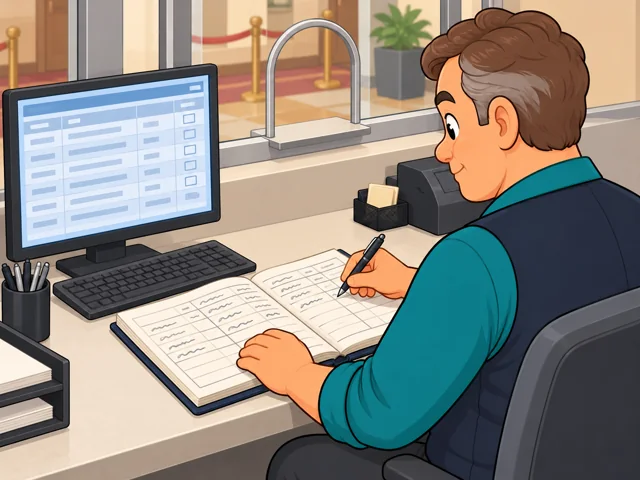
You enter each exchange in the computer log, using the paper log when a transaction calls for it.
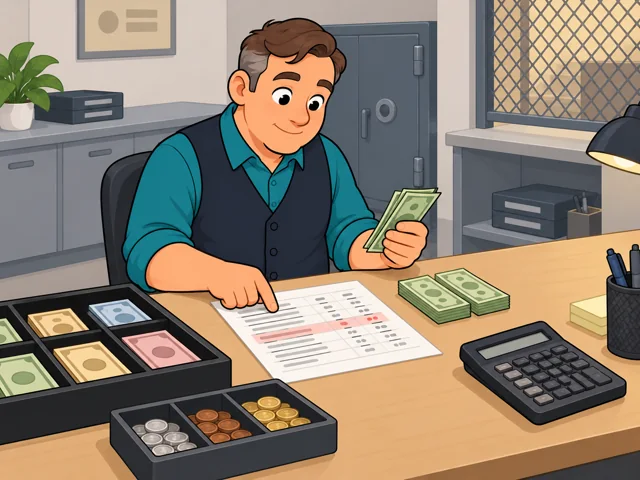
Match your count to the transaction summary, and if they differ, recheck counts and entries for the gap.

Spot bills, coins or chips running low at the window and request what upcoming exchanges will need.
United States
United States · May 2025
United States · 2025–2035
Quick orientation
You typically learn the work on the job, including casino procedures and transaction rules.
National median for gambling cage workers, equivalent to $18.07 an hour.
Employment is projected to shrink, with about 1,200 openings a year nationwide.
Money counters help count cash, while electronic logs keep transaction records. Some casinos also use customer kiosks.
Cashiers still check exchanges, document what happened and answer guests’ questions.
How much routine window work moves to kiosks—and how much cashier time shifts to helping with machines—remains uncertain.
Pay in context
The national median was $37,580 a year, or $18.07 an hour, in May 2025. That is a midpoint across gambling cage workers, not a starting offer.
The 10th-percentile wage was $29,100 a year ($13.99 an hour), and the 90th-percentile wage was $49,430 ($23.76 an hour). These describe the wage distribution, not a guaranteed progression with experience.
Some cage jobs include tips. Compare the base hourly wage and expected weekly hours first, then ask how tips are handled.
Employment is projected to fall 3.1% from 2025 to 2035, while averaging about 1,200 openings each year. A shrinking occupation can still need people to replace workers who leave.
A high school diploma or equivalent is the typical preparation. Entry depends on the employer’s experience requirements and the gaming rules where you apply.
After entry
This starts where the entry routes leave off: early work, growing capability, and advancement or specialization.
Learn the window’s transaction steps, recordkeeping and gaming rules until you can complete routine exchanges accurately.
Where cross-training is available, learn to supply other cashiers, check their paperwork and process departmental deposits.
With cage experience, you can pursue supervision: reviewing shift reports, approving transactions, coordinating staffing and resolving guest complaints.
You work directly with guests through repeated cash and chip exchanges. Clear explanations and keeping your window stocked matter throughout the shift.
More of your work involves other cashiers and internal funds. You check gaming paperwork and handle deposits from departments such as food and beverage, alongside some guest transactions.
Try it
Make paper chips worth $1, $5 and $25 and a pretend cash bank. Have a friend redeem five batches while you record each exchange. Reconcile the cash left with your log. Notice whether talking while counting makes you lose your place.
Stay safe: Use pretend money; no gambling or casino visit is needed.