

Career profile

Geneticist

Geneticists study how genes shape traits that pass from parents to offspring.

You turn open heredity questions into tests and explanations. That might mean tracking a plant trait, studying disease or, as a physician, helping diagnose patients.
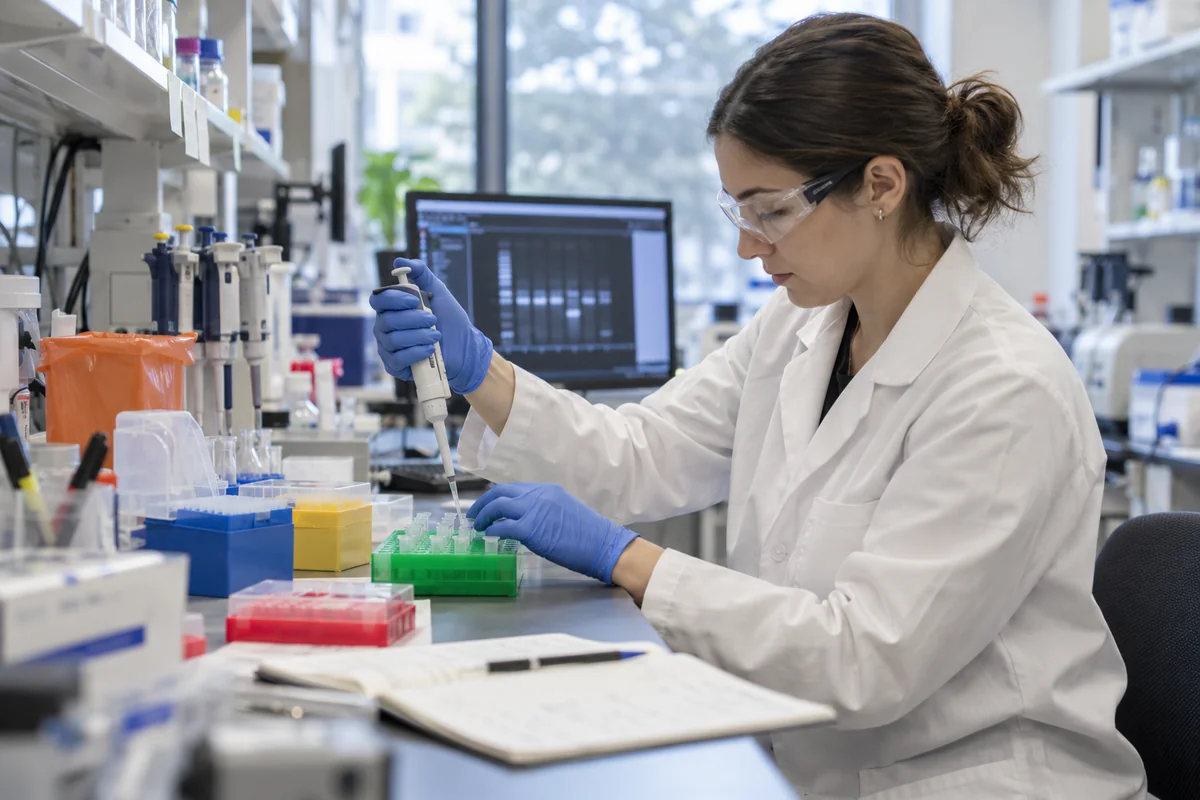
Geneticist prepares samples with a pipette in a laboratory.

A day in the life

1A geneticist and colleague plan an experiment by comparing two matched groups on a tabletop diagram.

Design a test for one gene

Decide what to compare side by side so the test shows whether one gene really affects a trait.
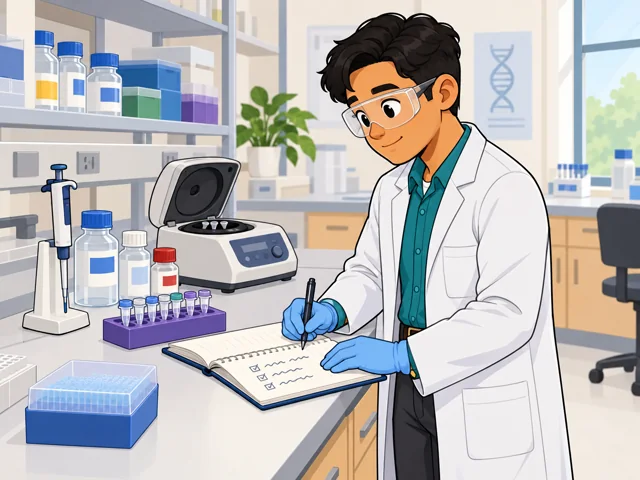
2Wearing laboratory protective gear, a geneticist records a DNA extraction method beside prepared sample tubes and a pipette.

Extract, then log the procedure

In lab jobs, you extract DNA (deoxyribonucleic acid), then record the procedure in a lab notebook.

3A geneticist examines an unexpected point in a genetic data plot and checks the pattern against an uncertainty plot.

Double-check a surprising result

Use statistics software to compare the gene data and confirm a pattern is real before you interpret it.

4A geneticist writes a research manuscript while checking a draft figure against the methods recorded in a laboratory notebook.

Show your work to peers

Turn your findings into charts and graphics, then describe your methods so other scientists can check your conclusions.
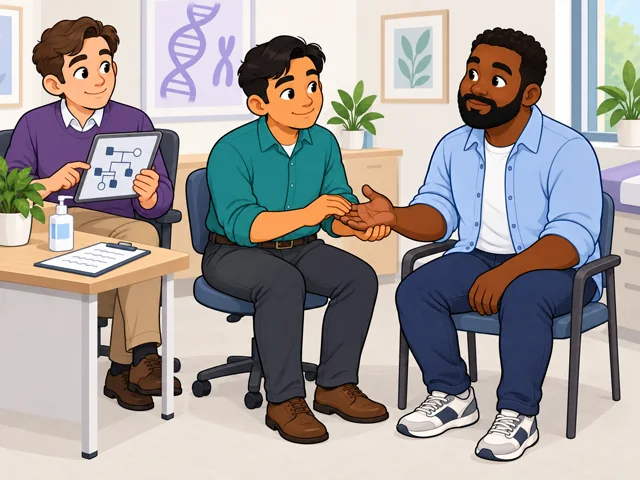
5A clinical geneticist examines an adult patient's hand while a genetic counselor reviews family history. The patient has very deep warm brown skin with clearly readable facial features.

Puzzle out an unexplained disorder

In clinical doctor jobs, you evaluate patients with undiagnosed conditions and care for them with genetic counselors.

Quick facts

Preparation

Usually graduate study

United States

Pay

Not displayed

Pay depends on the role; see the research and physician salary examples below.

Outlook

Not displayed

A national growth rate and annual openings count specific to geneticists are not available.

Quick orientation

Preparation, pay & outlook

Preparation

Usually graduate study

Research and patient-care routes require different preparation.

Geography
United States
Period
Not applicable

Pay

Not displayed

Pay depends on the role; see the research and physician salary examples below.

Geography
United States
Period
2025

Outlook

Not displayed

A national growth rate and annual openings count specific to geneticists are not available.

Geography
United States
Period
2025–2035

Fit, tradeoffs & changing tools

Things to weigh

  • Writing papers and seeking research funding take time away from experiments.
  • Some hospital roles include shared night and weekend call.

Where AI may help

Programs that learn patterns from large datasets—artificial intelligence—can help researchers predict which genetic changes may matter.

What people still lead

You choose the biological question, assess the evidence, and decide what experiment should test a prediction.

What we can’t predict yet

How much interpretation these tools can take over depends on whether their predictions remain reliable with new data and unfamiliar biological problems.

Pay in context

Earnings

Research positions and physician positions have different qualifications and pay. These employer ranges show the distinction; they are not a national pay scale.

Federal plant genetics research

A 2026 U.S. Department of Agriculture recruitment listed $89,508–$192,331 annually across General Schedule grades 12–15. The stated range used the Rest of U.S. pay scale; actual pay depended on duty location and grade. That recruitment has closed.

Geography
United States, multiple duty stations
Period
2026 recruitment
Pay basis
Advertised annual full-time salary; multiple federal grades; locality-dependent

Clinical physician work

Cleveland Clinic listed $230,000–$303,750 annually for full-time clinical geneticist physicians in Cleveland, Ohio, excluding benefits. Experience, clinical expertise and work history affect the offer. This is physician pay, not a research-geneticist benchmark.

Geography
Cleveland, Ohio
Period
2026 posting, accessed October 4
Pay basis
Advertised annual full-time physician salary, excluding benefits

Getting started

Train for genetics research

What the route involves
Build a biology foundation, then pursue graduate research training. A Doctor of Philosophy (PhD) program can combine genetics courses, laboratory rotations and an original dissertation.
What it can lead to
Preparation for research careers using experimental or computational approaches; the degree level employers expect varies by position.

Train as a clinical geneticist physician

What the route involves
Earn a Doctor of Medicine (MD), Doctor of Osteopathic Medicine (DO), or equivalent. One route then requires at least one year of accredited residency with direct patient care, followed by a two-year medical genetics and genomics residency.
What it can lead to
Completed training supports eligibility to apply for the American Board of Medical Genetics and Genomics certification examination in Clinical Genetics and Genomics. Combined residency routes also exist.

Choose whether you want to investigate genetic questions through research or train as a physician who treats patients.

After entry

Career paths

This starts where the entry routes leave off: early work, growing capability, and advancement or specialization. This path also has a credential or licensing boundary; see the requirements and limits.

  1. Get established

    Make your sample records and analyses reliable enough for colleagues to follow.

  2. Develop a specialty

    Build deeper expertise in an area such as statistical genetics or experiments that test gene function.

  3. Lead a research program

    Develop a connected set of studies, lead collaborations and take responsibility for the program's scientific results.

Where you can work

University research laboratories

Work among faculty, graduate students and postdoctoral researchers. Experiments share the calendar with seminars, research discussions and trainee learning.

  • Lab
  • Office
  • Indoors

Agricultural research centers

Connect genetic measurements with crop performance. Fieldwork and collaboration with breeders bring practical growing conditions into the research.

  • Lab
  • Field work
  • Travel

Hospital genetics departments

Clinical geneticists work with genetic counselors, see children or adults in clinics, and may consult on hospitalized patients while teaching medical trainees.

  • Indoors
  • On call

Try it

See whether the job clicks before you commit to the path.

Model a simple inheritance question on paper. Give each of two imaginary parents one A card and one a card. Randomly draw one from each parent, record the pair, and repeat 20 times with replacement. Compare your results with the four possible combinations. Do you enjoy explaining why observations differ from predictions?

Stay safe: This is a simplified model, not a way to predict your own traits or health.

Explore more careers

Sources

  1. O*NET OnLine. 19-1029.03 — Geneticists. Accessed 2026-10-04.
  2. O*NET OnLine / U.S. Bureau of Labor Statistics. National wages: Geneticists. Accessed 2026-10-04.
  3. U.S. Bureau of Labor Statistics. Occupational projections and worker characteristics. Accessed 2026-10-04.
  4. Stanford Medicine. Department of Genetics. Accessed 2026-10-04.
  5. National Human Genome Research Institute. Artificial Intelligence, Machine Learning and Genomics. Accessed 2026-10-04.
  6. U.S. Department of Agriculture, Agricultural Research Service. Research Geneticist (Plants), announcement 868877900. Accessed 2026-10-04.
  7. Cleveland Clinic. Clinical Geneticist, requisition 1058457. Accessed 2026-10-04.
  8. American Board of Medical Genetics and Genomics. Certification Pathways. Accessed 2026-10-04.
  9. American Board of Medical Genetics and Genomics. Application Requirements. Accessed 2026-10-04.

Your message goes to the Great Jobs team. How we use your information