
Career profile

Geographer

Geographers study why events and features show up in particular places.

Picture a map showing where building is spreading. Geographers combine data on people and land to explain that growth and its effects.
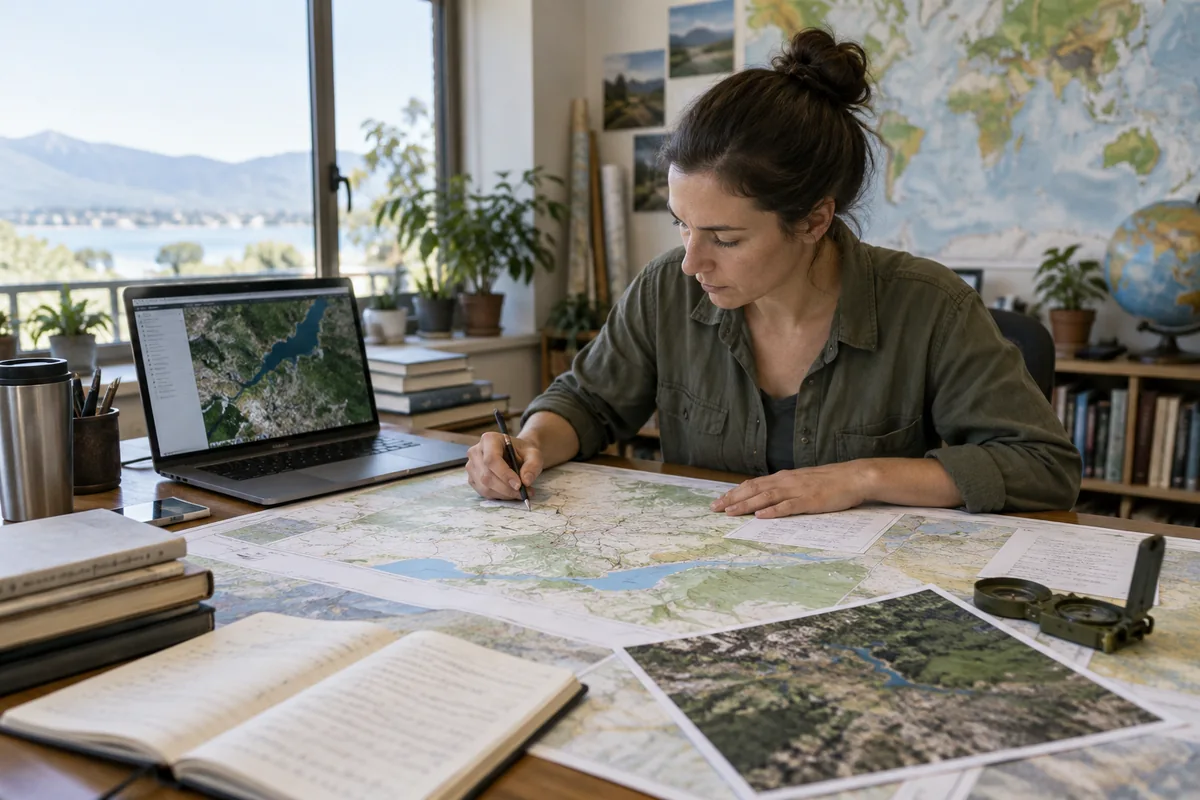
Geographer studying a map and satellite imagery at a desk.

A day in the life

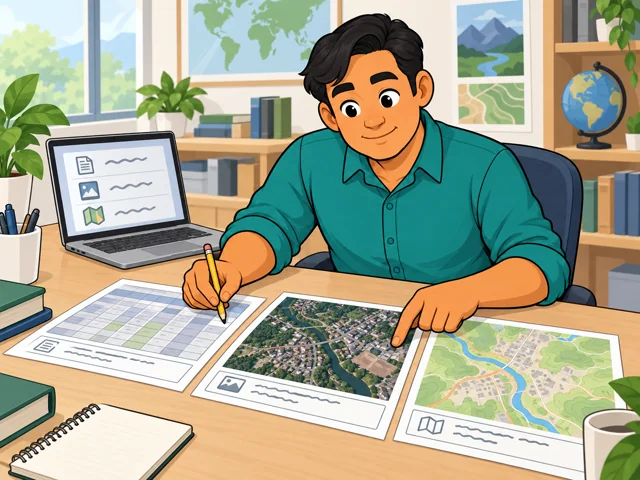
1A geographer compares metadata fields on a census table, aerial image, and map spread across a research table.

Gather census counts, imagery and maps

Confirm when each one was made before you treat them as showing one place at one moment.
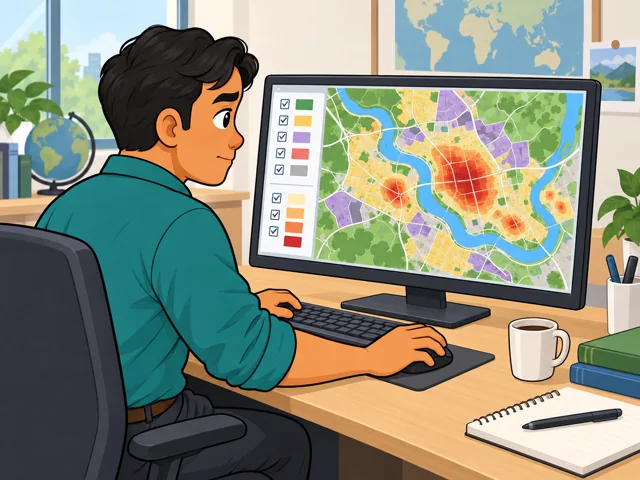
2At a GIS workstation, the geographer examines overlapping population and land-use layers on a map.

Spot patterns where layers overlap

In a geographic information system (GIS), stack population data on land-use data and study where the two overlap.

3The geographer takes notes while two adult women describe how they use a neighborhood square, one gesturing toward its pedestrian path.

Interview people who live there

For human geography projects, you interview locals to understand lived experience that a map alone cannot explain.
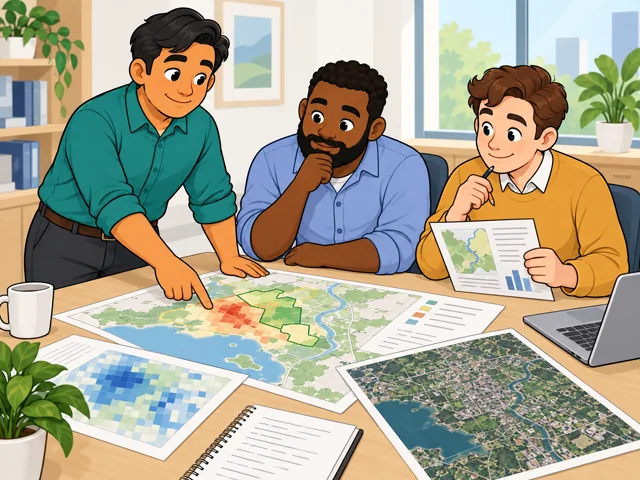
4The geographer explains a mapped overlap to two male colleagues as they review his report and the supporting geographic sources.

Share the map and report

Make a map and written report that show coworkers the pattern, your interpretation and the evidence.

Quick facts

Preparation

Bachelor’s degree

United States

Pay

$102,040/year

United States · May 2025

Outlook

2.1% decline

United States · 2025–2035

Quick orientation

Preparation, pay & outlook

Preparation

Bachelor’s degree

Typical entry education; some positions require graduate study.

Geography
United States
Period
Not applicable

Pay

$102,040/year

National median for geographers, equivalent to $49.06/hour.

Geography
United States
Period
May 2025

Outlook

2.1% decline

Employment is projected to shrink, with about 100 openings annually.

Geography
United States
Period
2025–2035

Fit, tradeoffs & changing tools

Things to weigh

  • Expect substantial computer and sitting time, including checking data before you can analyze it.
  • Fieldwork roles can involve travel to remote locations.

Where AI may help

In land-change research, software can learn from labeled examples to classify satellite images and flag changes across large areas.

What people still lead

Researchers test those results against reference data and revise methods when they miss gradual changes or perform unevenly across places.

What we can’t predict yet

How much image checking can become automatic depends on whether methods handle different landscapes and uneven observations reliably.

Pay in context

Earnings

These national figures describe employed geographers across experience levels, not a starting-salary promise.

Median and national spread

The median was $102,040 a year, or $49.06 an hour. The 10th-to-90th-percentile range was $66,770–$136,660 annually. Those endpoints describe the wage distribution, not entry and senior salaries.

Geography
United States
Period
May 2025
Pay basis
Annual and hourly wages for wage and salary geographers, SOC 19-3092

Employer setting matters

Federal-government geographers had a $110,010 median; state-government geographers had a $75,590 median. These compare different groups of workers, not identical jobs.

Geography
United States
Period
May 2025
Pay basis
Annual industry medians; federal excludes postal service, state excludes education and hospitals

Openings despite a decline

Employment is projected to fall 2.1% from 2025 to 2035, while about 100 openings are projected each year on average.

Geography
United States
Period
2025–2035
Pay basis
Employment projection and annual average openings for geographers, SOC 19-3092; not compensation

Getting started

Study geography

What the route involves
Earn a bachelor’s degree with geography, statistics, GIS, and satellite-image analysis coursework.
What it can lead to
You may qualify for entry-level geographer positions, including federal jobs.

Combine coursework with experience

What the route involves
For the federal route, complete coursework equivalent to a geography major, or a related major including at least 24 semester hours in geography or related fields, plus appropriate experience or additional education.
What it can lead to
This can meet the basic requirements for federal Geography Series 0150 without using the degree route.
What to check
These are federal basic requirements. You must also meet the position’s grade-specific qualifications.

A bachelor’s degree is the usual starting point. Some research jobs require a master’s or doctoral degree.

After entry

Career paths

This starts where the entry routes leave off: early work, growing capability, and advancement or specialization.

  1. Get established

    Learn your team’s geographic database and quality checks. Make sure another person can trace an update to its source.

  2. Build repeatable methods

    Develop programs that check geographic rules or create maps, then assess the quality of their output.

  3. Develop a specialty

    Specialize in questions such as how floods or fires change landscapes. Move toward designing studies that connect observed changes with their causes.

Where you can work

Census geography teams

Work alongside cartographers, statisticians, and technology specialists on national geographic records. Accuracy includes keeping address and boundary updates consistent with information from local partners.

  • Office

Land-change research centers

Compare satellite images across time and test mapping methods. Projects investigate environmental change, so explaining why vegetation or water changed matters alongside producing the map.

  • Office

Try it

See whether the job clicks before you commit to the path.

Compare two dated aerial or satellite images of a familiar area. Mark one visible change, propose two possible explanations, and name the evidence you would need to choose between them. Notice whether investigating the cause interests you as much as spotting the change.

Explore more careers

Sources

  1. O*NET OnLine. Geographers — 19-3092.00. Accessed 2026-10-10.
  2. U.S. Bureau of Labor Statistics. Geographers — Occupational Outlook Handbook. Accessed 2026-10-10.
  3. U.S. Bureau of Labor Statistics. May 2025 national Occupational Employment and Wage Statistics — pinned facts binding. Accessed 2026-09-29.
  4. U.S. Bureau of Labor Statistics. Employment Projections Table 1.2, 2025–2035 — pinned facts binding. Accessed 2026-09-29.
  5. U.S. Office of Personnel Management. Geography Series 0150. Accessed 2026-10-10.
  6. U.S. Census Bureau. About the Geography Program. Accessed 2026-10-10.
  7. U.S. Geological Survey. Patterns in the Landscape — Analyses of Cause and Effect. Accessed 2026-10-10.
  8. U.S. Geological Survey. Lessons learned implementing an operational continuous United States national land change monitoring capability. Accessed 2026-10-10.

Your message goes to the Great Jobs team. How we use your information