
Career profile

Healthcare Social Worker

Healthcare social workers help patients and families with practical, social and emotional fallout of illness.

One shift can move from a patient's bedside to a care-team meeting, then to a housing search and a carefully written follow-up note.

A hospital social worker reviews discharge planning materials at a desk.
Photo by Deidre Smith, Naval Hospital Jacksonville, U.S. Navy. Public domain U.S. federal government work; DVIDS attribution and applicable DoD image restrictions remain.

A day in the life

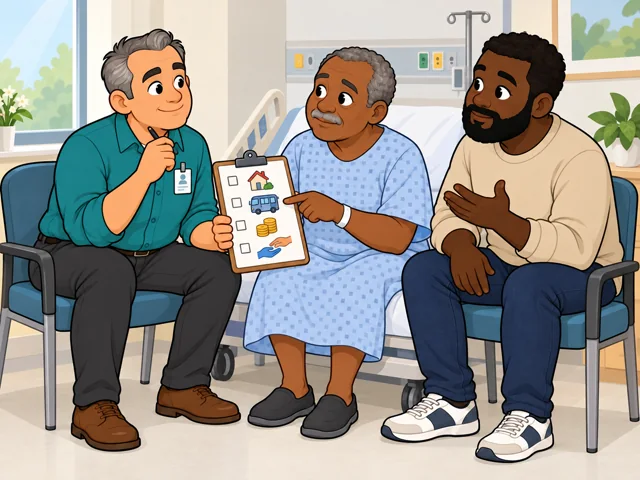
1A healthcare social worker interviews an older patient and his caregiver about transportation, home support, and other barriers to care.

Find what stands in their way

Ask patients or relatives about health, home, transport, money, caregivers and the local help they already have.

2A healthcare social worker coordinates discharge needs with two care-team coworkers around a shared planning sheet.

Plan a safe discharge or transfer

Settle with clinicians and other staff what must be ready when a patient leaves or changes care settings.

3A healthcare social worker compares service options and contacts a provider while preparing a referral.

Link people to services they need

Check what exists, then refer people to home care, benefits, housing, legal aid, support groups or community services.

4A healthcare social worker helps an older patient and his caregiver discuss recovery choices and concerns in a private room.

Talk through options and fears

Help patients and caregivers understand their options, cope with illness and voice worries about recovering or dying.

5A healthcare social worker follows up by phone and updates the care plan to track whether arranged services helped.

Track progress against the plan

Record the plan, track progress against its goals and check whether referrals and other supports actually worked.

Quick facts

Preparation

Master’s degree

United States · 2025 National Employment Matrix

Pay

$67,880 median

United States · May 2025

Outlook

8% growth

United States · 2025–2035

Quick orientation

Preparation, pay & outlook

Preparation

Master’s degree

BLS lists a master’s degree as the typical entry education for this occupation. Some nonclinical roles accept a BSW; clinical authority requires additional state-specific steps.

Geography
United States
Period
2025 National Employment Matrix

Pay

$67,880 median

National median annual wage for healthcare social workers; this is not a starting salary.

Geography
United States
Period
May 2025

Outlook

8% growth

Projected employment change for healthcare social workers, from 194,800 jobs in 2025 to 211,300 in 2035.

Geography
United States
Period
2025–2035

Fit, tradeoffs & changing tools

Things to weigh

  • Time pressure, conflict, and exposure to illness can be part of the work, especially in patient-facing settings.
  • Large caseloads and understaffing can be stressful; some jobs also include evenings, weekends, holidays, or on-call coverage.
  • You may work with crisis, serious illness, loss, or frustrated families while still completing detailed records and follow-up.

Where AI may help

Medical-record, database, scheduling, office, and video-meeting tools can organize information, reminders, referrals, and team communication.

What people still lead

People still lead sensitive interviews, counseling, crisis response, advocacy, and judgments about how health and life circumstances interact.

What we can’t predict yet

In clinical social work, AI is already being used for documentation and treatment-planning support, but guidance and state rules are still developing. Privacy, consent, accuracy, bias, and oversight remain practical limits.

Pay in context

Earnings

Use the national figure as a reference point, then check the setting and location where you may work.

National median

Healthcare social workers had a median annual wage of $67,880. Half earned more and half earned less; the figure is not an entry-level rate. The median hourly wage was $32.63.

Geography
United States
Period
May 2025
Pay basis
OEWS annual wage; median, not starting pay

The national spread

In May 2025, the 10th-percentile annual wage was $46,220 and the 90th-percentile wage was $100,360. These are wage percentiles, not starting and senior salaries.

Geography
United States
Period
May 2025
Pay basis
National annual wage percentiles

Current outlook

BLS projects 8% employment growth, from 194,800 jobs in 2025 to 211,300 in 2035. A national projection does not guarantee a local opening.

Geography
United States
Period
2025–2035
Pay basis
BLS employment projection; not compensation

Why offers differ

Experience, responsibility, performance, tenure, and geographic area can affect earnings. Compare the salary, schedule, benefits, and credential requirements together.

Geography
United States
Period
BLS methodology current in 2026
Pay basis
Interpretation of national OEWS wage estimates

Getting started

Accredited BSW route

A bachelor’s program plus supervised field education.
What the route involves
Complete a CSWE-accredited BSW and its supervised field education; accredited baccalaureate programs require at least 400 field hours.
What it can lead to
Preparation for entry-level nonclinical social-work positions and, if you later continue, possible eligibility for an advanced-standing MSW.
What to check
This route does not establish eligibility for every healthcare job. Employers and states may require an MSW, license, or other credential.

Accredited MSW route

Standard MSW programs generally take about two years; advanced-standing rules differ.
What the route involves
Enter an accredited MSW after a bachelor’s degree, complete graduate coursework, and finish supervised field education.
What it can lead to
Master’s-level preparation for specialized healthcare roles and the education required to begin a clinical-licensure path.
What to check
An MSW alone does not authorize independent clinical practice; licensing requirements are set by each state.

Post-MSW supervised clinical route

What the route involves
After the MSW, complete the supervised practice your state requires and follow its application and examination process.
What it can lead to
Eligibility to seek a clinical license and, where the state authorizes it, independent clinical practice.
What to check
License names, supervision hours, exams, fees, title protection, and scope of practice vary by state.

The main fork is between nonclinical work and a longer clinical path. Check both employer requirements and your state board before choosing a program.

After entry

Career paths

This starts where the entry routes leave off: early work, growing capability, and advancement or specialization. This path also has a credential or licensing boundary; see the requirements and limits.

  1. Get established

    Build reliable routines for interviewing, documenting, making referrals, coordinating care, and following up within your employer’s workflow.

  2. Develop capability

    Handle more complicated barriers and transitions while learning the healthcare system, local resource network, and care-team communication.

  3. Advance or specialize

    Build expertise in medical, geriatric, hospice, or palliative work, or move toward supervising services and improving programs.

Where you can work

Hospitals and inpatient care

Discharge deadlines and changing medical conditions can make the pace quick. Expect close coordination with patients, families, and a larger care team.

  • Indoors
  • Office
  • Shift work
  • On call
  • Safety-sensitive

Outpatient and ambulatory care

Contact may be brief and episodic—through a walk-in clinic or phone call—or continue through a specialty clinic. The mix depends on the employer.

  • Indoors
  • Office

Home, hospice, and community care

The work may involve home visits, caregiver guidance, serious-illness conversations, and coordination across several community services.

  • Field work
  • Office
  • Travel

Try the coordination

Build a fictional discharge plan

Invent a patient who needs transportation, affordable medication, follow-up care, and caregiver support. Use public local-resource pages to draft five questions you would ask, three referrals you would investigate, and a two-minute explanation of the plan. Notice whether you enjoy sorting incomplete information while keeping the person’s priorities visible.

Stay safe: Use a fictional case and public information only; do not seek or share anyone’s private health information.

Explore more careers

Sources

  1. O*NET OnLine. 21-1022.00 — Healthcare Social Workers. Accessed 2026-09-21.
  2. U.S. Bureau of Labor Statistics. Occupational Outlook Handbook: Social Workers. Accessed 2026-09-21.
  3. U.S. Bureau of Labor Statistics. Occupational Projections and Worker Characteristics, 2025–35. Accessed 2026-09-21.
  4. Council on Social Work Education. Accreditation FAQs. Accessed 2026-09-21.
  5. Association of Social Work Boards. Becoming a Licensed Social Worker. Accessed 2026-09-21.
  6. National Association of Social Workers. Artificial Intelligence: Resources and Information for Clinical Social Workers. Accessed 2026-09-21.
  7. U.S. Department of Veterans Affairs, Minneapolis VA Health Care. 100 Years of VA Social Work. Accessed 2026-09-21.
  8. Defense Visual Information Distribution Service. Social Work [Image 2 of 2]. Accessed 2026-09-21.

Your message goes to the Great Jobs team. How we use your information