
Career profile

Installation and Maintenance Helper

Repair helpers assist repair workers taking machines apart, replacing parts and putting them back together.

Keeping tools and supplies ready for repair workers means you watch their work up close and learn it while you help.

A repair worker adjusts a carousel horse in a workshop.
Wilson Hui / CC BY 2.0

A day in the life

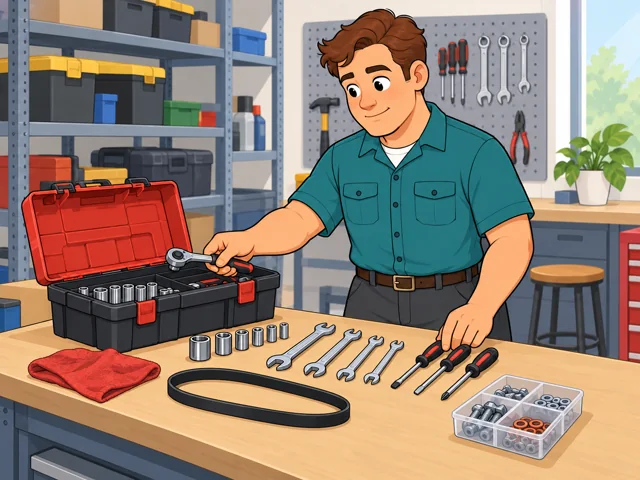
1The helper arranges wrenches, screwdrivers, sockets, and a replacement belt on a workshop bench.

Gather tools and supplies

Gather the tools and supplies the repair worker will need before the job begins.
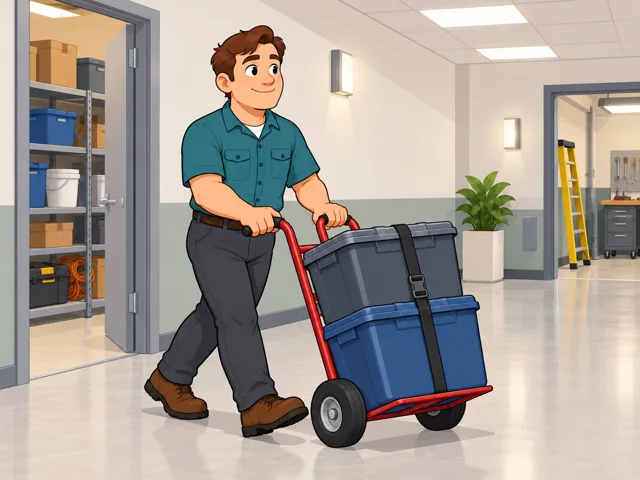
2The helper pushes secured supply bins on a hand truck from storage along a clear service corridor.

Wheel supplies to the repair

Load a hand truck or dolly with supplies from storage and wheel it to the repair.
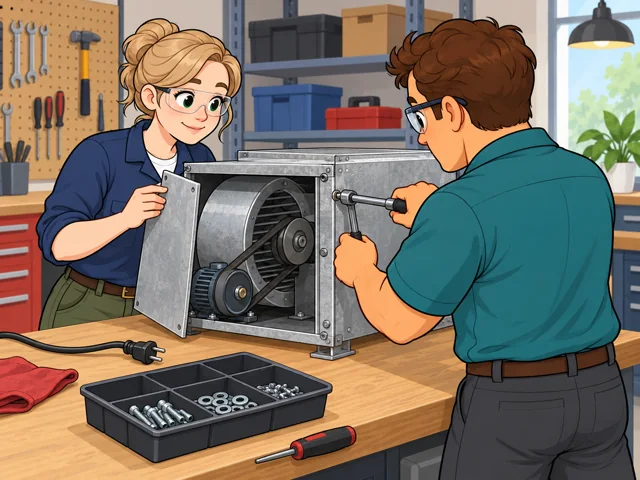
3The helper removes a casing fastener from a disconnected ventilation unit while a woman repair worker steadies the cover; removed bolts and washers sit in a divided tray.

Take a unit apart

Alongside the repair worker, pull parts off a unit and sort the fasteners for reassembly.

4The helper sweeps debris into a dustpan while a male coworker wipes a wrench beside the reassembled equipment.

Clean up after the repair

Once the repair is done, clean the tools and clear the work area so another job can start.

Quick facts

Preparation

High school + workplace training

United States · 2025

Pay

$19.05/hour

United States · 2025

Outlook

5.3% projected growth

United States · 2025–2035

Quick orientation

Preparation, pay & outlook

Preparation

High school + workplace training

Typical preparation is a high school diploma or equivalent followed by short-term on-the-job training. Individual employers set their requirements.

Geography
United States
Period
2025

Pay

$19.05/hour

The 2025 national median was $39,630 a year.

Geography
United States
Period
2025

Outlook

5.3% projected growth

About 13,600 openings per year are projected nationally for 2025–35.

Geography
United States
Period
2025–2035

Fit, tradeoffs & changing tools

Things to weigh

  • Standing, bending, noise, and hot or cold work areas can wear you down.
  • In public facilities, emergencies such as flooding can interrupt routine work and bring hours outside the normal schedule.

Where AI may help

In some jobs, software records equipment readings or helps control building systems.

What people still lead

You still handle parts, position tools, and coordinate movements with the repair worker.

What we can’t predict yet

How much checking shifts to software will depend on the equipment; older and newer systems may need different amounts of hands-on attention.

Pay in context

Earnings

When comparing offers, ask about the starting rate, expected hours, benefits, and requirements for the next pay level.

The national midpoint

Median pay was $39,630 annually, or $19.05 hourly, in 2025. Half of workers earned more and half earned less; this is not a starting-pay promise.

Geography
United States
Period
2025
Pay basis
National median employee wages for occupation 49-9098; annual and hourly values reported separately.

The pay spread

In 2025, the lowest-paid 10% earned $14.09 an hour or less, while the highest-paid 10% earned $26.87 or more. The annual thresholds were $29,310 and $55,890. These describe the wage spread, not steps on a career ladder.

Geography
United States
Period
2025
Pay basis
National 10th- and 90th-percentile employee wages for occupation 49-9098; annual and hourly estimates reported separately.

Pay across workplaces

For historical context, May 2023 average hourly pay was $16.49 in automotive repair and maintenance, $18.57 at building equipment contractors, and $23.71 in local government excluding schools and hospitals. These are national averages for helpers, not current offers.

Geography
United States
Period
May 2023
Pay basis
Industry-specific hourly mean employee wages for occupation 49-9098; excludes self-employed workers.

Openings beyond new jobs

Employment is projected to grow 5.3% from 2025 to 2035, with about 13,600 openings annually. Openings include replacing workers who leave the occupation, so they outnumber newly created jobs.

Geography
United States
Period
2025–2035
Pay basis
Employment projection, not compensation.

Getting started

Enter a beginner helper job

What the route involves
Join a facilities crew and learn routine upkeep, moving supplies, and minor repairs.
What it can lead to
Some public helper classifications accept applicants without previous formal training or experience.
What to check
Check the actual position’s age and driving requirements before applying.

Bring existing tool experience

What the route involves
Apply existing trade or materials-handling skills to a maintenance crew’s work.
What it can lead to
You can pursue helper positions that expect practical experience at entry.
What to check
Federal positions can also require driving and forklift licenses, citizenship eligibility, and background and drug screening.

You work with experienced repair workers who direct and check your work. Some helper jobs teach beginners; others expect useful skills before hiring.

After entry

Career paths

This starts where the entry routes leave off: early work, growing capability, and advancement or specialization.

  1. Become dependable

    Learn the shop’s tools and routines. Practice completing minor tasks accurately and explaining what you found.

  2. Take on harder tasks

    Build trade skills and learn to read equipment drawings as your tasks become more demanding.

  3. Move toward maintenance worker

    A possible next role is general maintenance and repair worker. Build the skills to handle a wider range of repairs; the move depends on your abilities and available positions.

Where you can work

Public buildings and facilities

Routine upkeep can share the day with moving furniture, window repairs, or cleanup after a leak. Emergencies may change both the task and your hours.

  • Indoors
  • Outdoors
  • Physical demands

Large institutional project crews

You move materials between storage and worksites while learning from several trades. Projects may run on day or night shifts.

  • Indoors
  • Shift work
  • Physical demands
  • Safety-sensitive

Try it

See whether the job clicks before you commit to the path.

Choose instructions for a small, unpowered assembly, such as a shelf. Without assembling it, sort its hardware, identify the tools, and lay out what another person would need first. Notice whether you enjoy making someone else’s work easier and keeping track of small parts.

Stay safe: Use loose parts and instructions only; do not dismantle appliances or powered equipment.

Explore more careers

Sources

  1. O*NET OnLine. 49-9098.00 — Helpers--Installation, Maintenance, and Repair Workers. Accessed 2026-10-03.
  2. U.S. Bureau of Labor Statistics. Occupational projections and worker characteristics, 2025–35. Accessed 2026-10-03.
  3. Rockland County. Maintenance Helper — class specification. Accessed 2026-10-03.
  4. Architect of the Capitol. Maintenance Helper — announcement CEB-2026-399. Accessed 2026-10-03.
  5. U.S. Bureau of Labor Statistics. General Maintenance and Repair Workers — How to Become One. Accessed 2026-10-03.
  6. U.S. Bureau of Labor Statistics. Occupational Employment and Wage Statistics Tables. Accessed 2026-10-03.
  7. O*NET OnLine. California Wages: 49-9098.00 — United States comparison tables, 2025. Accessed 2026-10-03.
  8. U.S. Bureau of Labor Statistics. Occupational Employment and Wages, May 2023 — 49-9098 Helpers--Installation, Maintenance, and Repair Workers. Accessed 2026-10-03.

Your message goes to the Great Jobs team. How we use your information