
Haul pipe and couplings over
Gather pipe in the needed sizes, couplings and tools, and haul them where the crew is working.
Career profile
Plumber and pipefitter helpers prepare pipe, supply correct fittings, and help put piping systems together.
How does piping go together? You learn by hand, sometimes steadying pipe while a joint gets made, readying the next section, hauling, and cleaning up.
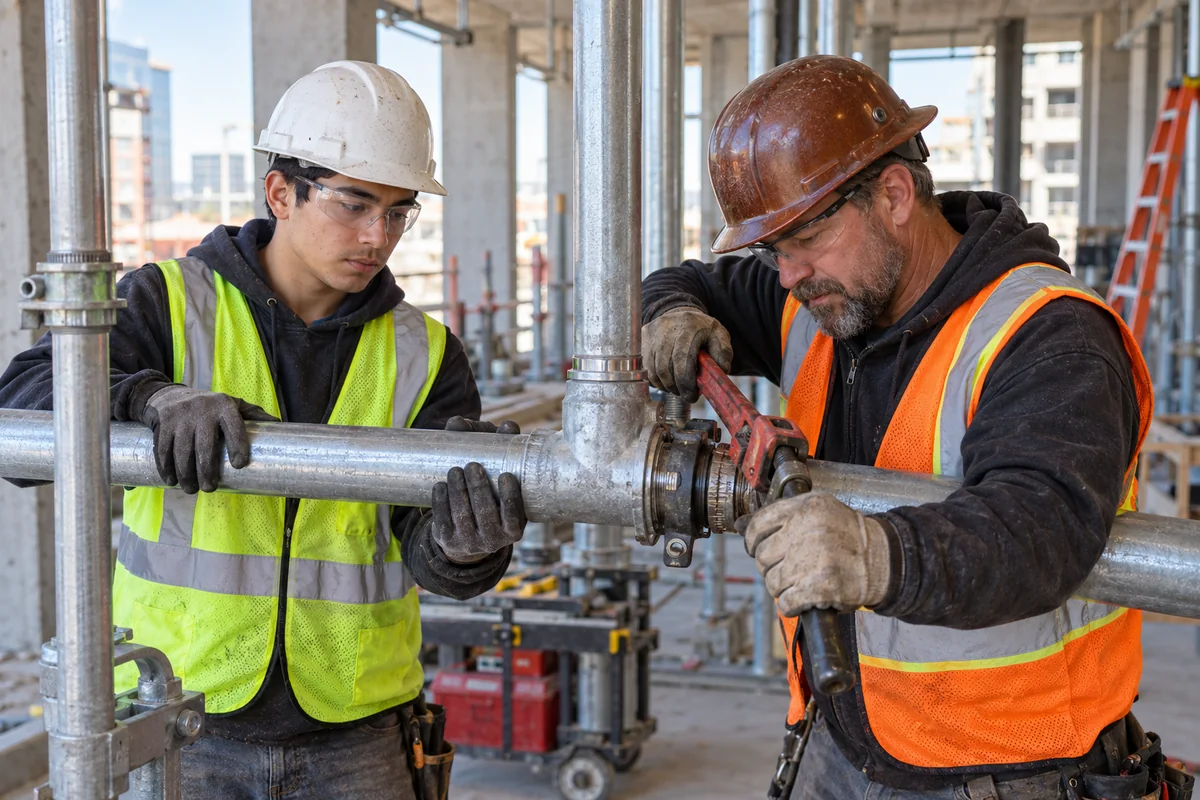
Gather pipe in the needed sizes, couplings and tools, and haul them where the crew is working.
Measure and cut pipe to fit, then on some jobs run the end through the threading machine.
Hold the pipe in position while the fitter aligns it, and help fit the coupling that joins them.
Clear scrap, gather tools and clean equipment so the crew can move freely and start the next job.
United States · 2025 entry characteristics
Pay depends on the helper position and location. The earnings context below covers several kinds of pipe-trade helpers together.
Plumbing and pipefitting helpers do not have a separate national forecast.
Quick orientation
A high school diploma or equivalent is typical. Helpers learn through short-term training at work; employer requirements vary.
Pay depends on the helper position and location. The earnings context below covers several kinds of pipe-trade helpers together.
Plumbing and pipefitting helpers do not have a separate national forecast.
A spreadsheet can help keep a material list organized. That makes checking quantities easier before you move the pipe and fittings.
You still handle awkward pieces, coordinate movements with the fitter, and notice when something does not line up.
More pipe assemblies may arrive already made in a shop. How much that shifts a helper's day from cutting and assembly to moving and positioning pieces will depend on the project.
Pay in context
Use these national figures as context for the wider group of pipe-trade helpers. They are not a starting-pay quote for this particular role.
Helpers to pipelayers, plumbers, pipefitters, and steamfitters together had a May 2025 median of $42,360 a year, or $20.36 an hour. Half earned more and half earned less.
The lowest-paid 10% earned $33,590 a year or less; the highest-paid 10% earned $57,780 or more. These are wage percentiles, not beginner and experienced-worker pay steps.
The combined group is projected to grow 2.4% from 2025 to 2035, with about 4,400 openings a year on average. Openings include replacement needs, not just new jobs.
You can seek helper employment directly or build basic skills in a plumbing course first. Helper work begins with guidance from experienced tradespeople.
After entry
This starts where the entry routes leave off: early work, growing capability, and advancement or specialization.
Learn tool names, where materials belong, and the crew's safety routines. Get comfortable following a demonstration and asking about an unclear step.
Build accuracy in measuring, cutting, and helping assemble pipe. Learn to catch a wrong size or a poor fit before the crew moves on.
Some helpers enter a plumbing or pipefitting apprenticeship. These usually combine paid work and technical instruction over four or five years; later licensing requirements depend on the trade and location.
You help with repairs and installations at customers' homes. Keeping the work area orderly and speaking professionally with homeowners matter alongside the pipe work; some crews need evenings or weekends.
You work with fitters assembling piping around plant equipment such as pumps and tanks. The day centers on moving materials and helping position connections within a larger piping system.
Try it
Draw a simple pipe route with two turns. Make paper pieces for straight lengths and elbow fittings, then ask a friend to call for each piece while you sort and pass it over. Notice whether you enjoy matching parts accurately and keeping the next piece ready.
Stay safe: Keep this a tabletop model; do not disconnect or alter real plumbing.