
Career profile

Histotechnologist

Histotechnologists make fine tissue detail show clearly and find out why a slide went wrong.

Want precise lab work that puts biology in your hands? You prepare tissue for pathologists, troubleshoot machines and judge how well lab methods work.
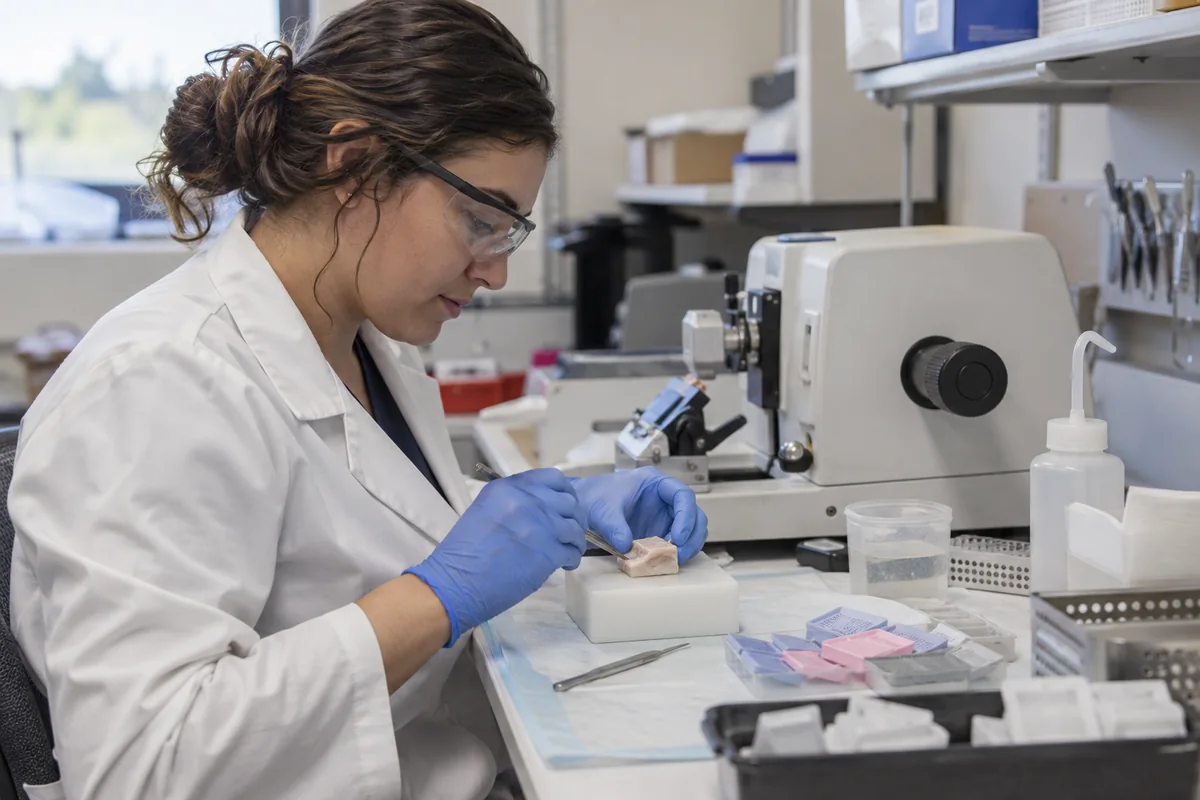
histotechnologist trimming a preserved tissue sample at a histology bench.

A day in the life

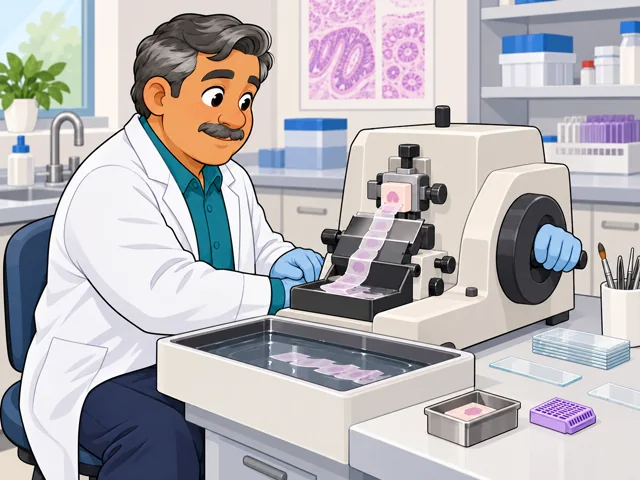
1A histotechnologist turns a microtome handwheel, cutting a delicate ribbon of thin sections from tissue embedded in wax.

Embed tissue, then slice it

You set tissue in a wax block first, then cut very thin slices for slides on a microtome.
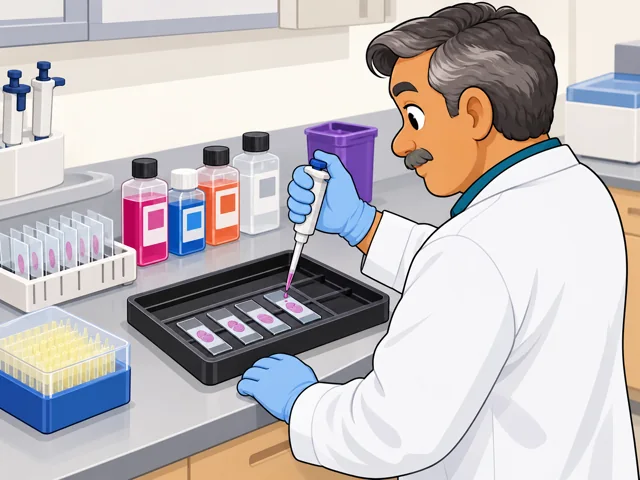
2A histotechnologist carefully applies staining reagent to a tissue section on a slide at a laboratory staining bench.

Stain slices to reveal structures

Apply stains so structures show up, and in specialist immunohistochemistry work, mark specific proteins with antibodies.
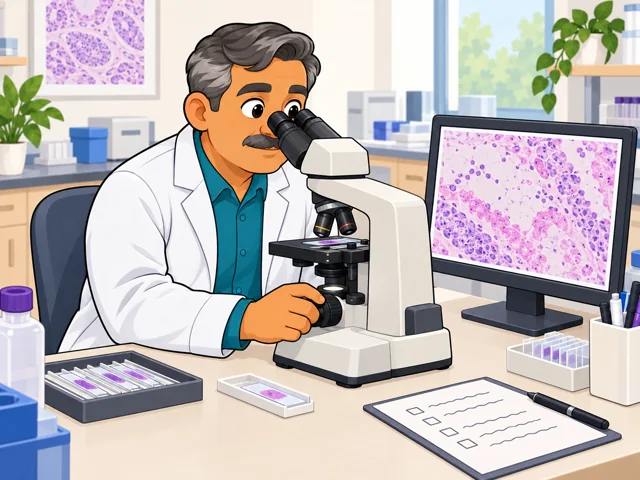
3A histotechnologist examines a poorly stained tissue slide through a microscope, with a control slide and preparation records ready for troubleshooting.

Trace a poor stain's cause

If staining looks off under the microscope, check slide prep, stain controls and equipment before anyone accepts results.
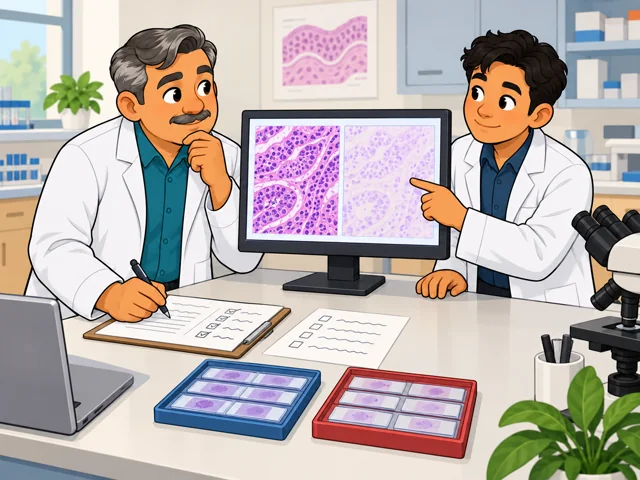
4A histotechnologist and a coworker compare tissue staining results on a screen while the histotechnologist records a problem with a trial method.

Help trial a new stain

In some positions, you help test a new staining method, measure it against lab needs and note problems.

Quick facts

Preparation

Bachelor's + histology preparation

United States · 2026

Pay

Not available

A national median is not reported for this title. Broader clinical laboratory pay appears below.

Outlook

Not available

National growth and openings are not reported separately for histotechnologists.

Quick orientation

Preparation, pay & outlook

Preparation

Bachelor's + histology preparation

The certification routes below pair a degree with accredited training or qualifying laboratory experience.

Geography
United States
Period
2026

Pay

Not available

A national median is not reported for this title. Broader clinical laboratory pay appears below.

Geography
United States
Period
May 2025

Outlook

Not available

National growth and openings are not reported separately for histotechnologists.

Geography
United States
Period
2025–2035

Fit, tradeoffs & changing tools

Things to weigh

  • Repeated hand movements and deadline pressure are part of the work; accuracy still matters when slides are piling up.
  • You handle human specimens and hazardous chemicals. Protective equipment and careful handling are everyday requirements.

Where AI may help

Automated instruments can run staining steps. In some labs, scanners turn glass slides into digital images for viewing and analysis.

What people still lead

You still maintain instruments, investigate failed runs and check whether a method produces usable results.

What we can’t predict yet

How much troubleshooting can become automated remains uncertain, especially when unfamiliar tissue or a new method behaves differently.

Pay in context

Earnings

Histotechnologist-specific national pay is not reported. The broader clinical laboratory workforce offers context, but its figures are not a salary estimate for this specialty.

A broader national benchmark

Clinical laboratory technologists and technicians had a median of $62,930 a year, or $30.26 an hour, in May 2025. The lowest 10% earned below $38,910 annually; the highest 10% earned above $100,990. These are wage percentiles, not starting and senior salaries.

Geography
United States
Period
May 2025
Pay basis
BLS occupational wages for clinical laboratory technologists and technicians, SOC 29-2010; annual median and reported hourly equivalent

Openings across the broader field

For clinical laboratory technologists and technicians overall, employment is projected to grow 3% from 2025 to 2035, with about 20,800 openings annually. Many replace people who leave the occupation. Histotechnologists' share is not reported.

Geography
United States
Period
2025–2035
Pay basis
Employment projections, not compensation

Read an offer beyond its headline rate

An employer may weigh your experience, skills and education when setting pay. Check whether a quoted range excludes overtime, shift differentials and benefits.

Geography
United States
Period
2026
Pay basis
Employer-specific base-pay terms; additional compensation varies

Getting started

Combine a degree with accredited histology training

What the route involves
Earn an accredited bachelor's degree with 30 semester hours across biology and chemistry, including both. Complete a Histotechnician or Histotechnologist program accredited by the National Accrediting Agency for Clinical Laboratory Sciences within the past five years.
What it can lead to
This meets the education and training requirements for HTL(ASCP) exam Route 1.

Build qualifying laboratory experience after college

What the route involves
Earn an accredited bachelor's in biological science or chemistry, or a bachelor's with 30 semester hours across both subjects. Add one year of full-time acceptable clinical histopathology experience within the past five years.
What it can lead to
Documented qualifying experience provides an HTL(ASCP) Route 2 option.
What to check
The laboratory must qualify, and experience must cover fixation, processing, embedding, sectioning, staining—including immunohistochemistry—and laboratory operations.

Two routes lead toward the American Society for Clinical Pathology (ASCP) Scientist in Histotechnology certification, HTL(ASCP). After meeting eligibility requirements, you must pass the exam.

After entry

Career paths

This starts where the entry routes leave off: early work, growing capability, and advancement or specialization. This path also has a credential or licensing boundary; see the requirements and limits.

  1. Get dependable at the bench

    Learn your lab's specimen records and workflow. Build consistency in embedding, cutting and staining before taking on unfamiliar preparations.

  2. Handle harder preparations

    Develop skill in specialized staining and tracing technical failures. Learn how to assess a method's performance, not just complete its steps.

  3. Become a senior technical resource

    A senior histotechnologist can help validate methods, tackle difficult troubleshooting and coach colleagues. This adds responsibility for how the laboratory's work holds up.

Where you can work

Large hospital pathology laboratories

You may work within a specialty team handling surgical specimens, frozen sections or specialized stains. High specimen volume shapes the pace; some positions include off-shifts, weekends or on-call work.

  • Indoors
  • Lab
  • Shift work
  • On call
  • Safety-sensitive

University research cores

You prepare tissue for investigators' experiments. A project may need sections cut to particular anatomy or different preparation methods; some cores also stain and scan slides. Discussing experimental goals helps determine the work.

  • Indoors
  • Lab

Try it

See whether the job clicks before you commit to the path.

Choose an openly available teaching image of a stained tissue slide. Make a blurred or low-contrast copy, then compare them: which details became harder to see? Write two questions you would ask about slide preparation. Notice whether checking image quality makes you curious about the process behind it.

Stay safe: Use teaching images only; this is a quality-observation exercise, not diagnosis or specimen handling.

Explore more careers

Sources

  1. O*NET OnLine. Histotechnologists — 29-2011.04. Accessed 2026-10-09.
  2. U.S. Bureau of Labor Statistics. Clinical Laboratory Technologists and Technicians. Accessed 2026-10-09.
  3. American Society for Clinical Pathology Board of Certification. Scientist in Histotechnology — HTL. Accessed 2026-10-09.
  4. American Society for Clinical Pathology Board of Certification. State Licensure. Accessed 2026-10-09.
  5. Mayo Clinic. Histology Technician or Histotechnologist — Anatomic Pathology, job 384718. Accessed 2026-10-09.
  6. Cleveland Clinic. Histotechnologist — Immunohistochemistry, requisition 348646. Accessed 2026-10-09.
  7. VCU Health. Histotechnologist Senior — Anatomic Pathology Core Lab, R46851. Accessed 2026-10-09.
  8. University of Arizona Department of Pathology. Clinical Pathology Core Laboratory. Accessed 2026-10-09.
  9. UT Southwestern Medical Center. Histo Pathology Core — Routine Histology. Accessed 2026-10-09.

Your message goes to the Great Jobs team. How we use your information