
Career profile

HVAC/R Technician

Heating and cooling mechanics install, check, and fix systems that heat, cool, ventilate, and refrigerate.

When someone reports warm air, that's only a first clue: you follow wiring, pressures, airflow, controls, and moving parts until the whole system makes sense.
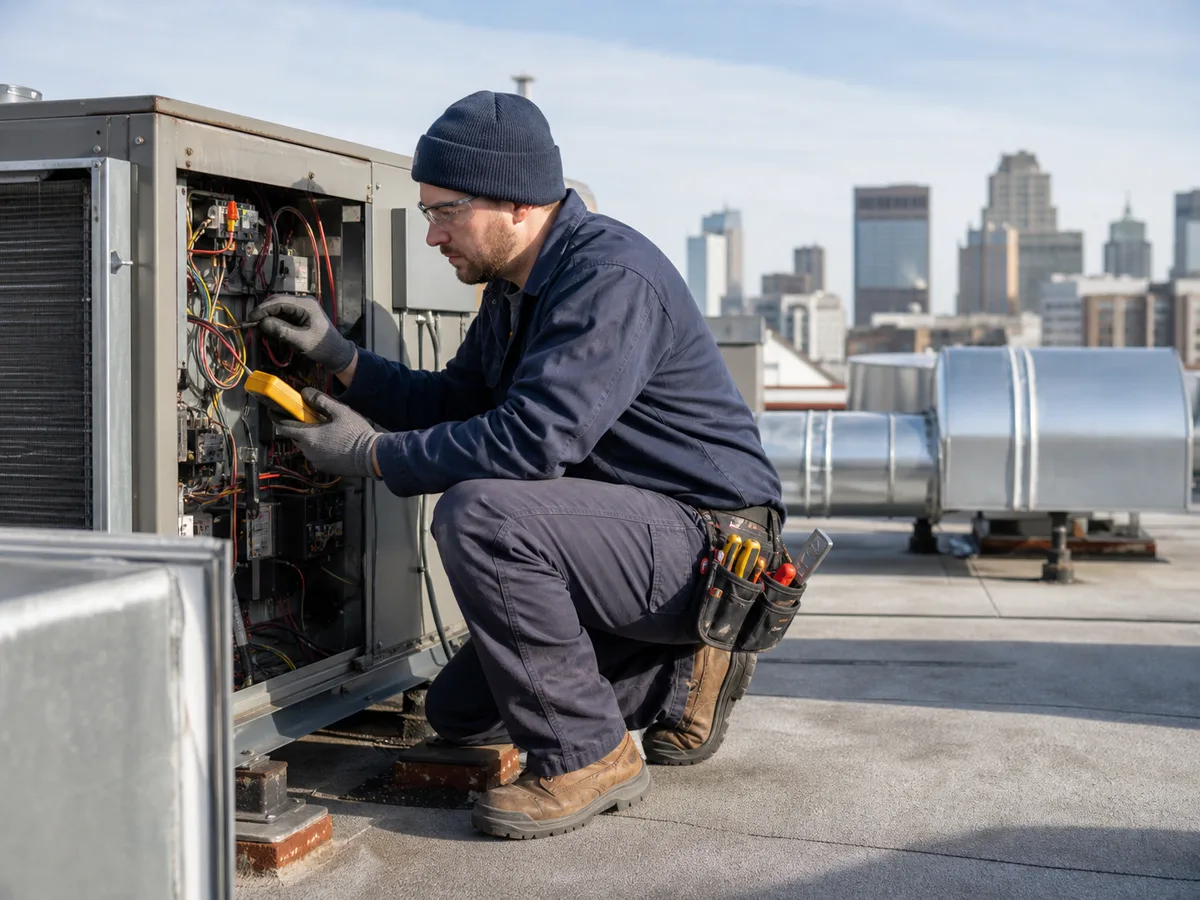
An HVAC technician tests controls inside rooftop equipment.

A day in the life

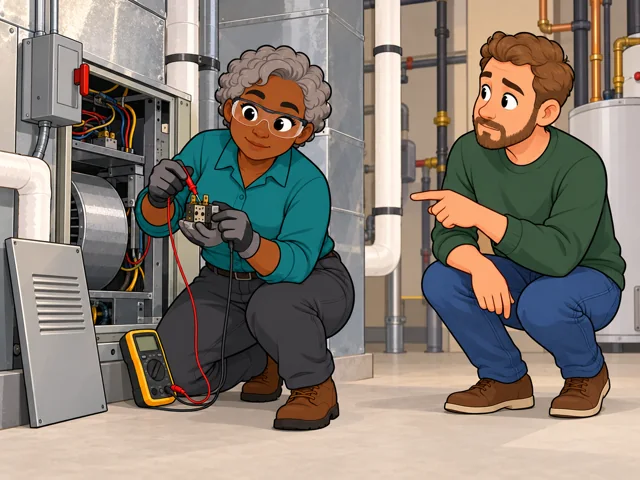
1An experienced technician tests an isolated air-handler component while a building user points out where he noticed the problem.

Narrow down the cause

Ask what the customer noticed, inspect the system, read gauges and displays, and test electrical and mechanical parts.
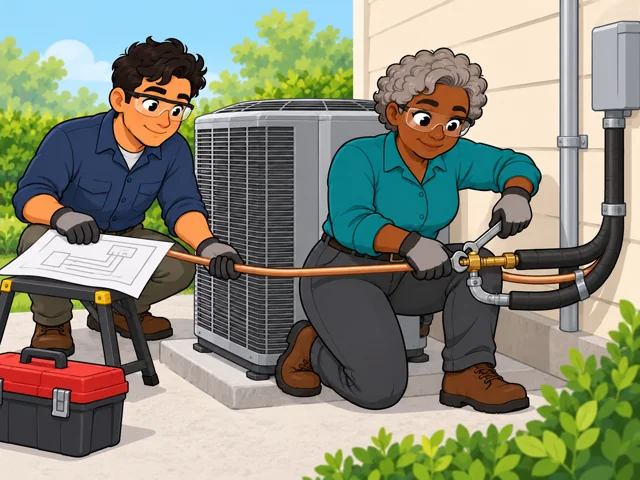
2The technician fits copper tubing to a new outdoor condenser while a coworker supports the tubing and checks its planned route.

Install a system to plan

Place units, wire controls, fit pipe or tubing, then check the setup against the plans and manufacturer's settings.
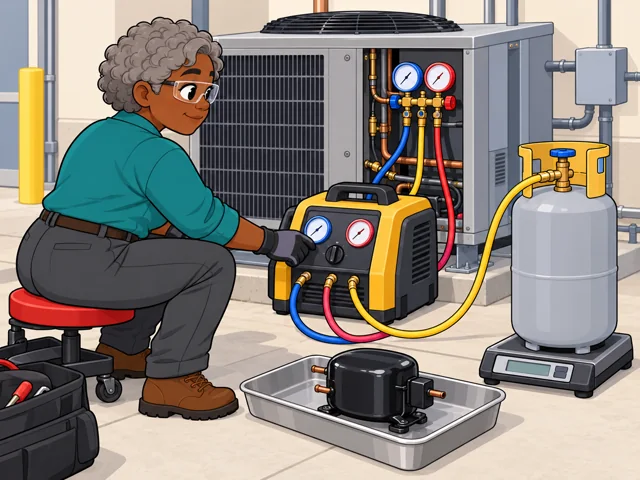
3The technician monitors refrigerant recovery into a cylinder on a scale before replacing a failed refrigeration component.

Find leaks, replace failed parts

Replace bad parts or wiring, and recover refrigerant properly when federal rules cover the equipment and job.
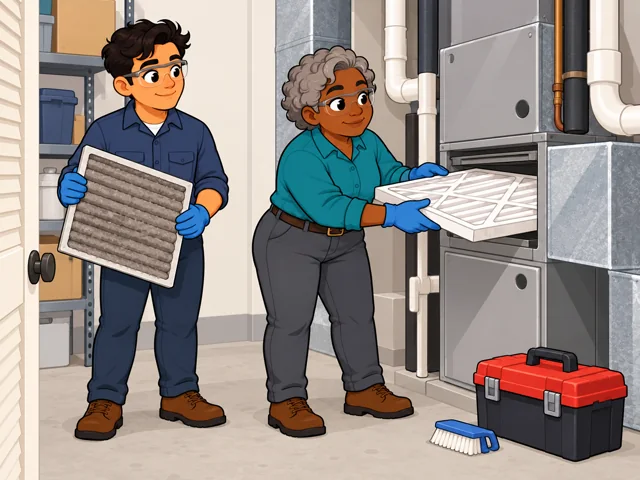
4The technician installs a clean air filter while a coworker holds the dusty filter removed during preventive maintenance.

Tune up a working unit

Clean the unit, change filters, check levels and connections, tune controls, and confirm everything runs as it should.
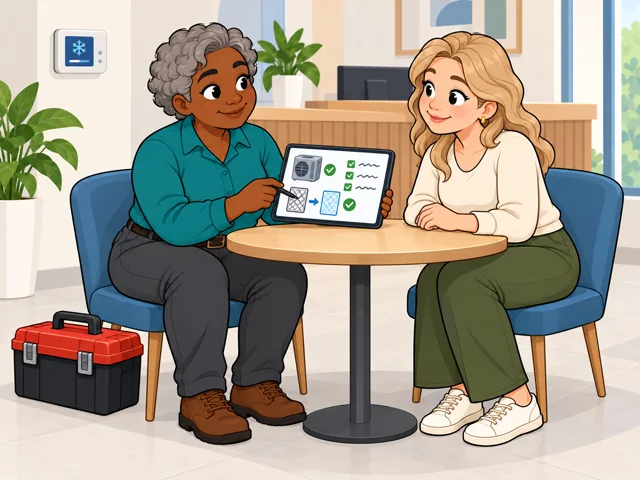
5The technician reviews a wordless service record with a customer and explains the completed repair and upcoming maintenance.

Log the work and explain it

Note the faults, parts, hours, and fixes, then explain what you changed and what upkeep may come later.

Quick facts

Preparation

Postsecondary nondegree award

United States

Pay

$61,010 a year

United States · May 2025

Outlook

11% projected growth

United States · 2025–2035

Quick orientation

Preparation, pay & outlook

Preparation

Postsecondary nondegree award

This is the typical entry-level education, though some employers consider high-school graduates. Long-term training on the job is also typical.

Geography
United States
Period
Not applicable

Pay

$61,010 a year

National median wage for heating, air-conditioning, and refrigeration mechanics and installers; this is a midpoint, not a starting salary.

Geography
United States
Period
May 2025

Outlook

11% projected growth

BLS projects 2025–2035 employment growth of 11%, with about 40,600 openings per year on average, including replacement needs.

Geography
United States
Period
2025–2035

Fit, tradeoffs & changing tools

Things to weigh

  • Equipment may be in cramped, awkward, very hot, very cold, or outdoor locations.
  • The work can involve heavy components and hazards from electricity, chemicals, pressurized systems, and hot surfaces; protective equipment and careful procedures matter.
  • Evening, weekend, emergency, overtime, or on-call work may appear, especially during peak heating and cooling seasons.

Where AI may help

Building-automation, data-logging, maintenance-management, and work-order software can organize alarms, readings, service histories, and records.

What people still lead

A technician still has to inspect the actual site, choose useful tests, handle components safely, judge the cause, and verify that the repair worked.

What we can’t predict yet

How widely these tools will spread—and what they will mean for staffing, beginner tasks, or pay—is uncertain.

Pay in context

Earnings

Use the national median as orientation, then check local employee wages and the exact schedule attached to a job.

The national midpoint

The May 2025 median was $61,010 a year, or $29.33 an hour. Half of workers in the occupation earned more and half earned less; this is not an entry-level figure.

Geography
United States
Period
May 2025
Pay basis
National occupational median wage from BLS OEWS; annual and hourly wage measures

The national spread

In May 2025, the 10th-percentile annual wage was $40,050 and the 90th-percentile wage was $95,210. These are wage percentiles, not starting and senior salaries.

Geography
United States
Period
May 2025
Pay basis
National annual wage percentiles

Why your number may differ

BLS notes that earnings vary with experience, responsibility, performance, tenure, and geographic area. Those factors do not form a guaranteed pay ladder.

Geography
United States
Period
May 2025 wage context
Pay basis
Factors affecting employee wages; not a career-stage progression

Getting started

Technical school or community college

Programs generally last 6 months to 2 years.
What the route involves
Complete an HVAC/R certificate or associate-degree program covering the trade's technical foundation.
What it can lead to
Build the classroom and lab preparation commonly used for entry, then continue developing through employer training.
What to check
A program does not replace every applicable refrigerant certification or state or local license.

Supervised hire after high school

What the route involves
Join an employer willing to consider a high-school graduate and begin beside experienced technicians on basic work such as cleaning furnaces or insulating lines.
What it can lead to
Enter the occupation's lengthy on-the-job learning period and earn access to harder assignments as your competence grows.
What to check
This option depends on the employer and is supervised entry, not immediate independent practice.

HVAC/R apprenticeship

Usually several years.Paid
What the route involves
Combine paid work under supervision with technical instruction in areas such as safety, blueprint reading, tools, and heating and cooling systems.
What it can lead to
Progress through structured work experience while building a broader set of installation and service skills.
What to check
For covered refrigerant work, an apprentice may work without Section 608 certification only while closely and continually supervised by a certified technician.

Entry can begin in a classroom, in supervised employment, or through an apprenticeship. Every route still involves learning on real equipment.

After entry

Career paths

This starts where the entry routes leave off: early work, growing capability, and advancement or specialization. This path also has a credential or licensing boundary; see the requirements and limits.

  1. Get established

    Start with basic work beside experienced technicians. For covered refrigerant work, pass the appropriate EPA-approved Section 608 test unless you are an apprentice working under the close and continual supervision of a certified technician.

  2. Develop capability

    Take on electrical checks, pipe work, component replacement, control adjustments, and diagnoses that require several clues instead of one obvious fault.

  3. Advance or specialize

    Build depth in service, installation, computerized controls, testing and balancing, radiant heating, or commercial refrigeration.

    • With sufficient experience, another direction is instructing assistants or coordinating work rather than concentrating on one equipment specialty.

Where you can work

Service calls in homes and businesses

Travel among customer sites, diagnose systems where they are installed, and work indoors, outdoors, or in uncomfortable spaces when heating or cooling is down.

  • Indoors
  • Outdoors
  • Field work
  • Vehicle
  • Travel
  • On call
  • Physical demands
  • Safety-sensitive

Schools, hospitals, and other facilities

Work may center on one building or campus, with recurring maintenance and repairs across its heating, cooling, ventilation, and control equipment.

  • Indoors
  • Outdoors
  • Field work
  • Physical demands
  • Safety-sensitive

Commercial refrigeration sites

Grocery stores, hotels, restaurants, and similar businesses are common sites; these roles may focus more on refrigeration equipment than on comfort heating and cooling.

  • Indoors
  • Field work
  • Physical demands
  • Safety-sensitive

Try it

See whether the job clicks before you commit to the path.

Observe one ordinary heating or cooling cycle: compare the thermostat reading with how the room feels, listen for startup sounds, and note airflow at accessible vents. Notice whether you enjoy turning those observations into a testable next question.

Stay safe: Use only accessible room controls and vents; do not open or touch the equipment.

Explore more careers

Sources

  1. U.S. Bureau of Labor Statistics. Heating, Air Conditioning, and Refrigeration Mechanics and Installers. Accessed 2026-09-16.
  2. O*NET OnLine. 49-9021.00 — Heating, Air Conditioning, and Refrigeration Mechanics and Installers. Accessed 2026-09-16.
  3. U.S. Environmental Protection Agency. Section 608 Technician Certification. Accessed 2026-09-16.
  4. U.S. Environmental Protection Agency. Section 608 Technician Certification Requirements. Accessed 2026-09-16.

Your message goes to the Great Jobs team. How we use your information