
Career profile

Industrial Truck and Tractor Operator

Forklift and industrial tractor operators move heavy loads around warehouses, plants, and storage yards.

Position a load, drive it where it belongs, and confirm that the correct goods reached their spot. It rewards precise moves with visible results.
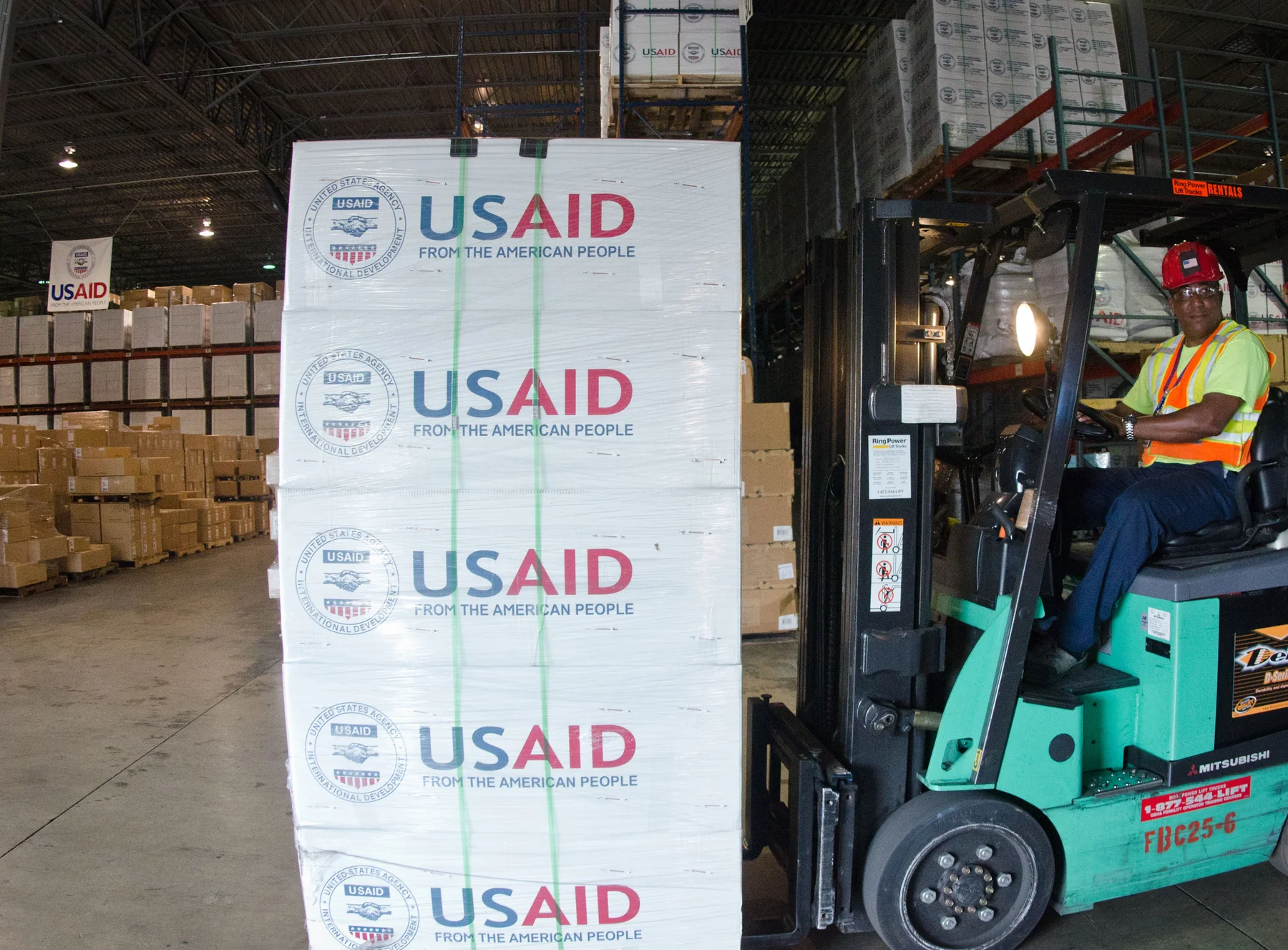
Industrial Truck and Tractor Operator drives a forklift carrying warehouse goods.
U.S. Department of Agriculture / Wikimedia Commons, Public domain

A day in the life

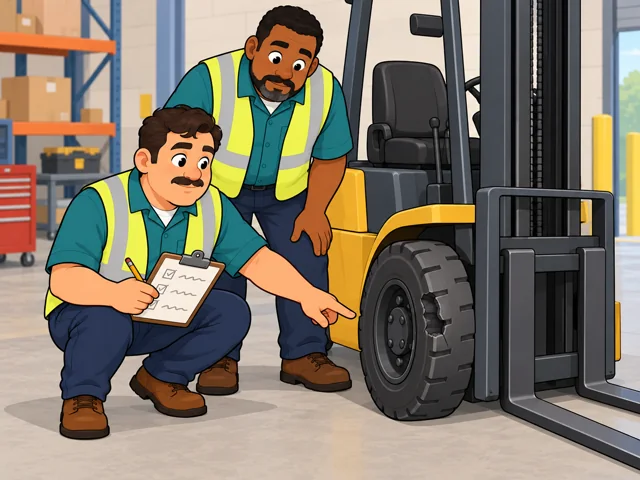
1The operator crouches beside a parked forklift, records a tire defect, and points it out to a coworker.

Inspect before driving, park unsafe trucks

Scan the forks and tires, test brakes and controls, then log any defect and tell your supervisor.
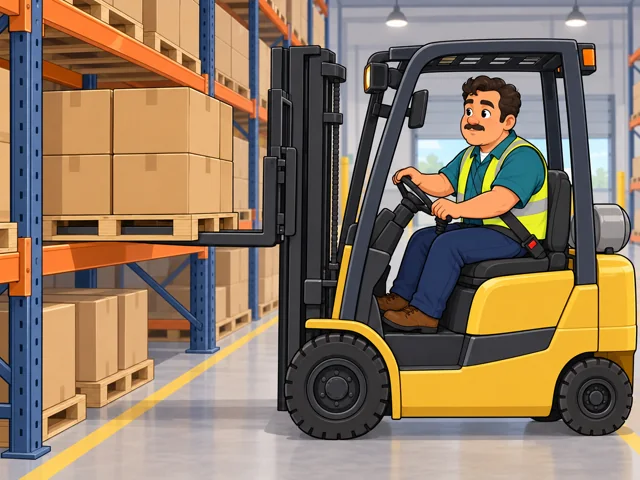
2The seated operator carefully aligns a loaded pallet with an open warehouse rack bay.

Stack a pallet on racking

Square the forks with the pallet, lift it, and set it onto the racking or a stack.
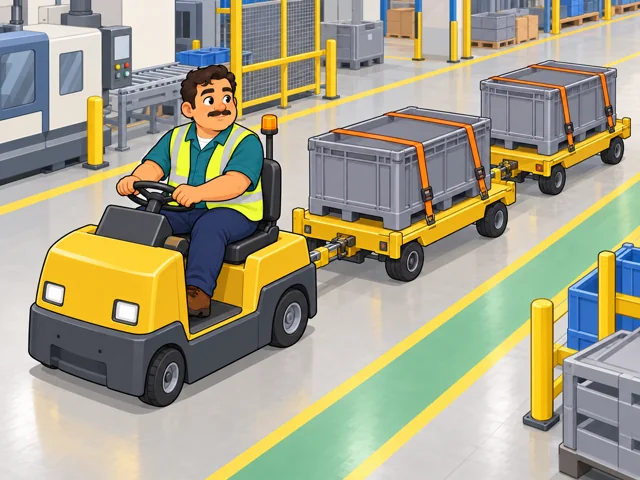
3The operator drives an industrial tow tractor pulling two trailers of secured materials through a factory.

Tow trailers with an industrial tractor

Some jobs have you tow loaded trailers of materials through a plant or storage site.
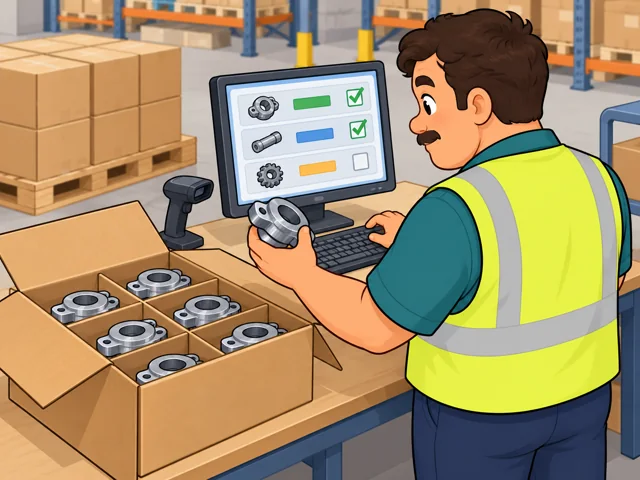
4The operator checks metal components in an open delivery carton and records the receiving information at an inventory terminal.

Log contents and weights

Verify what the load holds, and record production details or weights on labels or in an inventory system.

Quick facts

Preparation

Learn on the job

United States · 2025

Pay

$46,420 a year

United States · May 2025

Outlook

1.5% projected growth

United States · 2025–2035

Quick orientation

Preparation, pay & outlook

Preparation

Learn on the job

Short-term workplace training is typical. Some employers prefer a high school diploma.

Geography
United States
Period
2025

Pay

$46,420 a year

National median pay was $22.32 an hour in May 2025.

Geography
United States
Period
May 2025

Outlook

1.5% projected growth

About 64,700 openings a year are projected over 2025–35, including replacements.

Geography
United States
Period
2025–2035

Fit, tradeoffs & changing tools

Things to weigh

  • Repeated movements, noise, and hot or cold conditions can wear on you, especially when shipments are waiting.
  • Some operations run overnight, so the available shift may affect your sleep and social schedule.
  • A moving truck or falling load can seriously hurt someone nearby. Keeping people clear is part of the work.

Where AI may help

Computer-controlled forklifts can move pallets along planned routes. These automated guided vehicles can take over repetitive transport in suitable facilities.

What people still lead

People inspect equipment, report unsafe conditions, and troubleshoot problems. Working beside automated vehicles also takes training.

What we can’t predict yet

How much driving becomes automated depends on the site's layout and workflow. A job may shift toward handling exceptions and working with a mixed fleet.

Pay in context

Earnings

Use national wages as a starting point, then compare the hourly rate and schedule of jobs near you.

The middle and the spread

The May 2025 median was $46,420 a year, or $22.32 an hour. The lowest-paid 10% earned $36,840 or less; the highest-paid 10% earned $62,520 or more. Those cutoffs are not starting and experienced pay rates.

Geography
United States
Period
May 2025
Pay basis
National employee wage median and 10th/90th percentiles for SOC 53-7051; not total compensation.

A warehouse pay benchmark

In warehousing and storage, operators had a 2025 median of $48,170 a year, or $23.16 an hour—above the occupation's national median. An individual warehouse may pay more or less.

Geography
United States
Period
2025
Pay basis
Industry-specific median employee wages for industrial truck and tractor operators in NAICS 493.

Openings despite modest growth

Employment is projected to grow 1.5% over 2025–35, with about 64,700 openings annually. Most openings replace people leaving the occupation rather than represent newly created positions.

Geography
United States
Period
2025–2035
Pay basis
Employment projection for SOC 53-7051; openings are an annual average, not current vacancies.

Getting started

Join an employer that trains operators

What the route involves
Learn from an experienced operator through instruction and directly supervised driving practice.
What it can lead to
Successful workplace evaluation allows the employer to put you to work operating the truck.

Take a hands-on forklift course

What the route involves
Complete classroom safety instruction, practice lifting and maneuvering, and take a practical skills evaluation.
What it can lead to
You gain assessed equipment practice and a course certificate to discuss with prospective employers.
What to check
The employer still checks that your training fits its truck and workplace and evaluates your competence.

A degree is not typically required. For nonagricultural forklift work, you must be at least 18.

After entry

Career paths

This starts where the entry routes leave off: early work, growing capability, and advancement or specialization. This path also has a credential or licensing boundary; see the requirements and limits.

  1. Build consistency

    Make inspections and accurate load placement dependable habits.

  2. Learn another truck

    Expand to another truck type with the relevant training.

  3. Become an operator trainer

    With sufficient knowledge, training, and experience, you could teach and evaluate new operators.

Where you can work

Warehouses and distribution buildings

Storage aisles meet loading docks here. You work around stacked goods and trailers, paying close attention to dock edges and the space between truck and building.

  • Indoors
  • Vehicle
  • Safety-sensitive

Retail stores with forklift operations

Moving goods around a store adds a particular challenge: keeping customers and other pedestrians clear of the truck's route.

  • Indoors
  • Vehicle
  • Safety-sensitive

Try it

See whether the job clicks before you commit to the path.

Sketch a warehouse with a loading dock, storage racks, and a pedestrian crossing. Trace a pallet's trip from delivery to storage, then mark where blocked views or people would make you pause. Notice whether this kind of spatial planning holds your attention.

Stay safe: Keep this exercise on paper; it is not preparation to operate a forklift.

Explore more careers

Sources

  1. O*NET OnLine. Industrial Truck and Tractor Operators — 53-7051.00. Accessed 2026-10-02.
  2. U.S. Bureau of Labor Statistics. Material Moving Machine Operators. Accessed 2026-10-02.
  3. U.S. Bureau of Labor Statistics. Table 1.2 Occupational projections, 2025–35, and worker characteristics, 2025. Accessed 2026-10-02.
  4. O*NET OnLine. Industrial Truck and Tractor Operators wages — United States rows. Accessed 2026-10-02.
  5. U.S. Bureau of Labor Statistics. Warehousing and Storage: NAICS 493. Accessed 2026-10-02.
  6. Occupational Safety and Health Administration. 29 CFR 1910.178 — Powered industrial trucks. Accessed 2026-10-02.
  7. Occupational Safety and Health Administration. Powered Industrial Trucks eTool — Pre-Operation. Accessed 2026-10-02.
  8. Occupational Safety and Health Administration. Powered Industrial Trucks — Forklifts. Accessed 2026-10-02.
  9. Brookdale Community College. Forklift Operator Safety Certification. Accessed 2026-10-02.
  10. Toyota Material Handling. Automated Guided Vehicle FAQ. Accessed 2026-10-02.

Your message goes to the Great Jobs team. How we use your information