
Career profile

Instructional Coordinator

Instructional coordinators help teachers choose, improve and use the materials students learn from.

Where do students keep getting stuck? You find out, rewrite the course content, and guide teachers as they take up new approaches.

An instructional coordinator reviews lesson activities with two teachers.

A day in the life

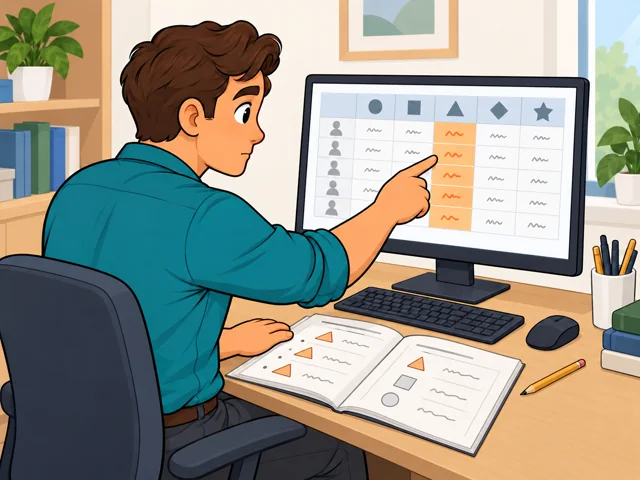
1An instructional coordinator compares highlighted assessment cells with an open lesson activity to investigate a recurring learning difficulty.

Spot a skill students keep missing

Compare test scores across a spreadsheet, and if one skill keeps slipping, ask whether the materials need changing.
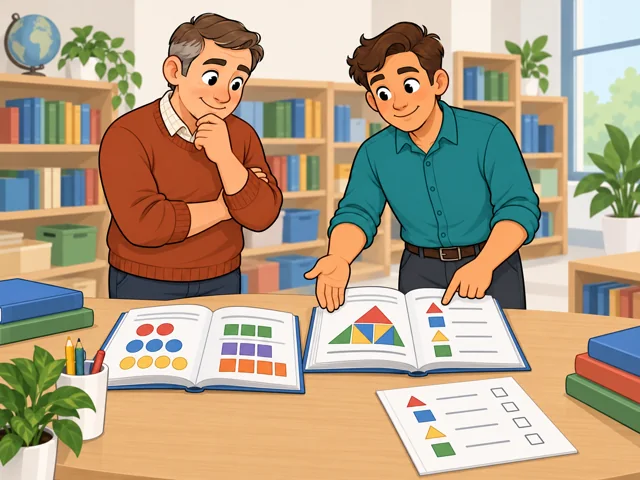
2The coordinator compares textbook activities with learning goals and recommends one to a male teacher.

Match textbook activities to learning goals

Check each textbook activity against what students should learn, then advise teachers on which resources to adopt.

3After observing a lesson, the coordinator and a female teacher review student work and discuss trying a grouping activity to clarify understanding.

Sit in on a teacher's class

You watch the lesson, then afterward discuss what students grasped and one change worth trying.
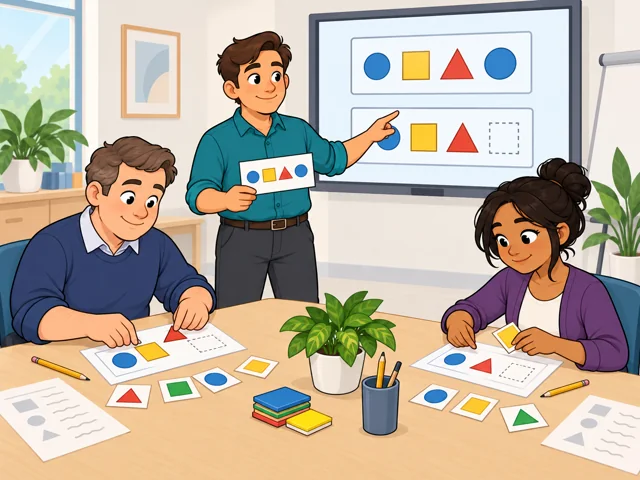
4The coordinator demonstrates a sample teaching sequence while two instructors rearrange their own course activities at a workshop table.

Show a new teaching approach

Demonstrate the approach first on a sample course module, then help instructors rework the materials they already use.

Quick facts

Preparation

Master’s + experience

United States · 2025

Pay

$77,440/year

United States · May 2025

Outlook

1.6% growth

United States · 2025–2035

Quick orientation

Preparation, pay & outlook

Preparation

Master’s + experience

Typical entry preparation includes a master’s degree and at least five years of related work experience.

Geography
United States
Period
2025

Pay

$77,440/year

National median; hourly equivalent $37.23.

Geography
United States
Period
May 2025

Outlook

1.6% growth

About 23,100 openings annually are projected nationwide over 2025–2035.

Geography
United States
Period
2025–2035

Fit, tradeoffs & changing tools

Things to weigh

  • Expect year-round work, often with meetings outside classroom hours.
  • In college course-development teams, several projects can compete for attention while course deadlines stay fixed.

Where AI may help

Artificial intelligence (AI) can help generate lesson drafts and suggest instructional resources or assessment questions.

What people still lead

You still need to check accuracy, judge whether activities match learning goals, and weigh whether a resource actually helps students.

What we can’t predict yet

How much drafting these tools can take over—and how much checking they create—remains unsettled. Responsibility for catching errors also has to be shared with tool developers.

Pay in context

Earnings

Use the median as a comparison point, not a starting-salary promise.

The national spread

The lowest-paid 10% earned below $47,980; the highest-paid 10% earned above $121,670. These are wage thresholds, not career stages.

Geography
United States
Period
May 2025
Pay basis
Annual employee wages; instructional coordinators

Workplace pay differs

Annual medians were $82,130 in local elementary and secondary schools, $73,070 in private colleges and universities, and $61,810 in state colleges and universities.

Geography
United States
Period
May 2025
Pay basis
Industry median annual wages; college categories include professional schools

Openings exceed new jobs

Projected employment grows by about 4,100 jobs over the decade, while annual openings average 23,100. Openings include replacing people who leave the occupation.

Geography
United States
Period
2025–2035
Pay basis
Employment projections, not compensation

Getting started

Build from classroom experience

What the route involves
Combine teaching experience with a master’s in education or curriculum and instruction.
What it can lead to
This prepares you for school curriculum positions; some require specific subject or grade-level experience.
What to check
Public-school roles may require a teaching or administrator license. Check your state education agency’s requirements.

Enter through instructional design

What the route involves
Earn a relevant bachelor’s degree and learn online course-design principles, including how to organize learning activities.
What it can lead to
Some Instructional Designer I roles accept applicants without previous experience to support course development under general supervision.
What to check
Requirements vary by employer; this route does not establish eligibility for a licensed school position.

School curriculum roles and instructional designer roles can have different entry requirements.

After entry

Career paths

This starts where the entry routes leave off: early work, growing capability, and advancement or specialization.

  1. Get established

    Start with a manageable course revision. Learn how instructors and the multimedia team move materials from draft to use.

  2. Develop your judgment

    Take a course through planning, activities, and assessment. Practice explaining your design choices to the instructor and keeping the project on schedule.

  3. Move toward senior design work

    Build deeper experience supporting faculty and designing online learning. Senior instructional designer roles are one next step; some require further graduate education.

Where you can work

School districts

Combine office work with school visits, classroom observations, and conversations about curriculum.

  • Office
  • Indoors
  • Travel

College distance-education teams

Work with faculty on online courses, using course-management software and digital media. Accessibility checks and course launch deadlines shape the work.

  • Office
  • Indoors

Try it

See whether the job clicks before you commit to the path.

Choose two freely available lessons on a topic you know. Compare their learning goal, activity, and final question. Write a short recommendation to a teacher explaining which lesson you would choose and one change you would make. Notice whether you enjoy judging the whole learning sequence.

Explore more careers

Sources

  1. O*NET OnLine. 25-9031.00 — Instructional Coordinators. Accessed 2026-10-02.
  2. U.S. Bureau of Labor Statistics. Instructional Coordinators — Occupational Outlook Handbook. Accessed 2026-10-02.
  3. U.S. Bureau of Labor Statistics. Table 1.2 Occupational projections, 2025–35, and worker characteristics, 2025. Accessed 2026-10-02.
  4. Texas A&M AgriLife. Instructional Designer I — Job Description. Accessed 2026-10-02.
  5. Del Mar College. Instructional Designer — Position Description. Accessed 2026-10-02.
  6. U.S. Department of Education. Designing for Education with Artificial Intelligence: An Essential Guide for Developers. Accessed 2026-10-02.

Your message goes to the Great Jobs team. How we use your information