
Resize a ring
Cut the band, reshape it, and join it again so the ring ends up a different size.
Career profile
Jewelers build and repair jewelry, shaping precious metals and setting gems with small hand tools.
A ring can look finished while a seam on it still hasn't been filed smooth, and jewelers work at that tiny scale.
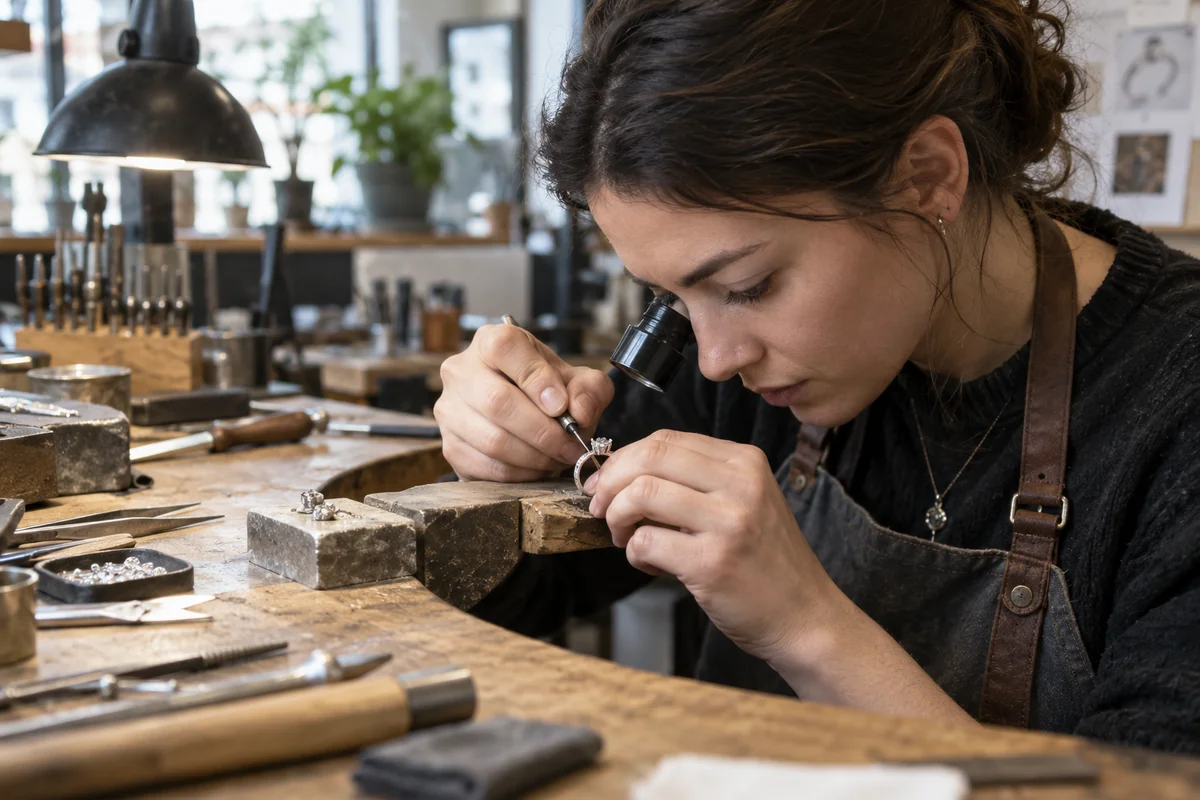
Cut the band, reshape it, and join it again so the ring ends up a different size.
Place the gem in its mount, then secure it with setting tools so it stays firmly held.
In design roles, you build a 3D digital model and tune its proportions, weighing size, cost and production.
File and polish the rough seam smooth, then check the finished piece under magnification.
United States · 2025–2035
United States · 2025
United States · 2025–2035
Quick orientation
A high school diploma or equivalent is typical; developing proficiency takes long-term on-the-job training.
2025 national median, or $25.26/hour, for jewelers and precious stone and metal workers together.
About 3,700 openings annually across the broader occupation, averaged over 2025–2035.
Computer-aided design (CAD) lets you revise a model before making it. Three-dimensional printing can turn that design into a physical model you can hold.
You still judge whether a design can be made well and inspect the setting and finish.
Automated polishing and printing may reduce some production work; how much handwork they take over will vary by piece and workshop.
Pay in context
These national figures cover jewelers and precious stone and metal workers together, not just bench jewelers.
The median was $52,540 a year, or $25.26 an hour. The 10th and 90th percentiles were $35,580 and $87,540 annually. Those are wage-distribution markers, not starting and experienced salaries.
Annual medians were $53,990 in jewelry, luggage and leather goods retail; $48,800 in jewelry and silverware manufacturing; and $46,390 in personal and household goods repair. Retail jobs may include commissions.
Employment is projected to fall 3.2%. About 3,700 annual openings are expected as workers leave the occupation.
Plan for substantial hands-on training after high school.
After entry
This starts where the entry routes leave off: early work, growing capability, and advancement or specialization.
Practice clean joins and even finishes. Compare your work with quality standards and correct defects.
Develop more stone-setting techniques and custom fabrication skills as your control improves.
Experience can lead to head-jeweler roles or shop management.
Bench work sits alongside customer service. Store schedules may include evenings, weekends and holidays.
Making pieces shares time with selling them online or at craft shows, sometimes on weekends.
Try it
Make a small ring model from modeling clay. Keep the band thickness even and shape a seat for an imaginary stone. Inspect it from several angles and revise it. Notice whether you enjoy patient adjustments at this scale.
Stay safe: Keep this to clay; it does not require heating metal or working on valuable jewelry.