
Career profile

Kindergarten Teacher

Kindergarten teachers build young children's early reading and number skills while guiding classroom behavior.

Besides designing the lesson plans, you notice when one child isn't catching on and needs the material taught another way.

An adult kindergarten teacher guiding young children through a hands-on counting activity with colorful beads at a classroom table; no numeral cards or text, children shown from behind without identifiable faces, blank neutral walls.

A day in the life

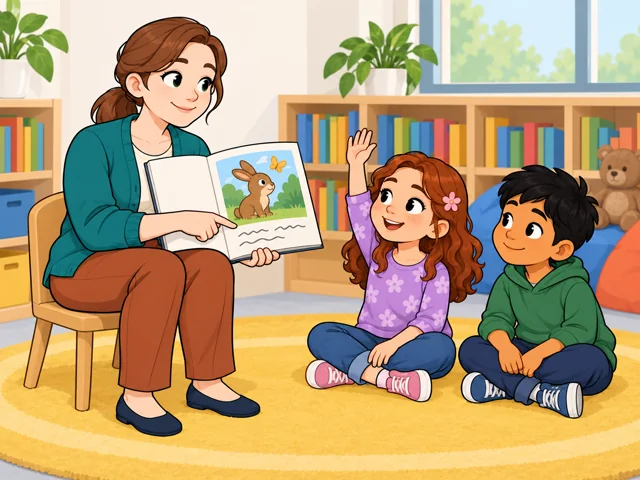
1A seated teacher points to marks beneath a picture in an open book while a girl raises her hand and a boy follows the page.

Share a picture storybook

Read an illustrated storybook aloud, get the kids talking about it, and point out letters they recognize.

2A teacher models touching blocks one at a time while a boy watches and prepares to count the row himself.

Have one child count blocks

If the child counts a block twice, demonstrate touching each one once, then let them try again.
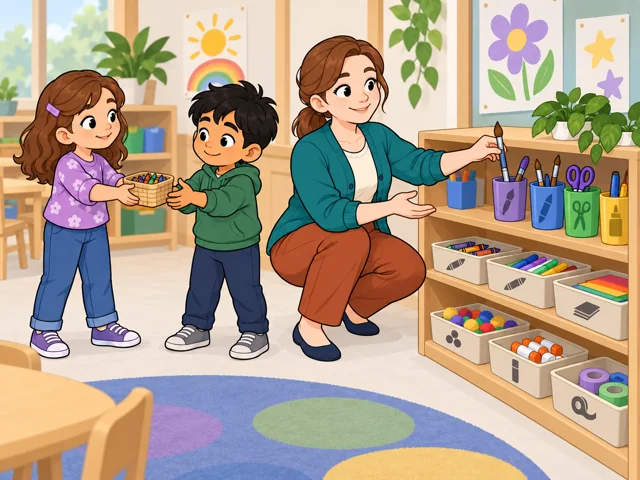
3A crouching teacher puts a brush away as a girl passes a shared crayon basket to a waiting boy beside the classroom shelves.

Teach cleanup and turn-taking

Model the cleanup steps, and help kids share and take turns when everyone wants the same materials.
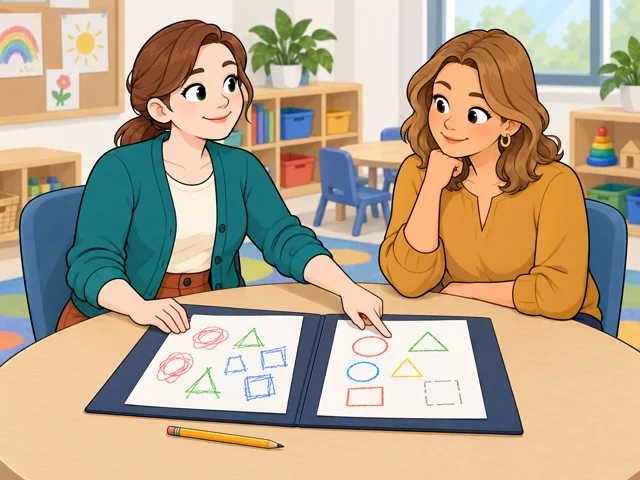
4A teacher and a parent compare a child's earlier and later shape drawings, with the teacher pointing out an unfinished shape for further practice.

Meet with a parent

Walk a parent through their child's work samples, showing growth and where the child still needs support.

Quick facts

Preparation

Bachelor’s degree

United States

Pay

$62,680/year

United States · May 2025

Outlook

Little change

United States · 2025–2035

Quick orientation

Preparation, pay & outlook

Preparation

Bachelor’s degree

Typical preparation; public schools also require state certification or licensure.

Geography
United States
Period
Not applicable

Pay

$62,680/year

National median for kindergarten teachers, excluding special education.

Geography
United States
Period
May 2025

Outlook

Little change

Employment is projected to decline 0.3%, with 11,900 openings annually on average, including replacements. Excludes special education.

Geography
United States
Period
2025–2035

Fit, tradeoffs & changing tools

Things to weigh

  • Noise and time on your feet can be tiring.
  • Lesson preparation can take evenings and weekends.

Where AI may help

Photos and audio recordings can capture children’s work and explanations, giving you something to revisit when checking progress.

What people still lead

You decide whether a screen activity helps a particular child learn and when conversation or hands-on play is more useful.

What we can’t predict yet

How much teaching shifts onto screens remains unsettled. New tools must earn their place without crowding out movement, play, and relationships.

Pay in context

Earnings

These national figures cover kindergarten teachers, excluding special education teachers.

The middle and the spread

The median was $62,680 annually. Dividing by 2,080 hours gives about $30.13 per hour for comparison only—not an actual teacher hourly rate. The 10th and 90th percentiles were $46,990 and $101,830; these are wage positions, not career stages.

Geography
United States
Period
May 2025
Pay basis
Annual wage median and percentiles; calculated hourly comparison

Workplace affects the comparison

Annual medians were $63,890 in local public schools, $51,810 in private schools, and $46,920 in child daycare services.

Geography
United States
Period
May 2025
Pay basis
Industry annual median wages for kindergarten teachers, except special education

Read the salary schedule

In New York City public schools, teacher pay reflects recognized experience, coursework, and degrees. When comparing jobs, check which experience and education the employer will credit.

Geography
New York City
Period
Not stated
Pay basis
Employer salary structure; no national premium implied

Getting started

Prepare during your bachelor’s degree

What the route involves
Complete teacher preparation and classroom student teaching with a mentor.
What it can lead to
Preparation for the state’s teaching-license requirements.
What to check
Requirements vary; generally, you must meet degree requirements, pass required tests and a background check, and obtain the license.

Add preparation after another degree

What the route involves
With an existing bachelor’s degree, complete alternative teacher preparation.
What it can lead to
A route toward full state certification.
What to check
Some programs allow supervised teaching while you train; others require coursework first. State requirements still apply.

Public-school licensure must cover kindergarten. Private schools typically do not require a license.

After entry

Career paths

This starts where the entry routes leave off: early work, growing capability, and advancement or specialization.

  1. Get established

    Make classroom routines predictable and build lesson plans you can adjust.

  2. Read learning more closely

    Use counting observations to choose the next challenge for each group, then check whether your changes helped.

  3. Help other teachers improve

    With experience, pursue mentor or lead-teacher responsibilities.

Where you can work

Elementary-school classrooms

Your day follows school schedules. You may coordinate lessons with special education teachers and escort children to specialist classes.

  • Indoors

Montessori kindergarten programs

Children choose materials and work individually or in small groups. You observe closely, demonstrate materials, and adjust individual learning plans within a three-year early childhood sequence.

  • Indoors

Try it

See whether the job clicks before you commit to the path.

Plan a five-minute kindergarten counting lesson using five blocks. Rehearse it with a friend who deliberately counts one block twice. Try a clearer demonstration, then ask what helped. Notice whether you enjoy figuring out the misunderstanding.

Explore more careers

Sources

  1. O*NET OnLine. Kindergarten Teachers, Except Special Education. Accessed 2026-10-03.
  2. U.S. Bureau of Labor Statistics. Occupational projections and worker characteristics. Accessed 2026-10-03.
  3. O*NET OnLine / U.S. Bureau of Labor Statistics. Kindergarten Teachers, Except Special Education: wage table, United States row. Accessed 2026-10-03.
  4. U.S. Bureau of Labor Statistics. Kindergarten and Elementary School Teachers. Accessed 2026-10-03.
  5. U.S. Bureau of Labor Statistics. May 2023 Occupational Employment and Wages: Kindergarten Teachers, Except Special Education. Accessed 2026-10-03.
  6. Institute of Education Sciences. Teaching Math to Young Children: Practice Guide Summary. Accessed 2026-10-03.
  7. National Association for the Education of Young Children. Technology and Young Children: Preschoolers and Kindergartners. Accessed 2026-10-03.
  8. National Association for the Education of Young Children and Fred Rogers Center. Technology and Interactive Media as Tools in Early Childhood Programs. Accessed 2026-10-03.
  9. New York City Public Schools. Benefits and Pay. Accessed 2026-10-03.
  10. American Montessori Society. Montessori Early Childhood Programs. Accessed 2026-10-03.

Your message goes to the Great Jobs team. How we use your information