
Career profile

Laundry and Dry-Cleaning Worker

Laundry and dry-cleaning workers wash or dry-clean dirty garments and linens so they're ready.

The job starts before any machine runs: choosing which pieces go together and which stains need a closer look.
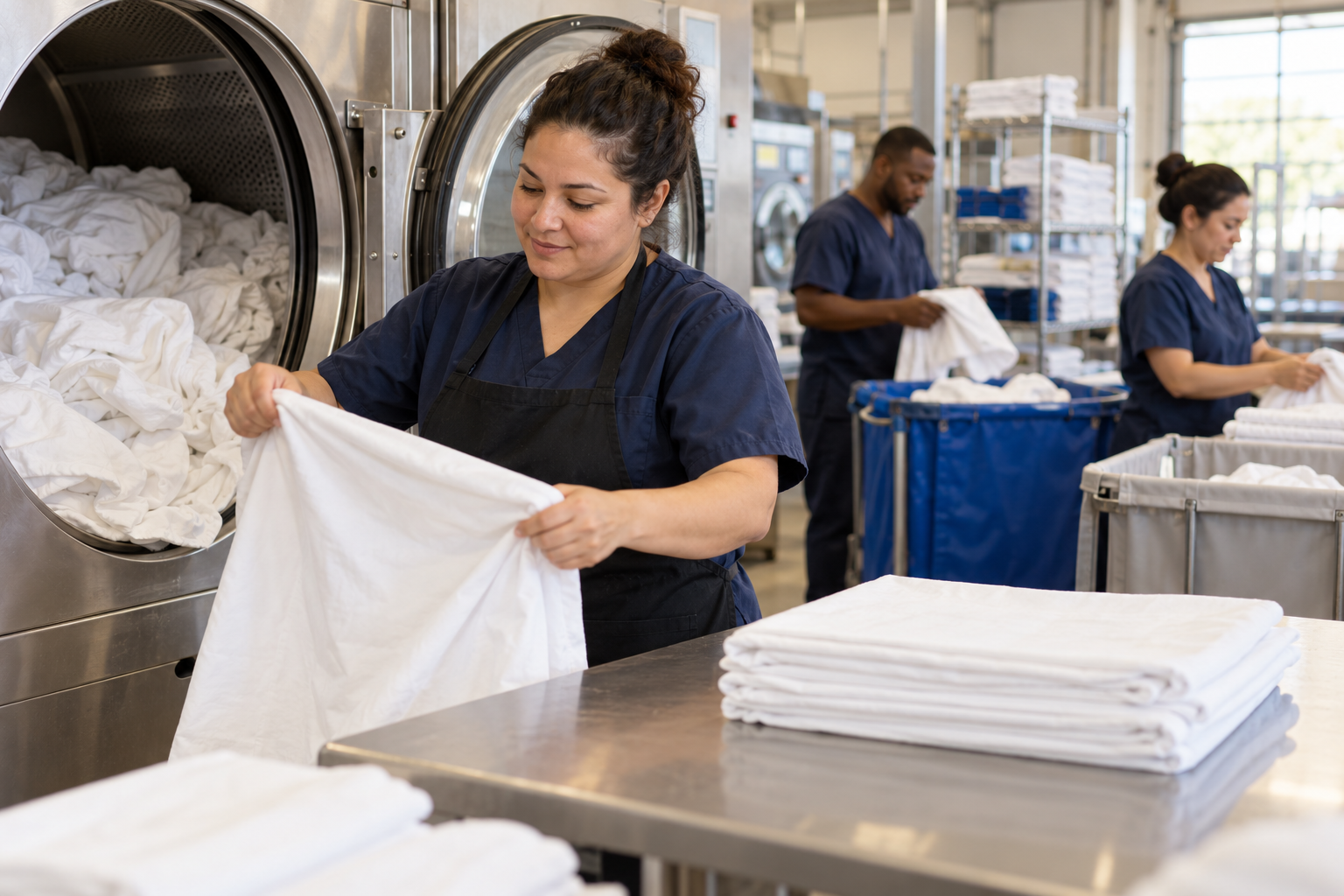
Laundry and Dry-Cleaning Worker folds clean linen beside industrial dryers.

A day in the life

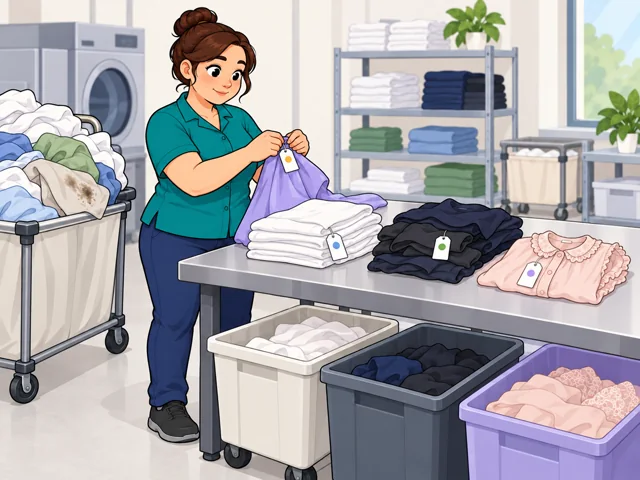
1A laundry worker attaches an identification tag to a garment beside separate groups of linens, dark clothing, and delicate items.

Tag and sort incoming pieces

Tag each new piece so it stays identifiable, then group by fabric, color, dirt level and cleaning process.
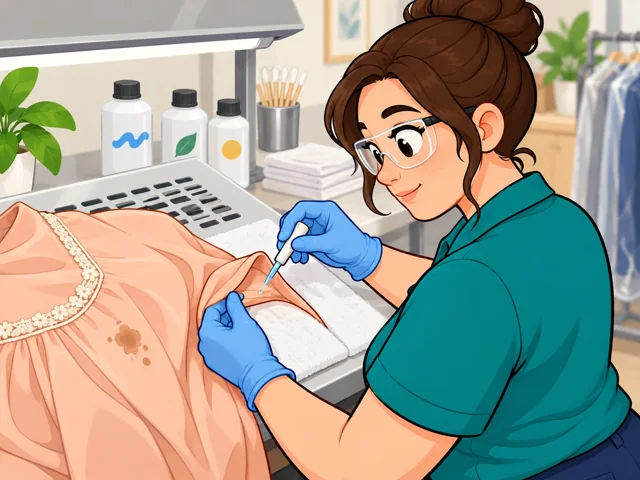
2The worker tests a hidden seam of a stained garment at a spotting station, checking the fabric near decorative trim.

Test a stain treatment first

In dry-cleaning roles, check fabric, trim and stain, then test a treatment on a hidden spot before use.
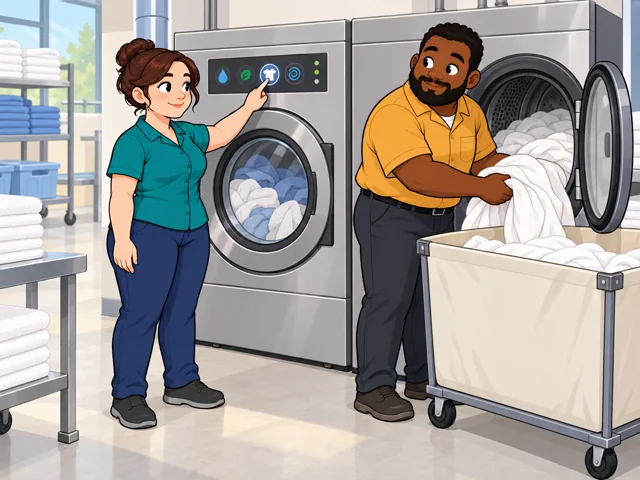
3The worker selects a washer setting while a male coworker unloads clean linens from a nearby dryer into a cart.

Load and run the machines

Fill commercial machines, pick fabric settings, monitor the cycle and arrange unloading so the next machine is free.
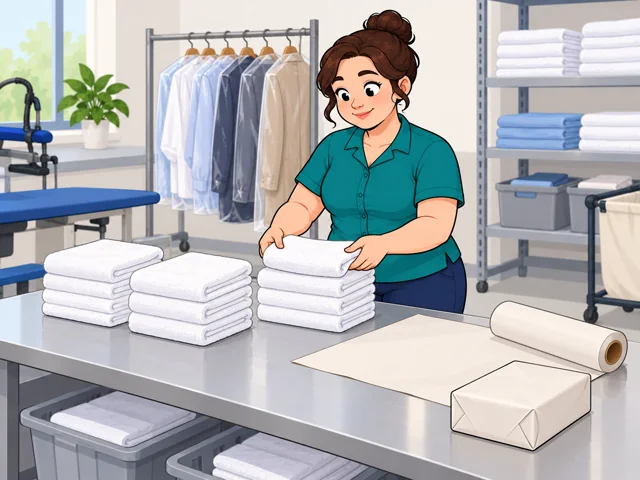
4The worker folds a clean towel onto an orderly stack and checks the finished pieces beside wrapping paper.

Fold, count and wrap

Iron or machine-fold items, or fold them by hand, then count, wrap or hang them to go back.
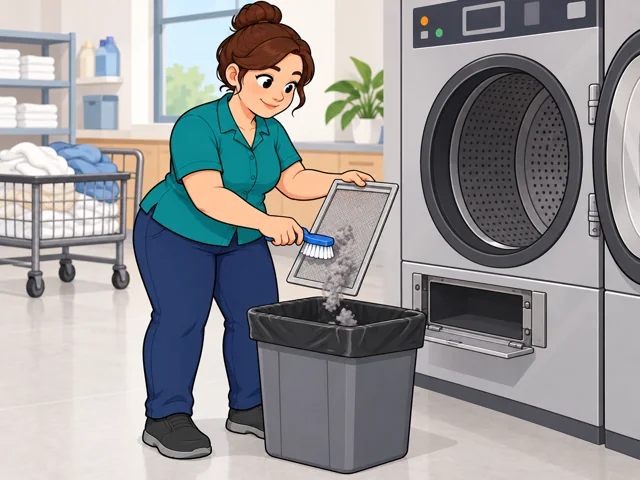
5The worker brushes lint from a removed dryer filter into a waste bin, with the surrounding aisle kept clear.

Clear filters and floor space

Between loads, clean the machine filters and clear clutter from around the equipment.

Quick facts

Preparation

Learn on the job

United States · 2025

Pay

$16.78/hour

United States · May 2025

Outlook

4.3% growth

United States · 2025–2035

Quick orientation

Preparation, pay & outlook

Preparation

Learn on the job

Typically no formal educational credential; short-term workplace training. Employers may set additional requirements.

Geography
United States
Period
2025

Pay

$16.78/hour

National median of $34,890 a year for laundry and dry-cleaning workers.

Geography
United States
Period
May 2025

Outlook

4.3% growth

Projected employment growth over 2025–35, with about 28,200 openings a year on average.

Geography
United States
Period
2025–2035

Fit, tradeoffs & changing tools

Things to weigh

  • Long periods of standing, bending and repeated hand movements can be tiring.
  • Production schedules can push the pace even when a load needs extra attention.
  • Soiled loads can have strong odors; handling them includes using protective equipment.

Where AI may help

Industrial sorting systems can separate dirty textiles automatically, and folding machines handle some finishing. These tools change how much laundry you move by hand.

What people still lead

People still inspect garment details and choose treatments that suit the fabric and stain.

What we can’t predict yet

How far automated handling spreads will shape whether a shift involves more feeding and folding or more watching equipment and handling exceptions.

Pay in context

Earnings

Compare the hourly rate and expected hours when weighing an offer. Annual wage estimates assume year-round, full-time work.

The national midpoint

The May 2025 median was $16.78 an hour, or $34,890 annually. Half earned less and half earned more; this is not a starting rate.

Geography
United States
Period
May 2025
Pay basis
Median employee wages; annual equivalent based on 2,080 hours

The national spread

In May 2025, the 10th-percentile wage was $13.19 an hour and the 90th-percentile wage was $20.77. These are wage percentiles, not starting and experienced pay rates.

Geography
United States
Period
May 2025
Pay basis
National hourly wage percentiles

Workplace pay differs

May 2023 hourly averages were $15.17 in laundry and dry-cleaning services, $15.43 in traveler accommodation and $17.83 in general hospitals. Treat these as historical comparisons, not current offers.

Geography
United States
Period
May 2023
Pay basis
Mean hourly employee wages within each industry

Openings include replacement hiring

Employment is projected to grow 4.3% from 2025 to 2035. About 28,200 annual openings include replacing people who leave the occupation, as well as growth.

Geography
United States
Period
2025–2035
Pay basis
Employment projection and average annual occupational openings; not compensation

Getting started

Join a hotel laundry team

What the route involves
Look for a laundry attendant role that accepts beginners. Learn machine operation and linen handling with the employer's trainer.
What it can lead to
You build experience processing the hotel's linens and keeping clean supplies ready for housekeeping.

Take hands-on dry-cleaning instruction

What the route involves
The Drycleaning and Laundry Institute offers introductory practice in sorting, machine operation, stain removal and pressing.
What it can lead to
You gain practical preparation for garment-processing work, including handling delicate fabrics.

Workplace training is the usual entry path. You can also take practical garment-care instruction before seeking a dry-cleaning role.

After entry

Career paths

This starts where the entry routes leave off: early work, growing capability, and advancement or specialization.

  1. Get consistent

    After entry, learn the load categories and machine settings until you can keep batches moving without mixing items or skipping checks.

  2. Handle more difficult pieces

    Build your knowledge of fabrics, trims and stains so you can tackle items that need more than the routine cleaning cycle.

  3. Specialize in garment care

    Develop advanced stain-removal and finishing skills to work on more demanding garments.

Where you can work

Hotel laundry rooms

Your output supplies housekeeping. Commercial washers, folding equipment and stocked linen carts connect your work to rooms being readied for guests.

  • Indoors
  • Physical demands

Garment dry-cleaning shops

Individual garments bring different fabrics, decorative trims and stains. You spend more attention on choosing treatment and getting each piece's finish right.

  • Indoors
  • Physical demands

Industrial laundry plants

Bulk loads move between large washers and dryers. Quantity targets and coordinated transfers shape the pace, and some plants staff evening shifts.

  • Indoors
  • Shift work
  • Physical demands

Try it

See whether the job clicks before you commit to the path.

Gather several clean garments from home. Read their care labels and sort them into compatible cleaning groups, setting aside uncertain pieces. Notice whether you enjoy catching the small differences before starting a load.

Stay safe: Keep this to inspection and sorting; do not experiment with stain-removal chemicals.

Explore more careers

Sources

  1. O*NET OnLine. 51-6011.00 — Laundry and Dry-Cleaning Workers. Accessed 2026-10-02.
  2. U.S. Bureau of Labor Statistics. Occupational projections and worker characteristics, 2025–35. Accessed 2026-10-02.
  3. U.S. Bureau of Labor Statistics. May 2023 Occupational Employment and Wages — Laundry and Dry-Cleaning Workers. Accessed 2026-10-02.
  4. White Lodging, through Marriott Careers. Laundry Attendant — Westin Austin Domain. Accessed 2026-10-02.
  5. Cintas. Warehouse Associate — Washroom Operator — 2nd Shift, Fort Wayne. Accessed 2026-10-02.
  6. Drycleaning and Laundry Institute International. School of Drycleaning Technology — Courses. Accessed 2026-10-02.
  7. Drycleaning and Laundry Institute International. Self Study Courses. Accessed 2026-10-02.
  8. JENSEN-GROUP. Laundry Automation and Innovation for North America. Accessed 2026-10-02.
  9. U.S. Bureau of Labor Statistics. May 2025 Occupational Employment and Wage Statistics, national estimates. Accessed 2026-09-29.

Your message goes to the Great Jobs team. How we use your information