
Inspect the locomotive before leaving
Look for mechanical faults on the locomotive and check the sand and fuel supplies before you pull out.
Career profile
Locomotive engineers drive freight or passenger trains, controlling them with the throttle and brakes.
Engineers watch the track ahead, follow the radio and control speed all at once. The appeal is handling a huge, powerful machine with precision.
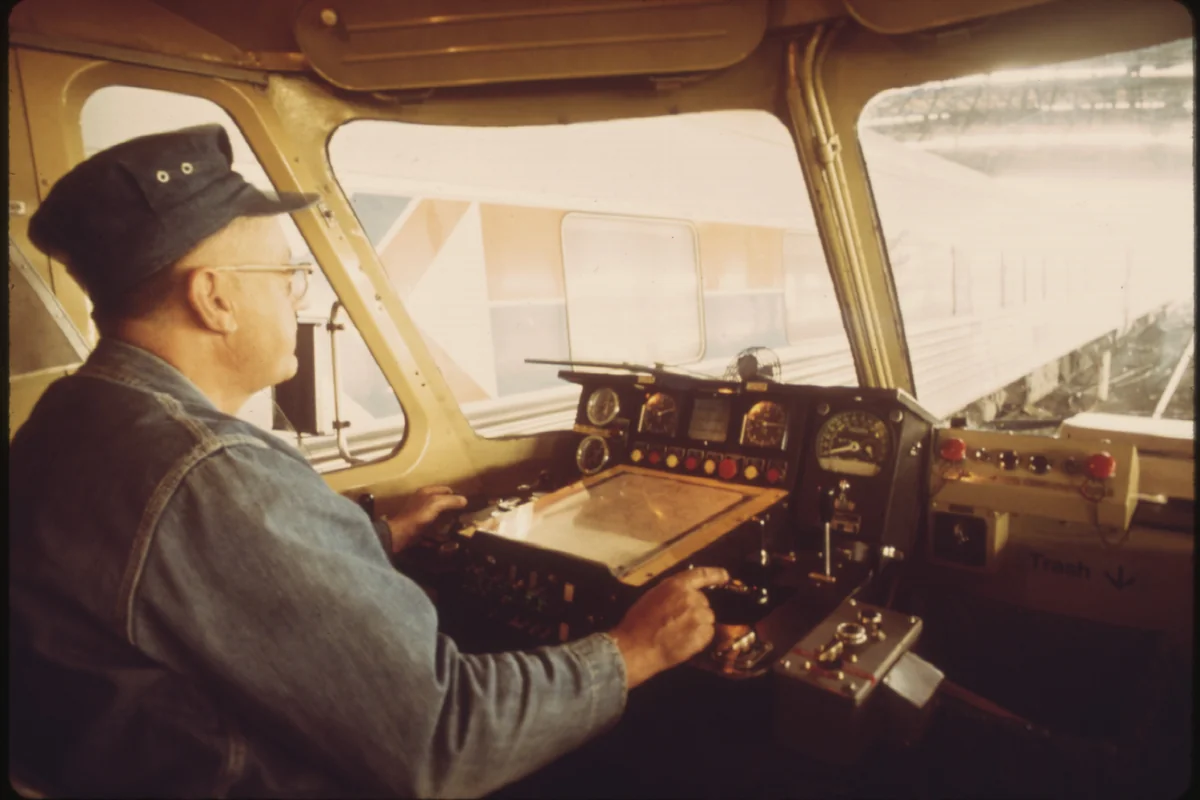
Look for mechanical faults on the locomotive and check the sand and fuel supplies before you pull out.
You read signals and train orders, then work the throttle and air brakes as line conditions change.
Trade updates with the conductor and the dispatcher about stops, delays and other trains.
Keep watching the speed and brake-pressure gauges, and note any trouble from the trip so it gets fixed.
United States
United States · 2025
United States · 2025–2035
Quick orientation
Many engineers first gain experience as conductors, then train at the controls.
National median for locomotive engineers; equivalent to $39.14 an hour.
Employment is projected to grow 0.5%, with about 2,000 openings a year.
Computer-based safeguards called Positive Train Control (PTC) help prevent certain collisions, overspeed derailments, and movements into protected work zones on equipped lines.
You still watch track conditions, communicate with the crew, and operate the train as conditions change.
How much further automation will take over routine train handling—and how that changes the engineer’s workload—remains uncertain.
Pay in context
The national median is $81,410 a year, or $39.14 an hour. It describes the middle of the occupation, not an offer to a new trainee.
In 2025, the 10th-percentile wage was $60,680 and the 90th-percentile wage was $109,220. These mark the lower and upper parts of the national distribution, not beginner and veteran pay grades.
At NJ TRANSIT, trainees and promoted engineers have different hourly rates, with later increases governed by the labor agreement. Check both rates when comparing a training offer.
About 2,000 openings a year are projected for 2025–2035, alongside just 0.5% employment growth. Openings include replacement needs; they are not all newly created positions.
A high school diploma or equivalent is the usual starting point. The route into the cab depends on the railroad.
After entry
This starts where the entry routes leave off: early work, growing capability, and advancement or specialization. This path also has a credential or licensing boundary; see the requirements and limits.
Learn the rhythm of covering different runs. At NJ TRANSIT, new engineers usually start on the extra list, with changing assignments before they hold a regular one.
Use continuing education to sharpen your handling of equipment, refresh operating rules, and build knowledge of the territory you run.
With experience and railroad selection, pursue a designated supervisor role testing engineers’ knowledge and skills and identifying needed retraining.
Move goods between terminals. Some assignments have irregular schedules, and long runs can mean extended time away.
Short passenger routes can offer more predictable schedules. Early on, covering different runs may still mean changing hours and locations.
At Amtrak, you operate across changing weather conditions and travel between cities. Assignments can include overnight hours and time away from home.
Try it
Watch five minutes of a recorded train cab view. Note when you notice a signal, curve, or station ahead, and what you would want to know before changing speed. See whether sustained watching and anticipating hold your interest.
Stay safe: Use recorded footage only; this is an observation exercise, not train-operating instruction.