
Career profile

Log Grader and Scaler

Log graders and scalers measure and grade logs to work out usable wood and value.

Can you spot the split or rotten core that makes two nearly identical logs different? Sharp eyes and careful measuring count when timber changes hands.
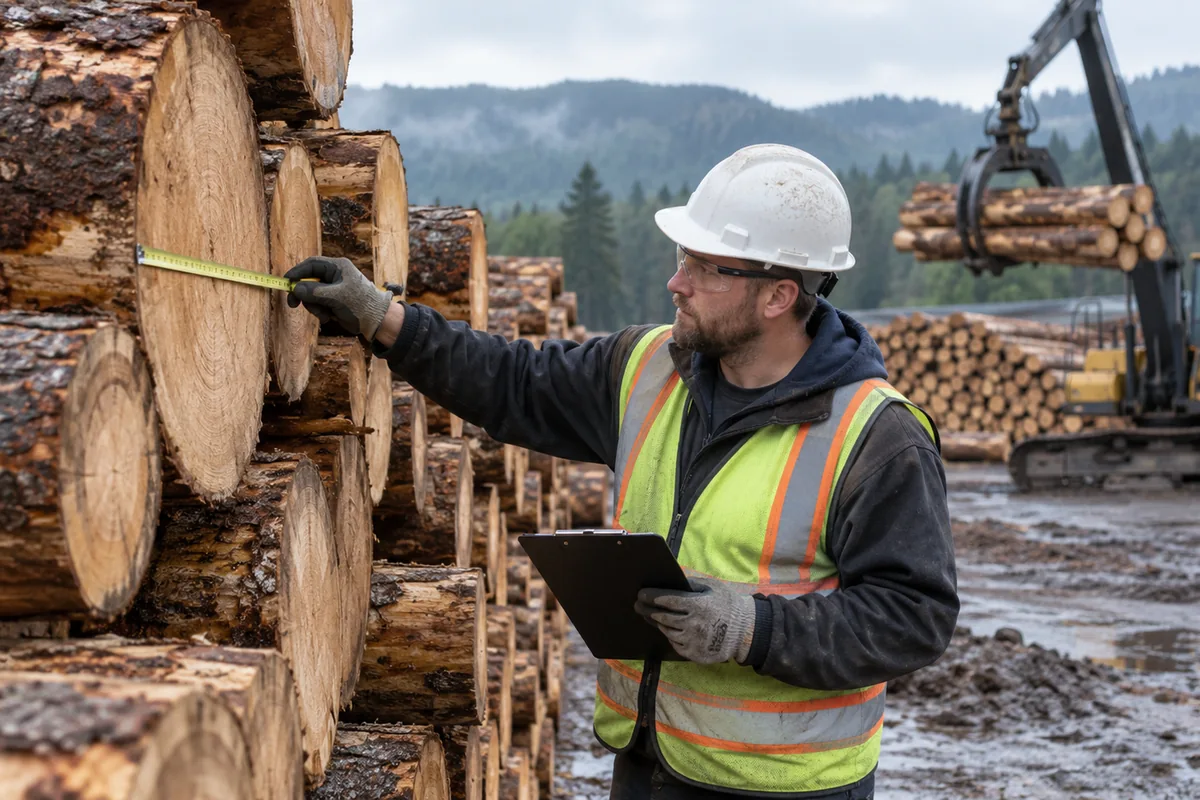
A log grader measuring and inspecting stacked timber logs at a lumber yard.

A day in the life

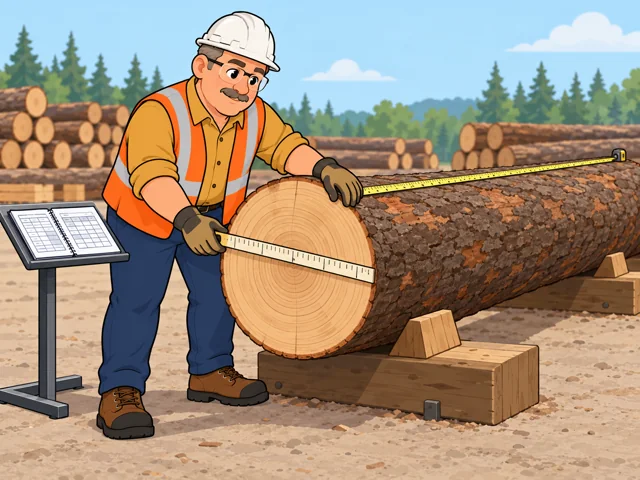
1A log grader measures a secured log’s diameter with a scale stick while a tape runs along its length and a volume reference rests nearby.

Size up each log

Measure length and diameter with a scale stick and logger's tape, then apply the required volume table.
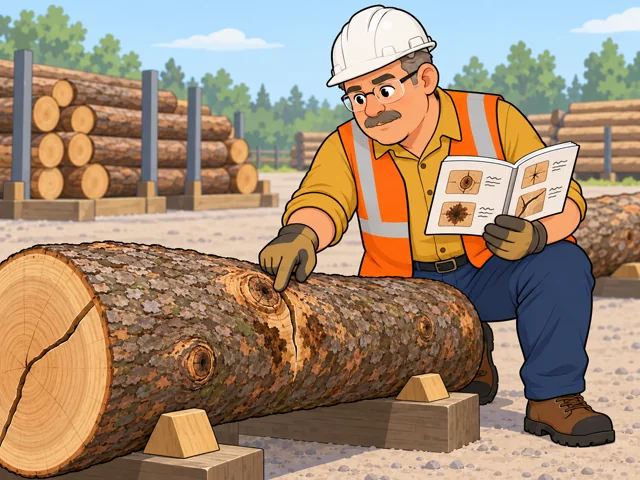
2The grader examines knots and a split in a secured log while comparing the defects with a grading reference.

Grade the log by its flaws

You look for knots, splits, decay and bends, then set the grade the grading rules call for.
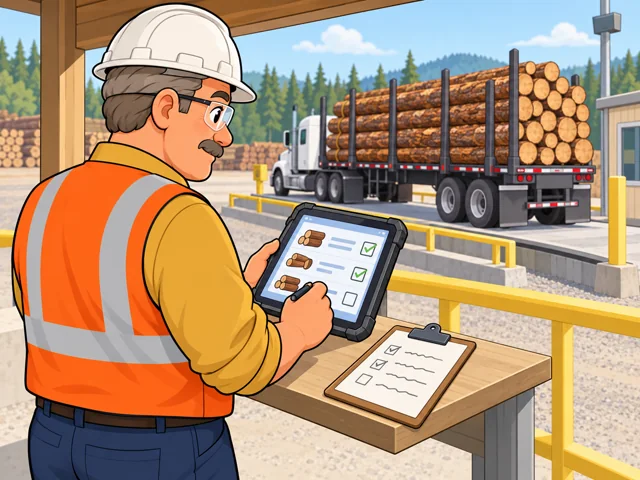
3The grader enters log measurements and defects into a handheld computer at a recording station beside a parked truckload.

Keep data with its truckload

Enter species, sizes and flaws on a handheld computer, which can calculate volumes and make the scale ticket.
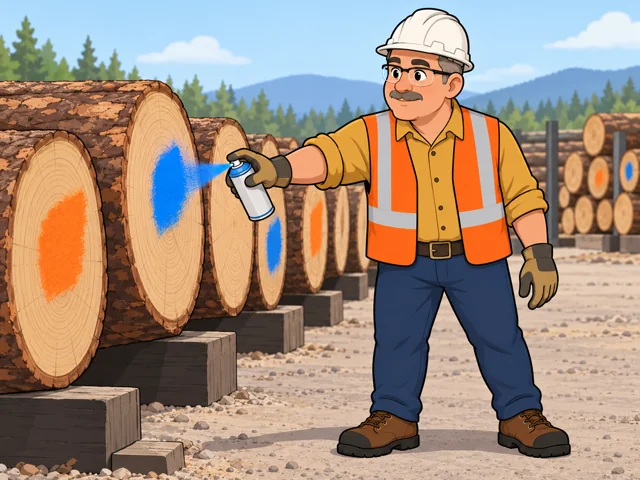
4The grader sprays an identification-color patch onto the end of a secured log beside other marked logs.

Mark logs by grade or species

Spray color codes on logs for species or grade, or call grades out to the log marker.

Quick facts

Preparation

High school diploma or equivalent

United States · 2025–2035

Pay

$46,330 a year

United States · May 2025

Outlook

2.2% decline

United States · 2025–2035

Quick orientation

Preparation, pay & outlook

Preparation

High school diploma or equivalent

The typical entry education for log graders and scalers.

Geography
United States
Period
2025–2035

Pay

$46,330 a year

National median employee wage, equivalent to $22.27 an hour.

Geography
United States
Period
May 2025

Outlook

2.2% decline

Employment is projected to shrink, with about 600 openings a year on average.

Geography
United States
Period
2025–2035

Fit, tradeoffs & changing tools

Things to weigh

  • Expect outdoor work in changing weather, around hazardous equipment.
  • Some jobs run beyond a standard full-time week.
  • Your measurements may be repeated by a check scaler. Differences mean revisiting how you measured or judged a defect.

Where AI may help

Handheld software can calculate volumes and prepare tickets. At equipped mills, scanners measure log shape; specialized systems can also build images of the wood inside.

What people still lead

Scalers still supply observations and apply grading rules. Check scalers compare results and help resolve differences in measurement.

What we can’t predict yet

How much hands-on inspection shifts to reviewing scanner results will depend on the mill’s equipment and how well it handles the logs being processed.

Pay in context

Earnings

Use the national figures as a reference, then compare an offer’s hourly rate, expected hours and benefits.

The middle of the pay range

The national median for log graders and scalers was $46,330 a year, or $22.27 an hour. Half earned more and half earned less.

Geography
United States
Period
May 2025
Pay basis
Employee wages; annual and hourly medians

The national spread

The 10th–90th percentile range was $34,950–$62,400 a year, or $16.80–$30.00 an hour. These are points in the wage distribution, not starting and senior pay steps.

Geography
United States
Period
May 2025
Pay basis
Employee wages; 10th and 90th percentiles

Openings despite a decline

Employment is projected to fall 2.2% from 2025 to 2035. About 600 openings a year are projected on average, including replacement needs; that is not a count of jobs available today.

Geography
United States
Period
2025–2035
Pay basis
Employment projection, not compensation

Getting started

Join a scaling bureau as a trainee

What the route involves
Learn measurement, grading and safe work routines with a field supervisor who reviews your progress.
What it can lead to
Successful training prepares you to work as a scaler and meet the bureau’s accuracy standards.

Build forestry study and experience

What the route involves
Combine forestry education with forestry-related work alongside log scalers.
What it can lead to
Columbia River Log Scaling & Grading Bureau gives hiring preference to applicants with two years of this combination.
What to check
This is an employer preference, not a national degree requirement or a substitute for required licensing.

A high school diploma or equivalent is the usual starting point. Employers differ in how much forestry experience they want before training you.

After entry

Career paths

This starts where the entry routes leave off: early work, growing capability, and advancement or specialization. This path also has a credential or licensing boundary; see the requirements and limits.

  1. Make your measurements dependable

    Use feedback to improve your measurements and keep each log’s record attached to the correct load.

  2. Handle harder defects

    Build skill with curved, broken or decayed logs. Compare your deductions with check-scale results to see where your estimates diverge.

  3. Move toward check scaling

    An advancement target is check scaler or field supervisor: repeat measurements to audit accuracy, explain differences and help other scalers improve.

Where you can work

Sawmill log yard

You work with the mill’s yard crew and other departments. Some positions also include operating a loader or water truck, so the job can mix inspection with equipment work.

  • Outdoors
  • Physical demands
  • Safety-sensitive

Independent scaling bureau

You provide measurements for buyers and sellers without owning the logs. Careful load identification and clear records help both sides use the same account of the wood delivered.

  • Outdoors
  • Safety-sensitive

Try it

See whether the job clicks before you commit to the path.

Draw two same-size log ends on paper, adding a rotten center to one. Measure both diameters, mark the defect and make a short tally describing the difference. Notice whether you enjoy separating size from usable wood and keeping a clear record.

Stay safe: Keep this a paper exercise; stacked logs and working log yards are not practice spaces.

Explore more careers

Sources

  1. O*NET OnLine. Log Graders and Scalers — 45-4023.00. Accessed 2026-10-10.
  2. U.S. Bureau of Labor Statistics. Logging Workers — passages specific to log graders and scalers. Accessed 2026-10-10.
  3. U.S. Bureau of Labor Statistics. Occupational Employment and Wage Statistics, May 2025 national estimates — SOC 45-4023. Accessed 2026-09-29.
  4. U.S. Bureau of Labor Statistics. Employment Projections, Table 1.2, 2025–2035 — SOC 45-4023. Accessed 2026-09-29.
  5. Idaho Board of Scaling Practices. Idaho Log Scaling Manual. Accessed 2026-10-10.
  6. Columbia River Log Scaling & Grading Bureau. Job Opportunities — employment policy for scaling personnel. Accessed 2026-10-10.
  7. Columbia River Log Scaling & Grading Bureau. Scaling. Accessed 2026-10-10.
  8. Columbia River Log Scaling & Grading Bureau. Check Scaling. Accessed 2026-10-10.
  9. Columbia River Log Scaling & Grading Bureau. About Us. Accessed 2026-10-10.
  10. Sierra Pacific Industries. Log Scaler — Quincy Sawmill. Accessed 2026-10-10.
  11. MiCROTEC. Logyard — scanning and sorting technology. Accessed 2026-10-10.
  12. Idaho Board of Scaling Practices. Scaler License. Accessed 2026-10-10.

Your message goes to the Great Jobs team. How we use your information