
Career profile

Materials Scientist

Materials scientists learn why a substance behaves as it does and how to change it.

Why does one metal sample crack while another flexes? You connect inner structure and makeup to behavior, then plan tests to improve the material.
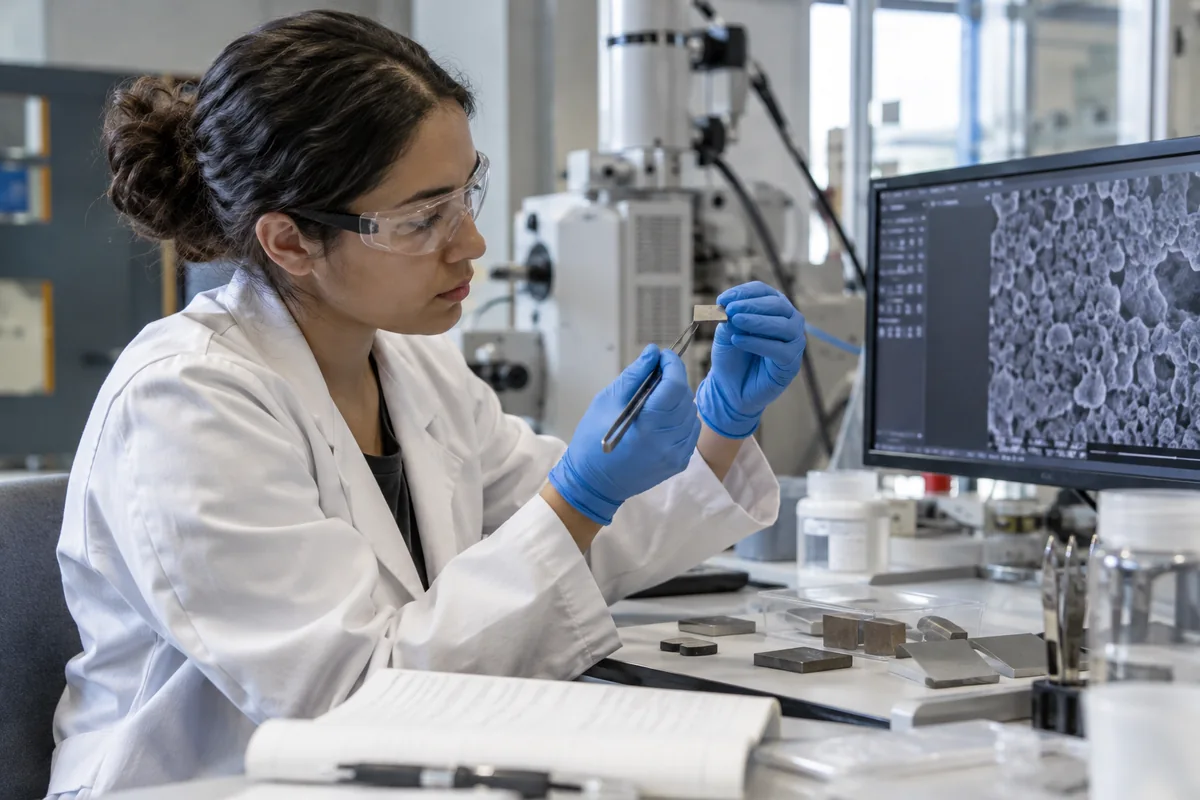
materials scientist testing a small material sample in a laboratory.

A day in the life

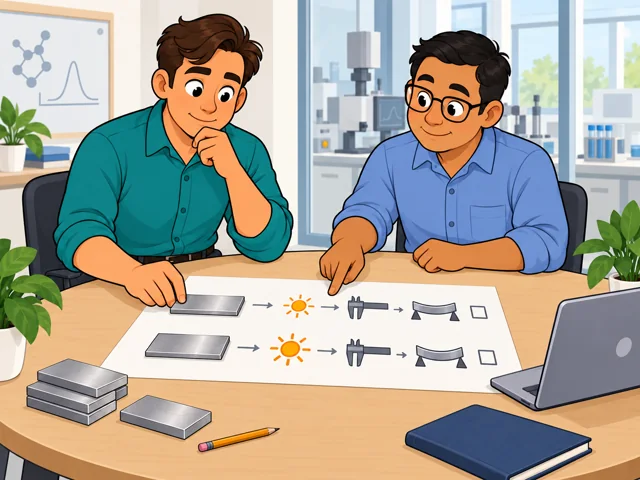
1A materials scientist and a colleague plan a comparison using matching metal samples and a diagram that varies one processing condition.

Choose what to vary

Pick one component or processing setting to vary, plus readings that show improvement, so the comparison stays fair.
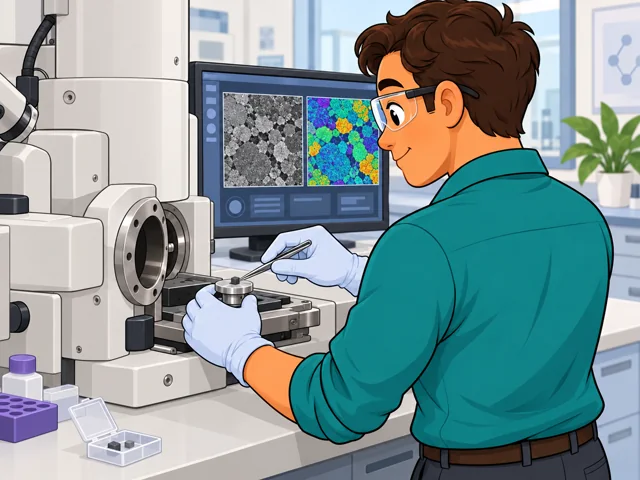
2A materials scientist positions a specimen on an electron microscope holder beside a screen showing tiny structures and a composition map.

See inside a sample

For microscopy projects, prepare an electron microscope specimen, then examine its tiny structures and map its makeup.
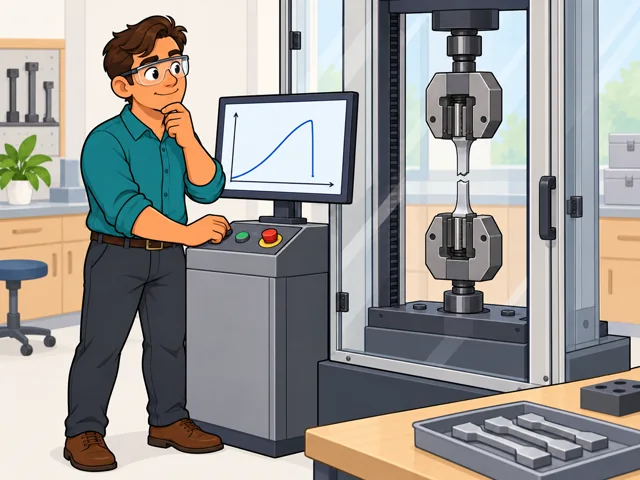
3A materials scientist studies a tensile-test curve beside a guarded machine holding the two ends of a fractured metal specimen.

Find where metal fails

Stretch a metal sample in a testing machine, then read the data to learn why it failed.
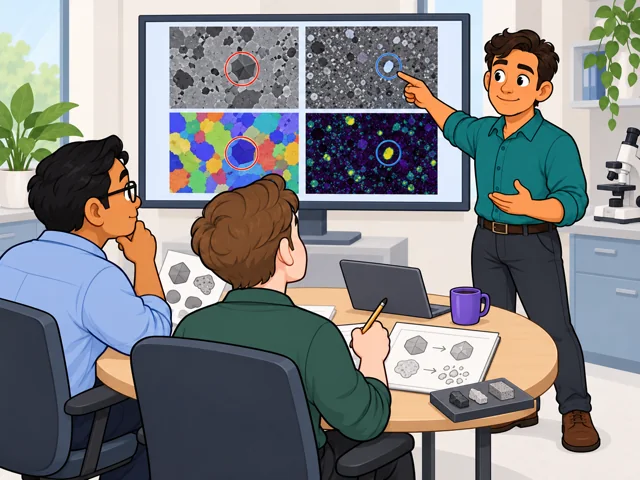
4A materials scientist explains microscopy evidence to two colleagues as they compare the findings with their experiment plan and sketch a follow-up test.

Make sense of the images

Check microscope results against the project's question, then show coworkers what they explain and what needs another experiment.

Quick facts

Preparation

Bachelor’s degree

United States · 2025–2035

Pay

$117,790/year

United States · May 2025

Outlook

8.3% projected growth

United States · 2025–2035

Quick orientation

Preparation, pay & outlook

Preparation

Bachelor’s degree

The typical entry education for materials scientists.

Geography
United States
Period
2025–2035

Pay

$117,790/year

National median for materials scientists; equivalent to $56.63 an hour.

Geography
United States
Period
May 2025

Outlook

8.3% projected growth

About 600 openings a year nationally, including replacement openings.

Geography
United States
Period
2025–2035

Fit, tradeoffs & changing tools

Things to weigh

  • Trial and error can be slow; an unsuccessful experiment still needs careful records.
  • Chemical work requires protective equipment and safety procedures. Time-sensitive experiments sometimes extend beyond normal hours.

Where AI may help

In some experimental labs, robots mix and heat samples while artificial intelligence helps choose the next recipe. Demonstrations include solid powders and thin films.

What people still lead

Researchers design the larger investigation and develop the instruments and methods that make automated experiments possible.

What we can’t predict yet

How much of a whole experiment can run unattended remains an open question, especially when a new material needs different handling or measurements.

Pay in context

Earnings

The national median is a useful reference, not a starting-salary offer.

The national spread

Materials scientists had a median wage of $117,790 a year, equivalent to $56.63 an hour. The lowest-paid 10% earned below $66,820; the highest-paid 10% earned above $197,290. These are wage percentiles, not career stages.

Geography
United States
Period
May 2025
Pay basis
National employee wage estimates for SOC 19-2032; annual wages and hourly equivalent, not total compensation.

What can affect an offer

Location, relevant experience, education, and training can influence starting pay. An advanced degree alone does not tell you what an employer will offer.

Geography
United States
Period
2026
Pay basis
Qualitative employer hiring factors; no occupation-wide pay premium estimated.

Openings over the next decade

Employment is projected to grow 8.3% from 2025 to 2035, with about 600 openings annually on average. Those openings include replacing people who leave the occupation, as well as growth.

Geography
United States
Period
2025–2035
Pay basis
Employment projection for SOC 19-2032; not a wage measure or count of current vacancies.

Getting started

Build a materials foundation

What the route involves
Complete a relevant bachelor’s degree. Materials science and engineering programs combine chemistry, physics, mathematics, computing, and laboratory study of how processing changes properties.
What it can lead to
You build preparation for entry-level materials work and for graduate study.

Prepare for research-focused positions

What the route involves
After a relevant bachelor’s degree, pursue a master’s degree or Doctor of Philosophy (PhD) with specialized research.
What it can lead to
You can meet the advanced-education requirement of research jobs that require graduate preparation.
What to check
Some positions also require work experience; graduate education is not required for every materials-scientist job.

A bachelor’s degree is the usual starting point.

After entry

Career paths

This starts where the entry routes leave off: early work, growing capability, and advancement or specialization.

  1. Get established

    Learn your employer’s instruments from experienced scientists before relying on your own measurements.

  2. Develop a method

    Become reliable at a technique such as electron microscopy, then improve sample preparation and analysis methods.

  3. Lead scientific work

    One advancement option is science management, taking responsibility for other researchers’ work.

Where you can work

Industrial materials laboratories

In a glass or ceramics company’s characterization lab, you work with project teams to explain product failures and processing problems. Several projects may compete for your instrument time.

  • Indoors
  • Lab

National-laboratory research groups

In materials-discovery projects, you may work alongside students and other researchers to connect computer predictions with experiments. Building custom equipment can be part of answering the research question.

  • Indoors
  • Lab

Try it

See whether the job clicks before you commit to the path.

Compare equal strips of the same paper, leaving one flat and folding another lengthwise. Bridge each across the same gap between two books and add coins one at a time. Record when each sags, repeat, and explain what you changed. Did you enjoy designing a fair test and explaining the result?

Stay safe: Keep the setup low over a tabletop. This explores how shape affects behavior; it does not measure an intrinsic material property.

Explore more careers

Sources

  1. O*NET OnLine. Materials Scientists — 19-2032.00. Accessed 2026-10-09.
  2. U.S. Bureau of Labor Statistics. Chemists and Materials Scientists — Occupational Outlook Handbook. Accessed 2026-10-09.
  3. U.S. Bureau of Labor Statistics. May 2025 national wage estimates — SOC 19-2032; supplied pinned binding. Accessed 2026-09-29.
  4. U.S. Bureau of Labor Statistics. Employment Projections Table 1.2, 2025–2035 — SOC 19-2032; supplied pinned binding. Accessed 2026-09-29.
  5. University of Illinois Urbana-Champaign. Materials Science & Engineering, Bachelor of Science — 2026–2027 Catalog. Accessed 2026-10-09.
  6. Corning. Senior Scientist, Electron Microscopy — requisition 78007. Accessed 2026-10-09.
  7. Lawrence Berkeley National Laboratory. Meet the Autonomous Lab of the Future. Accessed 2026-10-09.
  8. Lawrence Berkeley National Laboratory. Optimized Materials in a Flash. Accessed 2026-10-09.

Your message goes to the Great Jobs team. How we use your information