

Career profile

Mathematics College Instructor

College math instructors show students how math ideas work and how to justify answers.

A student lands on the right number but cannot say why. Pick a question or worked example that lets them build the logic themselves.
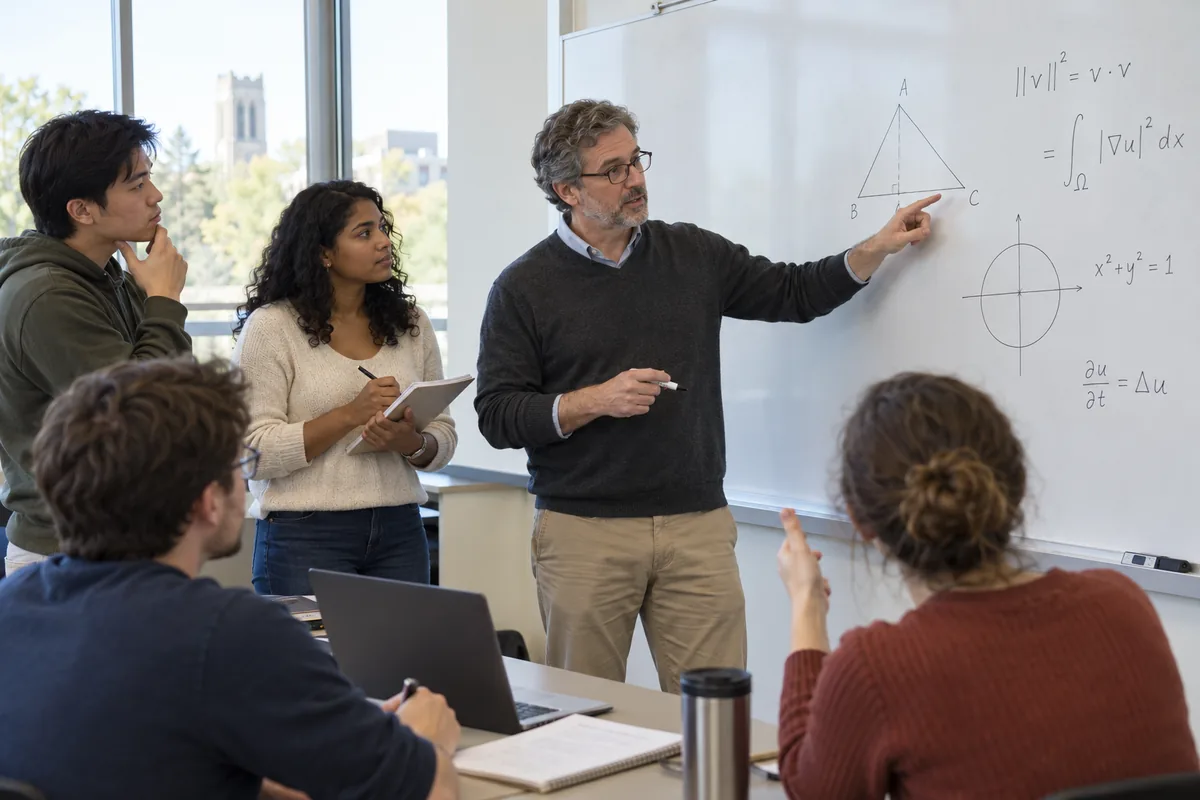
Mathematics instructor discusses a proof with university students.

A day in the life

1A mathematics instructor draws a tangent to a curve while two adult male students watch, one gesturing upward to discuss its slope.

Show slope with a tangent line

Sketch a curve and its tangent, ask how the slope shifts, then tie students' observations to the derivative.

2The instructor organizes practice problems at her desk and adds a final question with room for students to explain their reasoning.

Build the next problem set

Choose exercises that drill a technique, then add one asking students to explain why that technique works.

3The instructor compares student solutions, marks a repeated error, and prepares a short example to revisit in class.

Go through students' written solutions

If several students make the same algebra slip, write a short worked example before starting new material.

4During office hours, an adult male student points to a confusing step while the instructor helps him continue from that point.

Untangle work in office hours

Have a student point to where their work fell apart, then pick up from that exact step.
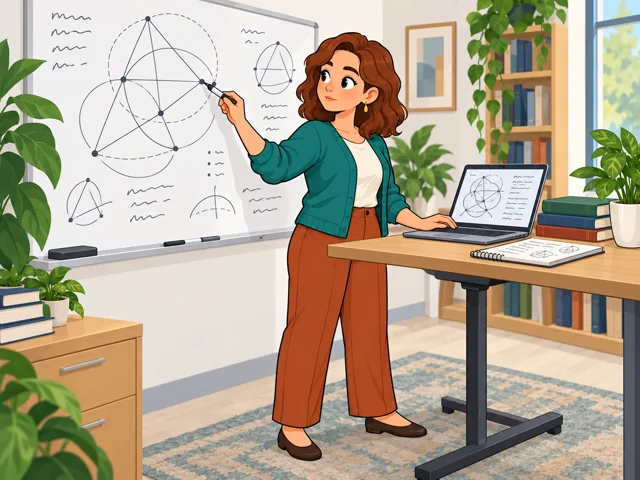
5The instructor checks a mathematical diagram and writes up her reasoning in a research manuscript.

Work on your own research

In research appointments, you explore a problem in your own specialty and write up findings for peers.

Quick facts

Preparation

Usually graduate school

United States

Pay

$79,940 median annually

United States · 2025

Outlook

1.7% projected growth

United States · 2025–2035

Quick orientation

Preparation, pay & outlook

Preparation

Usually graduate school

Some community colleges accept a master's degree; four-year colleges typically require a doctorate.

Geography
United States
Period
Not applicable

Pay

$79,940 median annually

For mathematical science teachers, postsecondary, in 2025.

Geography
United States
Period
2025

Outlook

1.7% projected growth

About 3,900 openings annually for mathematical science teachers, postsecondary, over 2025–2035.

Geography
United States
Period
2025–2035

Fit, tradeoffs & changing tools

Things to weigh

  • Class time is only part of the workload. Preparation and grading continue afterward; research appointments add competing publication demands.
  • Part-time teaching can mean working at several colleges, with separate schedules and course expectations to manage.

Where AI may help

Tools that generate text and worked answers—generative artificial intelligence, or AI—can help draft assessment ideas. You still need to examine what each question actually tests.

What people still lead

You decide whether a student understands the reasoning. A polished homework answer alone may reveal little when software can produce it.

What we can’t predict yet

How much assessment will move toward live explanations, classroom work, or other formats remains unsettled as these tools improve.

Pay in context

Earnings

Compare the pay with the contract: how many months it covers and what teaching, advising, and research it requires.

The national midpoint

The 2025 median was $79,940 annually for mathematical science teachers, postsecondary. Dividing by 2,080 gives about $38.43 an hour for comparison only; it is not a measured hourly wage or a faculty work schedule.

Geography
United States
Period
2025
Pay basis
Annual wage; calculated hourly equivalent uses 2,080 hours

The spread is wide

The lowest-paid 10% earned $49,180 or less; the highest-paid 10% earned $139,340 or more. These are wage percentiles, not starting and senior salaries.

Geography
United States
Period
2025
Pay basis
Annual wage percentiles for mathematical science teachers, postsecondary

Pay across college settings

In May 2023, mathematical science teachers averaged $92,240 annually at junior colleges and $96,860 at colleges, universities, and professional schools nationwide. These older figures compare workplace averages, not starting salaries; moving between settings does not guarantee a raise.

Geography
United States
Period
May 2023
Pay basis
Annual mean wages for mathematical science teachers, postsecondary, by industry; historical comparison

Openings exceed net growth

Employment is projected to grow 1.7% over 2025–2035, with about 3,900 openings a year on average. Openings include replacement needs, so they are not all newly created jobs or guaranteed full-time positions.

Geography
United States
Period
2025–2035
Pay basis
Employment projections for mathematical science teachers, postsecondary

Getting started

Earn a master's for teaching-focused openings

What the route involves
Complete a bachelor's degree, then a master's in mathematics. Build teaching experience alongside your studies when possible.
What it can lead to
You can meet the education requirement for some community-college mathematics positions.
What to check
Check each vacancy's degree and graduate-course requirements. Teaching experience may be preferred even when the degree meets the minimum.

Complete a doctorate for university teaching and research

What the route involves
Pursue a Doctor of Philosophy (Ph.D.) in mathematics or a relevant field, including original research and a dissertation.
What it can lead to
This meets the usual degree level for university faculty roles that combine teaching with mathematical research.
What to check
Hiring also evaluates evidence of teaching and research; completing the degree does not secure an appointment.

Plan for advanced mathematics study. The degree you need depends on the institution and appointment.

After entry

Career paths

This starts where the entry routes leave off: early work, growing capability, and advancement or specialization.

  1. Get established

    Turn your course outline into weekly lessons, keep grading current, and establish dependable office hours and student records.

  2. Improve your courses

    Use students' explanations and exam work to revise lessons. Learn which examples help them connect calculations with concepts.

  3. Advance or lead

    In eligible appointments, pursue promotion from assistant to associate professor through review of teaching, research, and service.

    • Move into department leadership, helping coordinate courses and faculty work.

Where you can work

Community colleges

Teaching and student support usually take priority. Your courses may range from foundational algebra to statistics, with advising and daytime, evening, or online sections shaping the week.

  • Indoors
  • Office

University teaching-and-research departments

Your week can combine mathematics classes for several majors, student research projects, your own research, and faculty committees. Those responsibilities compete for preparation and writing time.

  • Indoors
  • Office

Try it

See whether the job clicks before you commit to the path.

Teach a friend why adding two odd integers always gives an even integer. Prepare a numerical example and a general explanation, then ask them to explain it back. Notice whether you enjoy finding a new explanation when the first one does not land.

Explore more careers

Sources

  1. O*NET OnLine. Mathematical Science Teachers, Postsecondary. Accessed 2026-10-04.
  2. O*NET OnLine / U.S. Bureau of Labor Statistics. National Wages: Mathematical Science Teachers, Postsecondary. Accessed 2026-10-04.
  3. U.S. Bureau of Labor Statistics. Occupational projections, 2025–35, and worker characteristics, 2025. Accessed 2026-10-04.
  4. U.S. Bureau of Labor Statistics. Postsecondary Teachers. Accessed 2026-10-04.
  5. North Carolina Community College System / Edgecombe Community College. Instructor - Mathematics (9-month position). Accessed 2026-10-04.
  6. University of Washington. Assistant Professor (Tenure Track) - Mathematics, Tacoma. Accessed 2026-10-04.
  7. Mathematical Association of America. Instructional Practices Guide. Accessed 2026-10-04.
  8. Mathematical Association of America. MAA Statement on AI in Higher Education. Accessed 2026-10-04.
  9. U.S. Bureau of Labor Statistics. May 2023 Occupational Employment and Wages: Mathematical Science Teachers, Postsecondary. Accessed 2026-10-04.

Your message goes to the Great Jobs team. How we use your information