
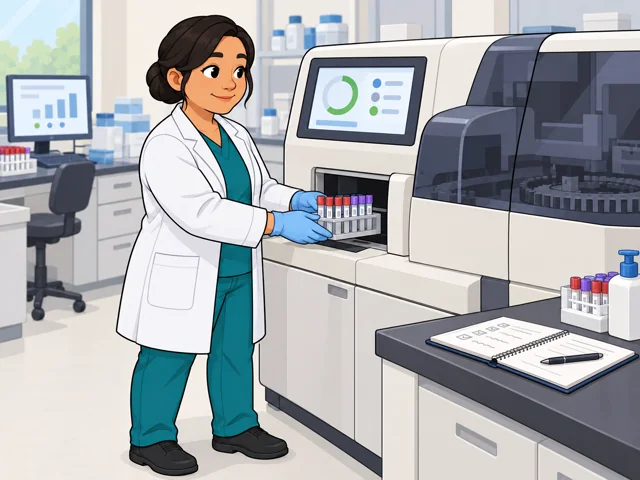
Run and log the analyzer
Load patient specimens into the analyzer, which measures substances in them, and keep its maintenance logs current.
Career profile
Medical laboratory scientists test patient specimens so clinicians can identify illness and guide care.
An analyzer produces a number, and you judge whether it makes sense, dig into problems and help decide if it can be trusted.
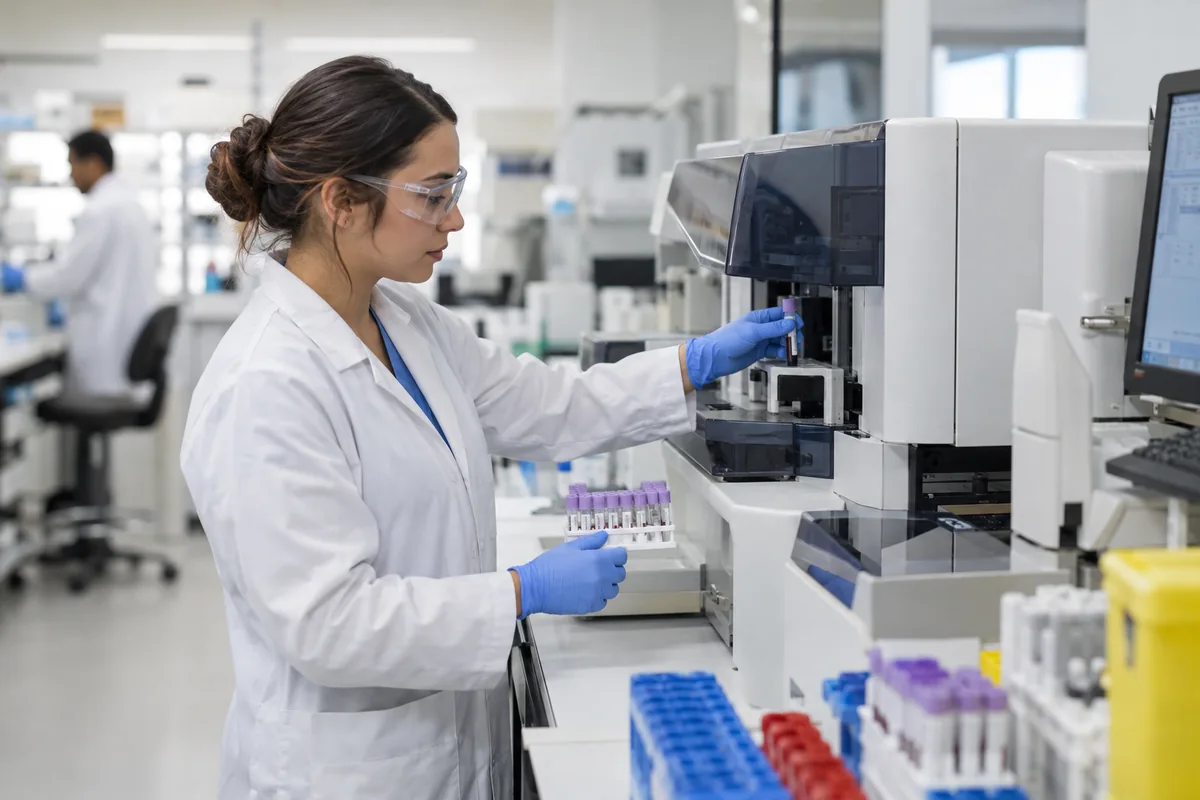
Load patient specimens into the analyzer, which measures substances in them, and keep its maintenance logs current.

At the hematology bench, you study the shapes and numbers of blood cells under a microscope.
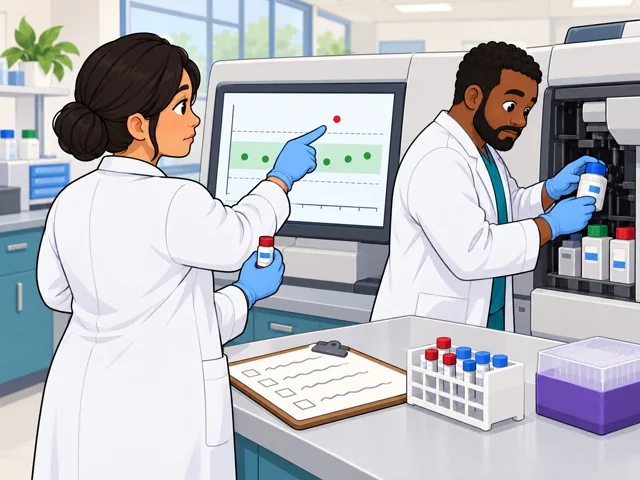
If a known-result control misses its limits, check the instrument and procedure before trusting patient results.

Enter results into the lab's computer system and talk a clinician through what a finding means.
United States
Scientist-only median pay is not reported. Broader laboratory pay figures appear below.
Scientist-only growth and openings are not reported; the broader group includes technicians.
Quick orientation
A degree paired with an accredited medical laboratory science program is an established route.
Scientist-only median pay is not reported. Broader laboratory pay figures appear below.
Scientist-only growth and openings are not reported; the broader group includes technicians.
In some specialty labs, automatic pipettors transfer samples into testing plates, reducing repetitive hand work.
You still check the quality of results, maintain instruments, and explain findings to clinicians.
As laboratories automate more steps, the balance between handling samples and investigating exceptions may shift. How far that shift goes will depend on the tests and equipment.
Pay in context
National pay for medical laboratory scientists alone is not reported. The nearest official figures combine clinical laboratory technologists and technicians.
For that combined group, the May 2025 median was $62,930 a year, or $30.26 an hour. The lowest 10% earned below $38,910; the highest 10% earned above $100,990. These are wage percentiles, not starting and senior salaries.
Employment is projected to grow 3% from 2025 to 2035, with about 20,800 openings annually. Many openings replace people leaving the occupation or workforce.
You can build clinical laboratory training into your first degree or add it after a science degree. Check prerequisites and clinical placements before choosing a program.
After entry
This starts where the entry routes leave off: early work, growing capability, and advancement or specialization. This path also has a credential or licensing boundary; see the requirements and limits.
Learn your laboratory’s instruments, control checks, and reporting system until you can run its routine workflow reliably.
Build skill in tracing instrument problems and checking whether a new testing method produces dependable results.
With experience, you may train staff or move into a supervisor role overseeing testing and quality.
You work with clinicians caring for current patients and communicate findings as testing proceeds. Round-the-clock care can mean rotating shifts and weekend coverage.
You may concentrate on a narrower set of tests. A neuroimmunology bench, for instance, can combine automated sample transfers with examining fluorescent patterns through a microscope.
Try it
Make a fictional control-results chart with an acceptable range of 9–11 and readings of 10, 10, 9, 12, and 13. Mark where you would pause and write two questions about the instrument or testing process. Notice whether checking the measurement interests you as much as getting the answer.
Stay safe: Use invented numbers only; this is a paper exercise, not a way to interpret medical results.