
Career profile

Mining and Geological Engineer

Mining engineers decide where and how to dig a mineral deposit out of the ground.

Rich-looking ore on a map can be hard to reach. You match the rock underground with the tunnels, roads and machines that bring it out.
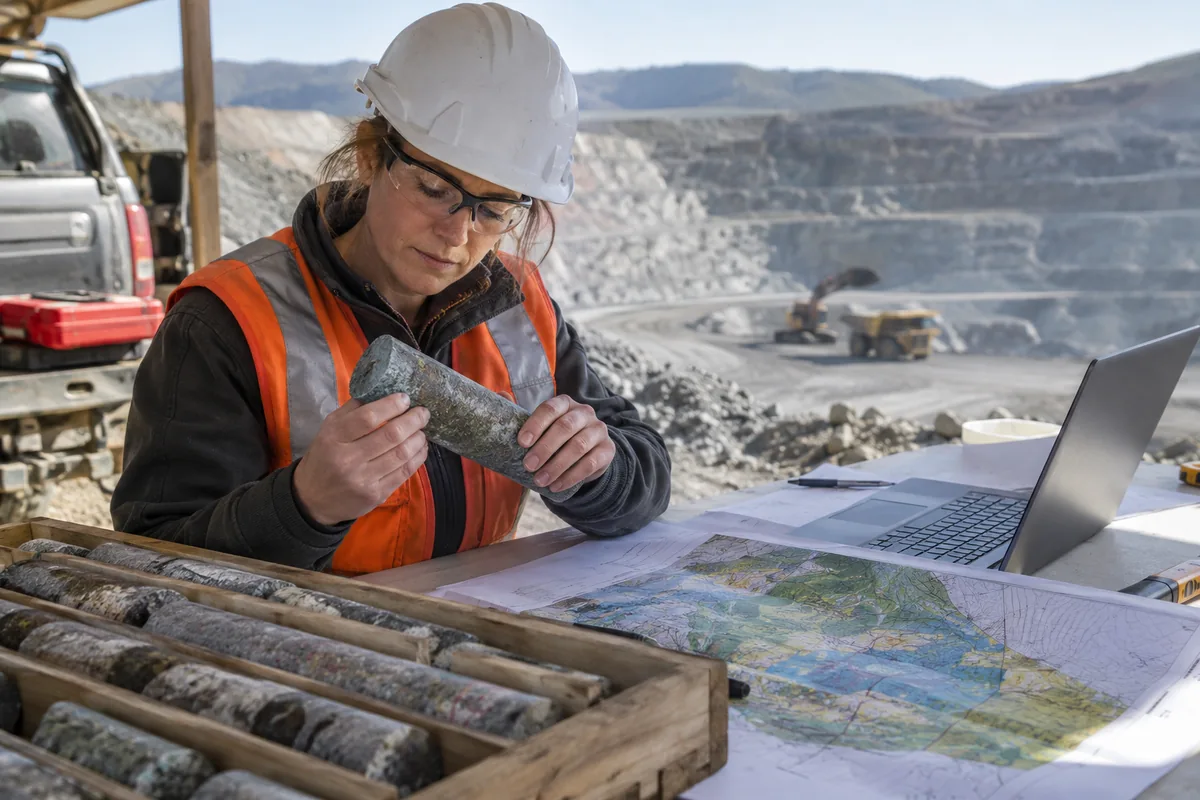
A geological engineer in a hard hat and safety vest examines a piece of drill core in a core shed, beside wooden trays of core samples.

A day in the life

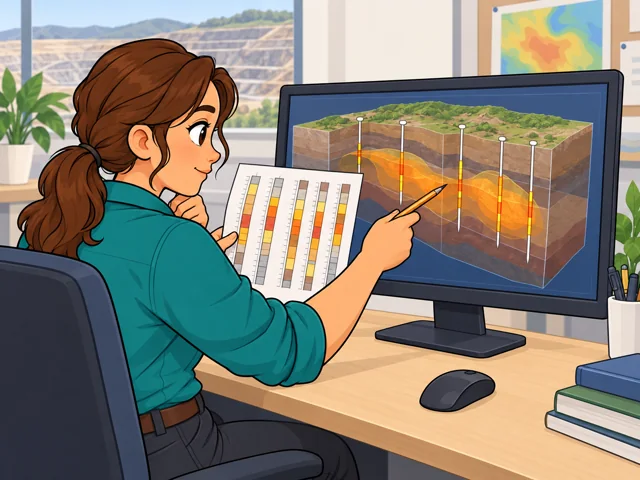
1A mining engineer compares colored intervals in drilling records with borehole traces through a three-dimensional mineral deposit model.

Match drill data to the model

Set drill hole data beside a 3D ore body model to judge how far worthwhile rock may reach.
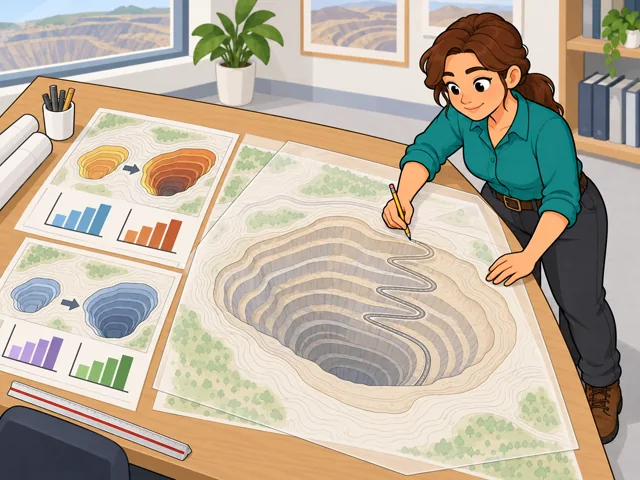
2The engineer sketches a surface-mine access road while comparing excavation sequences and their cost charts across a drafting table.

Plan roads and digging order

At a surface mine, sketch the access roads in, then weigh several digging orders by what each costs.
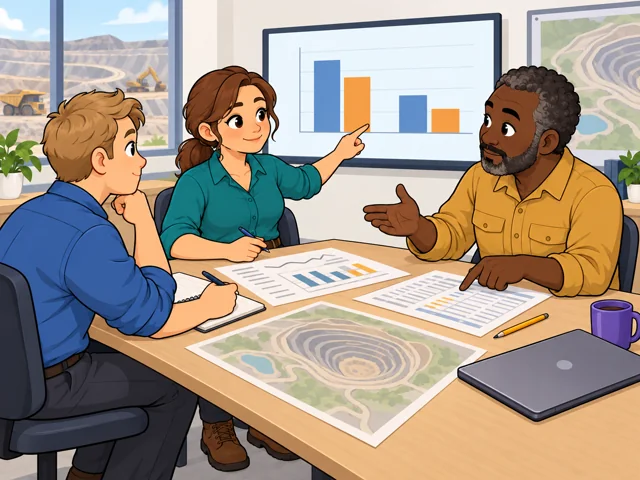
3The engineer reviews a production shortfall with two male mine colleagues, listening as the older colleague gestures toward operating records.

Chase a shortfall in output

Compare actual output with the plan and discuss the gap with site staff before proposing a change.
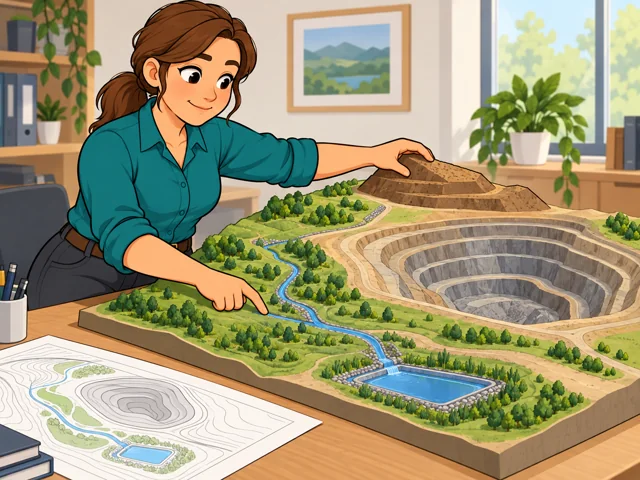
4The engineer evaluates waste placement on a mine terrain model, tracing drainage toward a pond and checking areas planned for restoration.

Decide where waste rock goes

Decide where dug-out waste rock goes, and fit water handling and land restoration into the overall mine plan.

Quick facts

Preparation

Bachelor’s degree

United States

Pay

$106,220/year

United States · May 2025

Outlook

3.8% growth

United States · 2025–2035

Quick orientation

Preparation, pay & outlook

Preparation

Bachelor’s degree

Usually mining or geological engineering, or a related field.

Geography
United States
Period
Not applicable

Pay

$106,220/year

National median, equivalent to $51.07/hour, including mining safety engineers.

Geography
United States
Period
May 2025

Outlook

3.8% growth

About 300 openings per year nationally, including mining safety engineers.

Geography
United States
Period
2025–2035

Fit, tradeoffs & changing tools

Things to weigh

  • Some mines are far from towns, and schedules can vary or run longer than usual.
  • Site visits can mean bad weather, protective equipment and strict safety procedures.

Where AI may help

Mine-planning software can turn drilling data into three-dimensional models and compare extraction schedules. Tools such as Vulcan let you test different assumptions.

What people still lead

You decide which ground conditions, safety limits and costs the plan must respect, then explain the choices to the people running the mine.

What we can’t predict yet

How much routine planning becomes automated remains uncertain; unusual geology and changing operating conditions can still force a plan to be reconsidered.

Pay in context

Earnings

The national median was $106,220 a year, or $51.07 an hour, in May 2025. These figures include mining safety engineers and are not starting-pay estimates.

The national spread

The 10th-percentile annual wage was $67,490; the 90th-percentile wage was $169,990. These mark the lower and upper ends of the middle 80% of workers, not beginner and senior salaries.

Geography
United States
Period
May 2025
Pay basis
National employee wage percentiles for mining and geological engineers, including mining safety engineers; not total compensation.

Openings include replacements

Employment is projected to grow 3.8% from 2025 to 2035, with about 300 openings annually on average. Openings include replacing people who leave the occupation, not just newly created jobs.

Geography
United States
Period
2025–2035
Pay basis
Employment projection for mining and geological engineers, including mining safety engineers; not a wage measure.

Getting started

Study mining engineering

What the route involves
Study mine design, rock behavior, ventilation and costs, with laboratory and field exercises.
What it can lead to
Build preparation for entry roles in mine engineering, operations and mining consulting.

Study geological engineering

What the route involves
Combine geology with engineering analysis and design; choose coursework that connects ground conditions with mineral resources.
What it can lead to
Build preparation for geological engineering work, including evaluating ground conditions for mining projects.

A bachelor’s degree is the usual starting point. Two relevant study paths emphasize different parts of the work.

After entry

Career paths

This starts where the entry routes leave off: early work, growing capability, and advancement or specialization. This path also has a credential or licensing boundary; see the requirements and limits.

  1. Get established

    Learn how your mine’s maps, measurements and production records fit together. Practice turning them into clear plans and reports.

  2. Develop your judgment

    Take on more detailed equipment choices or mine-design work, comparing technical options with their operating costs.

  3. Specialize or lead

    Become a technical specialist or move toward supervising engineers and technicians. Engineering management adds responsibility for the wider team.

Where you can work

At a mine or quarry

You visit the workings to see how designs hold up on the ground. A quarry may be near a town; a mineral mine may be isolated. Outdoor conditions shape site days.

  • Field work
  • Outdoors
  • Safety-sensitive

At an engineering-services firm

Office time gives you space to build models and compare designs. Site visits connect that computer work with the actual excavation.

  • Office
  • Field work
  • Travel

Try it

See whether the job clicks before you commit to the path.

On graph paper, draw an imaginary mineral deposit, a processing plant and a stream. Sketch two routes for moving rock to the plant. Compare their lengths and list what you would need to know about the ground before choosing. Notice whether you enjoy turning a map into a workable plan.

Explore more careers

Sources

  1. O*NET OnLine. Mining and Geological Engineers, Including Mining Safety Engineers — 17-2151.00. Accessed 2026-10-10.
  2. U.S. Bureau of Labor Statistics. Mining and Geological Engineers — Occupational Outlook Handbook. Accessed 2026-10-10.
  3. U.S. Bureau of Labor Statistics. Occupational Employment and Wage Statistics — May 2025 national estimates, SOC 17-2151. Accessed 2026-09-29.
  4. U.S. Bureau of Labor Statistics. Employment Projections Table 1.2 — 2025–2035, SOC 17-2151. Accessed 2026-09-29.
  5. Colorado School of Mines. Bachelor of Science in Mining Engineering. Accessed 2026-10-10.
  6. Missouri University of Science and Technology. Mining Engineering — Undergraduate Catalog. Accessed 2026-10-10.
  7. Missouri University of Science and Technology. Geological Engineering — Undergraduate Catalog. Accessed 2026-10-10.
  8. Maptek. Vulcan — 3D mine planning and geological modelling. Accessed 2026-10-10.
  9. National Council of Examiners for Engineering and Surveying. Licensure. Accessed 2026-10-10.

Your message goes to the Great Jobs team. How we use your information