
Career profile

Nuclear Medicine Technologist

Nuclear medicine technologists prepare and give radioactive drugs, then guide patients through scans or therapy.

Running the imaging camera is only one piece of a visit. Accurate doses, radiation safety, equipment checks and calm explanations to patients all matter.
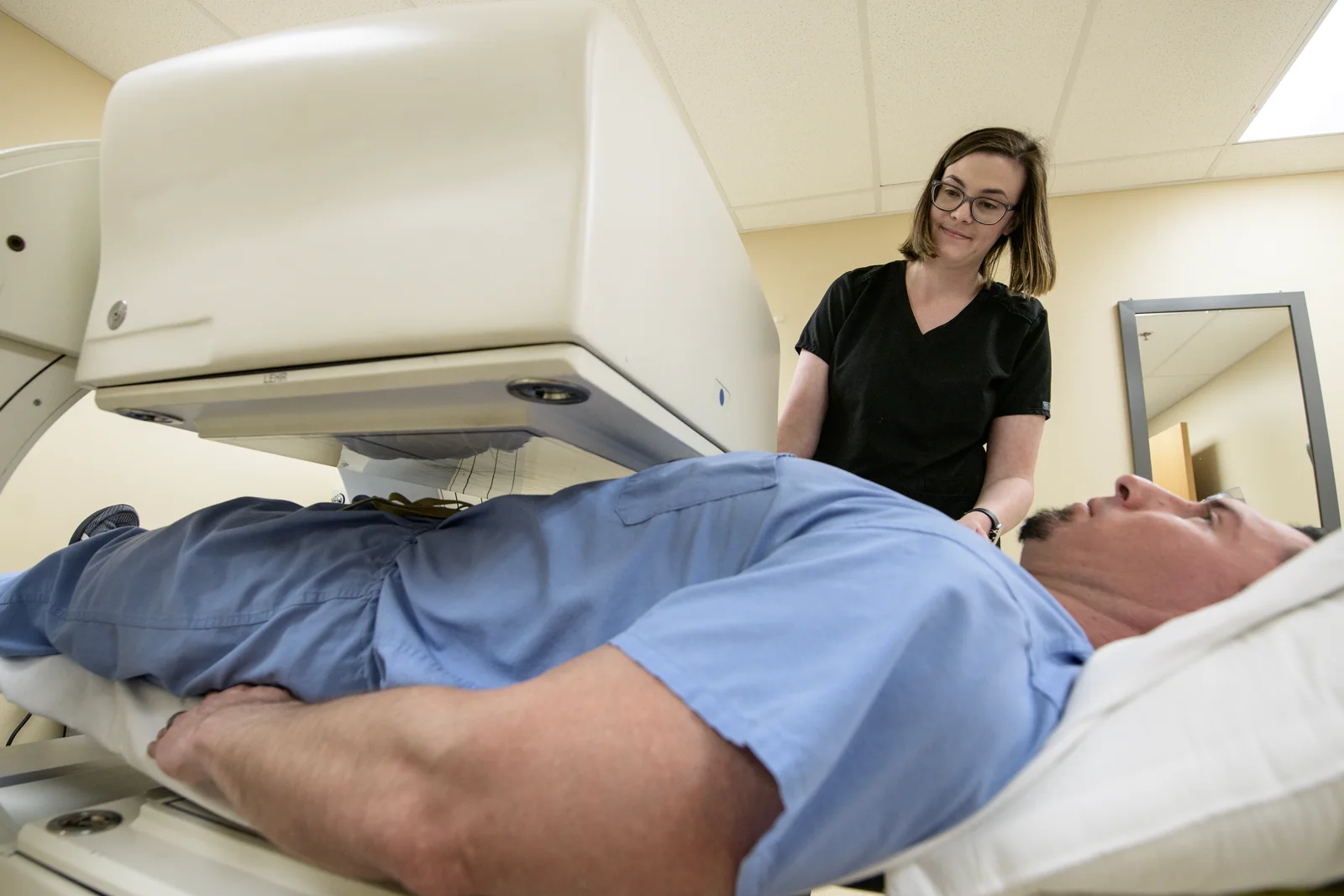
A nuclear medicine technologist checks a patient's comfort while operating a dual-head imaging camera.
Lance Cheung / USDA. Public domain U.S. Department of Agriculture photo. No USDA endorsement implied.

A day in the life

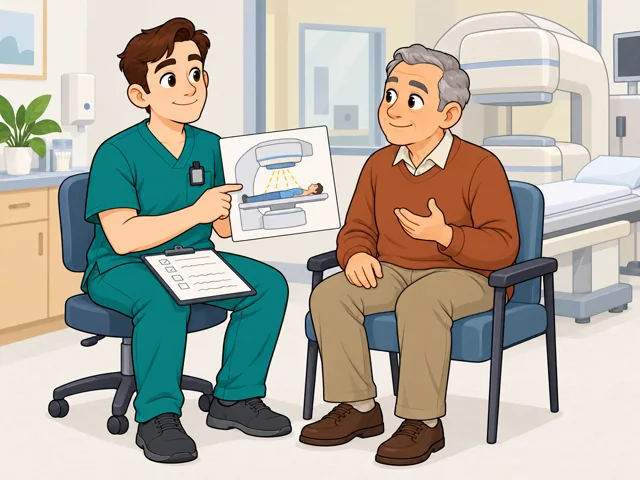
1A technologist reviews a history form and explains a nuclear medicine scan to a seated older man using a wordless diagram.

Walk a patient through the visit

You review relevant history, explain the procedure and safety steps, answer questions, and help the patient into place.
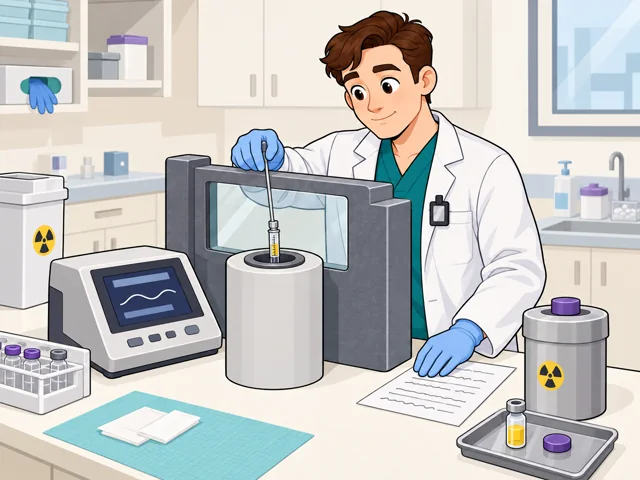
2A gloved technologist checks a radiopharmaceutical dose with a dose calibrator at a shielded preparation bench.

Ready the radioactive dose

Calculate or confirm the doctor's ordered dose, prepare it under radiation protection rules, and give it as directed.
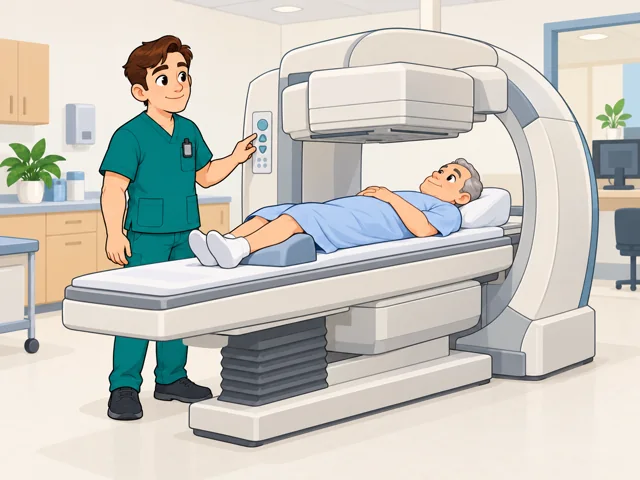
3A technologist operates a gamma camera beside an older man resting on the imaging table.

Image where the tracer goes

Position the patient, run a gamma camera, PET system or other scanner to see where the tracer went.
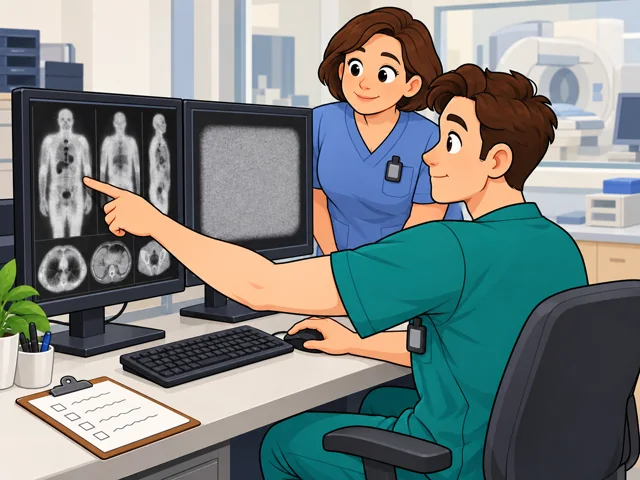
4A technologist and a woman coworker review nuclear medicine images and an equipment quality-control image at a workstation.

Process and check the images

Process the images, watch for technical problems and run quality-control tests so a doctor can interpret the study.
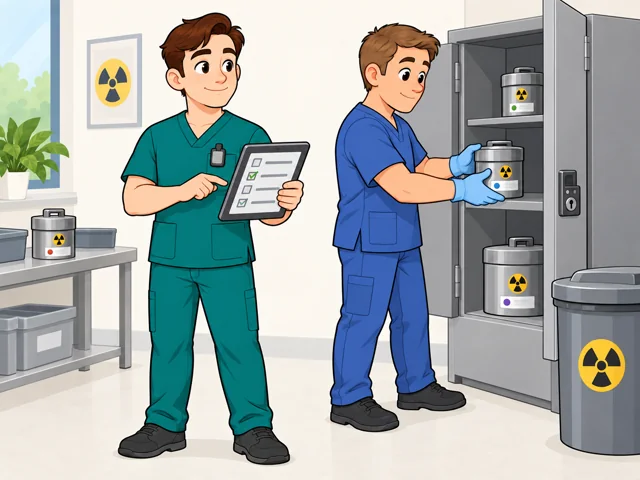
5A technologist completes a material-accounting record while a man coworker places a shielded container into secure storage.

Account for the radioactive material

Log doses given and procedure results, track all radioactive material, and store or discard it under required rules.

Quick facts

Preparation

Associate's degree

United States

Pay

$101,370

United States · May 2025

Outlook

4% growth

United States · 2025–2035

Quick orientation

Preparation, pay & outlook

Preparation

Associate's degree

Typical entry is an associate's degree from an accredited nuclear medicine technology program with supervised clinical experience.

Geography
United States
Period
Not applicable

Pay

$101,370

National median annual wage for nuclear medicine technologists; this is not a starting salary.

Geography
United States
Period
May 2025

Outlook

4% growth

Projected employment growth from 2025 to 2035, with about 800 openings per year on average, many from replacement needs.

Geography
United States
Period
2025–2035

Fit, tradeoffs & changing tools

Things to weigh

  • Radiation is part of the workplace. Shielding, monitoring badges, records, and careful handling reduce exposure, but safety procedures are not optional.
  • The job can mean long periods standing and helping lift or turn patients, along with exposure to infectious disease.
  • Hospital positions may include evenings, weekends, irregular hours, or on-call coverage.

Where AI may help

Computers already help acquire and process images, calculate and record doses, run cardiac studies, manage records, and monitor equipment.

What people still lead

The technologist still leads the patient interaction, safely prepares and administers material, positions the patient, checks quality, and follows the prescribed procedure.

What we can’t predict yet

Software and workflows may differ among departments and continue to change. Future effects on staffing and legal scope remain uncertain.

Pay in context

Earnings

National wage data combine workers across experience levels, employers, schedules, and locations, so use them as a benchmark rather than a promised offer.

National median

The median annual wage was $101,370: half of workers earned more and half earned less. The median hourly wage was $48.74.

Geography
United States
Period
May 2025
Pay basis
Annual wage estimate for employed nuclear medicine technologists

Observed wage spread

The lowest-paid 10 percent earned less than $78,080, while the highest-paid 10 percent earned more than $134,500. Those percentiles are not entry-level and senior-career labels.

Geography
United States
Period
May 2025
Pay basis
Annual wage distribution for employed nuclear medicine technologists

Getting started

Accredited nuclear medicine degree

Typically an associate's degree; bachelor's programs also exist.
What the route involves
Complete nuclear medicine coursework in areas such as anatomy, physics, chemistry, radioactive drugs, and computing, plus supervised clinical experience.
What it can lead to
Provides the typical education used to enter nuclear medicine technology and the clinical preparation employers expect.
What to check
Confirm that the program's accreditation and outcomes fit the licensing and employer requirements where you plan to work.

Related health degree plus certificate

A related associate's or bachelor's degree, followed by a 12-month nuclear medicine technology certificate.
What the route involves
First qualify in a related health field, such as radiologic technology or nursing, then complete focused nuclear medicine education and clinical training.
What it can lead to
Creates a transition into nuclear medicine for someone who already has substantial related healthcare education.
What to check
This is not a direct shortcut from high school; certificate programs set their own prior-degree and prerequisite rules.

Two common education routes lead toward entry. Most technologists become certified, some states require a license, and employers may set additional credential requirements.

After entry

Career paths

This starts where the entry routes leave off: early work, growing capability, and advancement or specialization.

  1. Get established

    Once hired, learn the department's protocols and procedure mix, then become consistent at preparing studies, documenting doses, checking equipment, and flagging problems.

  2. Handle more variation

    Build judgment across different patients and studies: adjust positioning and equipment settings, recognize technical problems, coordinate with the team, and keep your knowledge current.

  3. Specialize

    Experience and further assessment can lead toward PET, nuclear cardiology, or CT credentials. A specialty credential shows assessed proficiency but does not by itself guarantee expanded legal scope, a particular job, or higher pay.

    • Experienced technologists may also move toward student supervision, education, research support, or departmental responsibilities.

Where you can work

Hospitals

Hospitals employed 71 percent of these technologists in 2025. The setting may include a varied procedure mix, patients who need physical help, and evening, weekend, or on-call coverage.

  • Indoors
  • Shift work
  • On call
  • Physical demands
  • Safety-sensitive

Outpatient and diagnostic settings

These employers include physicians' offices, imaging clinics, laboratories, and outpatient care centers. One South Texas outpatient posting listed part-time daytime work with no weekends, showing one way schedules can differ from hospital on-call coverage—not a rule for every center.

  • Indoors
  • Safety-sensitive

Try the training on paper

Map one real program

Open one nuclear medicine technology program's curriculum and clinical handbook—or request them from admissions. Mark the anatomy, chemistry, physics, imaging, radiation-safety, and clinical requirements, then write which two parts interest you most and which two would test you.

Explore more careers

Sources

  1. U.S. Bureau of Labor Statistics. Occupational Outlook Handbook: Nuclear Medicine Technologists. Accessed 2026-09-22.
  2. O*NET OnLine. 29-2033.00 — Nuclear Medicine Technologists. Accessed 2026-09-22.
  3. Nuclear Medicine Technology Certification Board. Certification Exams. Accessed 2026-09-22.
  4. HCA Healthcare. Nuclear Medicine Technician - PT. Accessed 2026-09-23.

Your message goes to the Great Jobs team. How we use your information