
Career profile

Occupational Health and Safety Specialist

Safety specialists find hazards that could hurt workers, then plan changes that lower the risk.

For example, you trace dust to one task and help change how it's done. The payoff: something you noticed becomes a fix that works.

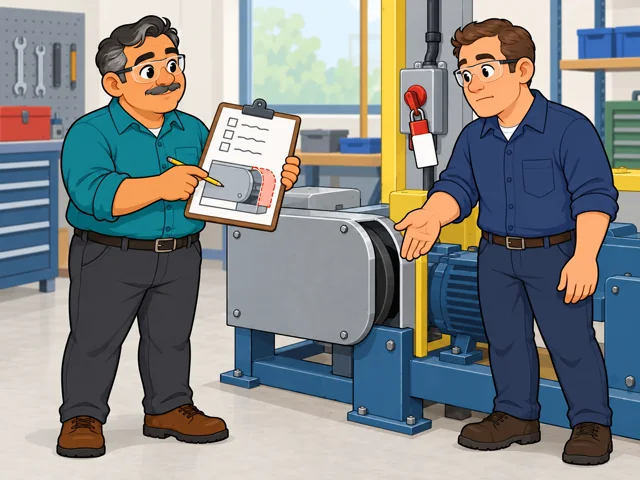
An occupational health and safety specialist inspects a machine guard with a worker.

A day in the life

1A safety specialist records a gap in a stopped machine's guard and shows a coworker a sketch of an extension.

Inspect a machine guard

Compare the guard against the safety rules, note the problem you find, and suggest a fix.

2A safety specialist compares a dust-monitor peak with a worker's task record and considers a proposed extraction-hood adjustment.

Trace a sudden dust spike

In exposure-monitoring roles, match dust monitor readings to tasks, find when exposure climbs, and weigh a proposed fix.

3A safety specialist and two coworkers reconstruct an incident from photographs and a report, then explore moving a cable out of a walkway.

Reconstruct an incident

Map out the order of events, read the written report, and name changes that could stop a repeat.
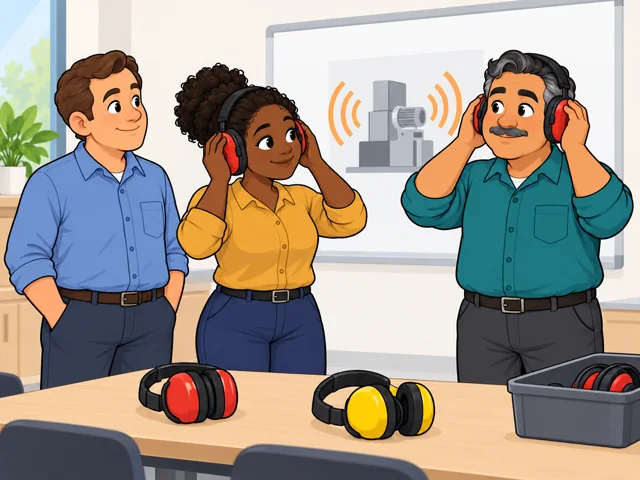
4A safety specialist demonstrates earmuff placement as one coworker practices and another watches beside a wordless noise-hazard diagram.

Demonstrate protective gear

You show workers the right way to use the gear and explain which danger it guards against.

Quick facts

Preparation

Typically a bachelor's degree

United States

Pay

$90,150 a year

United States · May 2025

Outlook

18% projected growth

United States · 2025–2035

Quick orientation

Preparation, pay & outlook

Preparation

Typically a bachelor's degree

Study occupational health and safety or a related field.

Geography
United States
Period
Not applicable

Pay

$90,150 a year

National median for specialists; equivalent to $43.34 an hour.

Geography
United States
Period
May 2025

Outlook

18% projected growth

Employment growth for specialists from 2025 to 2035.

Geography
United States
Period
2025–2035

Fit, tradeoffs & changing tools

Things to weigh

  • Site visits can mean prolonged standing, squatting, and working around hazards in protective equipment.
  • Some jobs involve substantial travel or weeks longer than 40 hours.

Where AI may help

Dust monitors and software can connect exposure peaks with particular activities, helping you locate a problem faster.

What people still lead

You still need to choose a suitable monitor, interpret its limits, and decide whether a change actually reduces exposure.

What we can’t predict yet

How much continuous monitoring replaces periodic sampling will depend on sensor reliability, cost, and workers' trust in how their data is used.

Pay in context

Earnings

Use the national figures as a comparison point when reading a job offer.

The midpoint and spread

The median was $90,150 a year, or $43.34 an hour. The 10th and 90th percentiles were $55,000 and $134,950. These describe the wage distribution, not starting and senior salaries.

Geography
United States
Period
May 2025
Pay basis
Annual and hourly employee wages for occupational health and safety specialists

Workplace type matters

Annual medians were $94,670 in construction, $91,590 in manufacturing, and $77,340 in management, scientific, and technical consulting.

Geography
United States
Period
May 2025
Pay basis
Industry median annual employee wages for occupational health and safety specialists

Openings across the country

About 17,100 specialist openings are projected annually, including replacement needs. This is a national projection, not a count of jobs currently advertised.

Geography
United States
Period
2025–2035
Pay basis
Projected annual average occupational openings; not compensation

Getting started

Study workplace health and safety

What the route involves
Earn a bachelor's degree with courses in safety management, ergonomics, and industrial hygiene—the study of workplace exposures.
What it can lead to
Meet the typical educational preparation for specialist positions.
What to check
Some positions require a master's degree.

Build qualifying experience for federal work

What the route involves
Build scientific or technical experience that demonstrates safety knowledge, then document how it matches a federal vacancy's requirements.
What it can lead to
Federal safety and occupational health management positions allow an experience-based qualification route.
What to check
General Schedule grade 5 requires knowledge equivalent to the specified education. Higher grades require specialized experience; the vacancy and federal group standards determine the full requirements.

A degree is the usual starting point. Some employers also prefer or require professional certification.

After entry

Career paths

This starts where the entry routes leave off: early work, growing capability, and advancement or specialization.

  1. Get established

    Join inspection teams, write clear findings, and learn to answer workers' practical safety questions.

  2. Take on a whole problem

    Plan inspections and use injury-report patterns to recommend changes across a worksite.

  3. Lead or specialize

    Move toward managing safety programs across multiple locations.

    • Develop a specialty such as laboratory safety or hearing protection.

Where you can work

Chemical plants

You examine production conditions and recommend changes to ventilation, equipment, or materials that expose workers to risk.

  • Indoors
  • Field work
  • Safety-sensitive

Public lands and field operations

At the Department of the Interior, work can span laboratories, shops, and isolated outdoor locations. Some assignments involve extreme temperatures or watercraft.

  • Indoors
  • Outdoors
  • Field work
  • Lab

Try it

See whether the job clicks before you commit to the path.

Sketch a familiar classroom or workspace. Pick one possible trip hazard, propose a change that removes it, and write how you would check whether the change worked. Notice whether you enjoy moving from observation to prevention.

Stay safe: Observe only; ask the person responsible for the space before moving anything.

Explore more careers

Sources

  1. U.S. Bureau of Labor Statistics. Occupational Health and Safety Specialists and Technicians. Accessed 2026-10-03.
  2. O*NET OnLine / U.S. Bureau of Labor Statistics. National Wages: Occupational Health and Safety Specialists. Accessed 2026-10-03.
  3. O*NET OnLine. 19-5011.00 — Occupational Health and Safety Specialists. Accessed 2026-10-03.
  4. U.S. Bureau of Labor Statistics. Occupational projections and worker characteristics. Accessed 2026-10-03.
  5. U.S. Office of Personnel Management. Safety and Occupational Health Management Series 0018. Accessed 2026-10-03.
  6. U.S. Department of the Interior. Safety and Occupational Health Management — GS-0018. Accessed 2026-10-03.
  7. National Institute for Occupational Safety and Health. The Use of Real-time Respirable Dust Monitors. Accessed 2026-10-03.
  8. National Institute for Occupational Safety and Health. Advanced Sensor Technologies and the Future of Work. Accessed 2026-10-03.

Your message goes to the Great Jobs team. How we use your information