
Career profile

Occupational Health and Safety Technician

Safety technicians measure hazards at work sites and help build safety programs into daily routines.

Numbers from your instruments become useful when you connect them to how workers really behave, giving the safety team proof it can act on.

An occupational health and safety technician measures air quality on a factory floor.

A day in the life

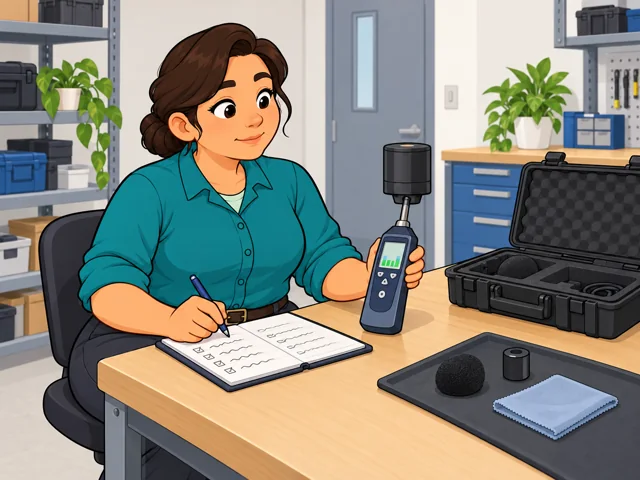
1A safety technician checks a sound-level meter connected to a calibrator and records its condition in an equipment log.

Calibrate your field instruments first

Calibrate your field instruments before you take any readings, then note their condition in the equipment log.
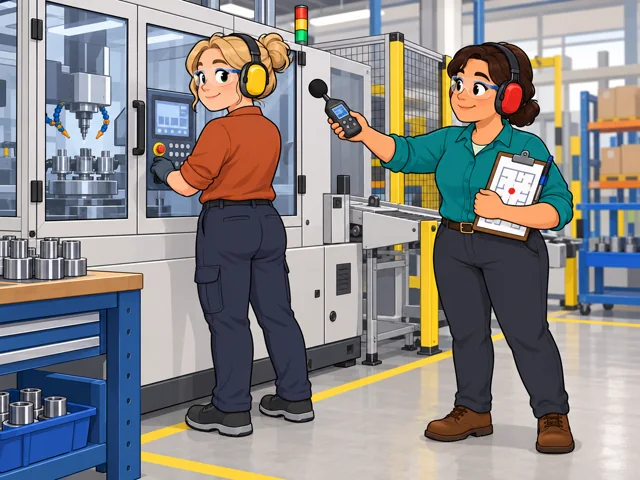
2A safety technician measures noise beside a machine operator and marks the reading's location on a floor sketch.

Measure noise where people work

Take sound-level meter readings in work areas, marking each spot so the safety team can interpret them.
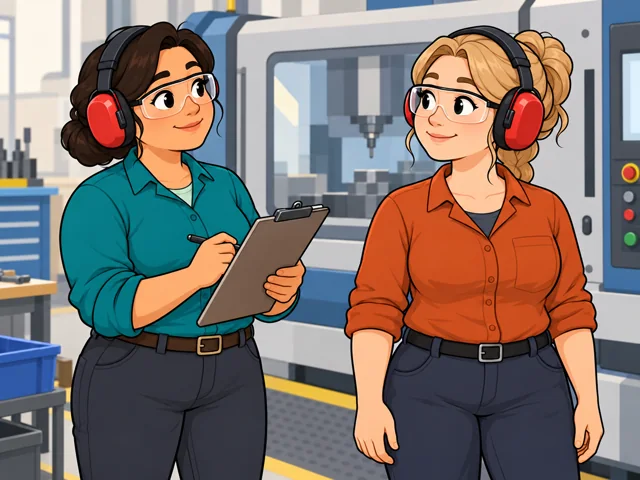
3A safety technician checks that a machine operator's hearing-protection earmuffs cover her ears properly.

Spot-check hearing protection use

Make sure the required protective gear is on hand and that workers are actually wearing it.
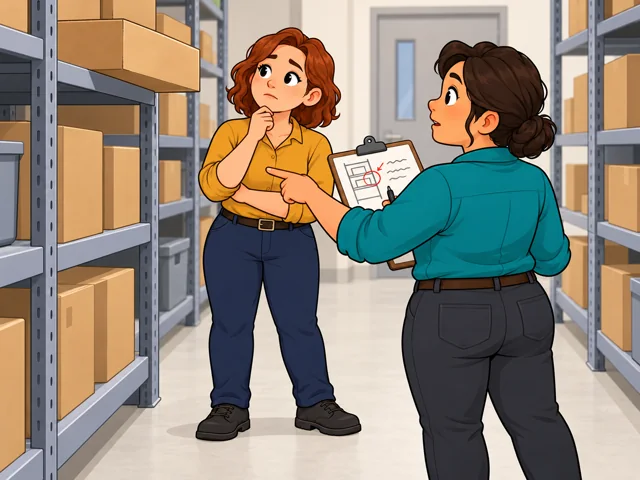
4A safety technician documents a carton projecting from a storage shelf and explains the falling-material concern to a supervisor.

Report a hazard, like risky shelving

Record where shelving could let stored items fall, then explain the danger to the supervisor, who arranges repairs.

Quick facts

Preparation

High school + workplace training

United States

Pay

$61,560/year

United States · May 2025

Outlook

19% growth

United States · 2025–2035

Quick orientation

Preparation, pay & outlook

Preparation

High school + workplace training

Some technicians study safety in college first.

Geography
United States
Period
Not applicable

Pay

$61,560/year

National median; $29.59 an hour.

Geography
United States
Period
May 2025

Outlook

19% growth

Projected technician employment growth.

Geography
United States
Period
2025–2035

Fit, tradeoffs & changing tools

Things to weigh

  • Some visits mean noise and uncomfortable protective equipment.
  • Pointing out unsafe practices can involve disagreement.

Where AI may help

Small wearable sensors and networks of monitors can collect exposure readings continuously, giving safety teams more information between individual sampling visits.

What people still lead

You still connect readings to the work being done, check equipment and discuss what needs attention with people at the site.

What we can’t predict yet

How much continuous monitoring replaces individual sampling will depend on sensor reliability, cost and worker acceptance. Protecting workers' data also matters.

Pay in context

Earnings

The national median was $61,560 a year, or $29.59 an hour, in May 2025. It is not a starting-pay quote.

The national spread

The lowest-paid 10% earned below $46,280; the highest-paid 10% exceeded $100,160. These are wage percentiles, not career stages.

Geography
United States
Period
May 2025
Pay basis
Annual employee wages, SOC 19-5012

Workplace type matters

Annual medians were $74,330 in construction, $66,940 in manufacturing and $59,350 in transportation and warehousing.

Geography
United States
Period
May 2025
Pay basis
Industry median annual employee wages, SOC 19-5012

Openings include replacements

An earlier 2024–34 projection estimated 3,400 technician openings annually from growth and replacement. This has a different time period from the growth snapshot.

Geography
United States
Period
2024–2034
Pay basis
Projected average annual openings, SOC 19-5012; not compensation

Getting started

Learn in an entry job

What the route involves
Enter with a high school diploma and learn inspections, testing and workplace rules on the job.
What it can lead to
You build the practical skills to carry out technician duties.
What to check
Requirements vary; some employers prefer or require professional certification.

Study occupational safety

What the route involves
Complete an associate degree covering hazard recognition, injury prevention, safety training and exposure control.
What it can lead to
You gain technical preparation for safety work and, in programs with a transfer pathway, further degree study.

Technicians work with safety specialists to collect evidence and implement improvements.

After entry

Career paths

This starts where the entry routes leave off: early work, growing capability, and advancement or specialization.

  1. Get established

    Learn the site's sampling equipment and record system until another person can follow your measurements and equipment checks.

  2. Handle more involved problems

    Build skill in investigating incidents and explaining corrective measures to supervisors, workers and contractors.

  3. Prepare for specialist work

    Further study can support a move toward safety specialist roles, which typically require a bachelor's degree. Check transfer arrangements before choosing courses.

Where you can work

College and institutional facilities

Some campus roles combine building inspections with training for staff and students. Technical programs may involve radiation, chemical exposure or ventilation, bringing you into contact with facilities staff and researchers.

  • Indoors
  • Lab
  • Office
  • Safety-sensitive

Federal distribution and repair facilities

At installations with repair shops and loading bays, inspections involve moving materials, machinery and stored chemicals. You talk with shop supervisors and contractors, and some buildings lack air conditioning.

  • Indoors
  • Field work
  • Safety-sensitive

Try it

See whether the job clicks before you commit to the path.

Choose an ordinary room you may use. Write a short observation record for one possible trip hazard: its exact location, what you can see and what you would ask the person responsible. Notice whether you enjoy making a concern precise enough for someone else to act on.

Stay safe: Observe only; do not move equipment or enter restricted areas.

Explore more careers

Sources

  1. U.S. Bureau of Labor Statistics. Occupational Health and Safety Specialists and Technicians. Accessed 2026-10-03.
  2. O*NET OnLine. 19-5012.00 — Occupational Health and Safety Technicians. Accessed 2026-10-03.
  3. Washington Office of Financial Management. Environmental Health & Safety Technician — Class 392I. Accessed 2026-10-03.
  4. U.S. Office of Personnel Management. Position Classification Appeal Decision C-0019-07-01. Accessed 2026-10-03.
  5. National Institute for Occupational Safety and Health. Advanced Sensor Technologies and the Future of Work. Accessed 2026-10-03.
  6. University of Alaska Anchorage. Occupational Safety and Health Associate Degree. Accessed 2026-10-03.

Your message goes to the Great Jobs team. How we use your information