
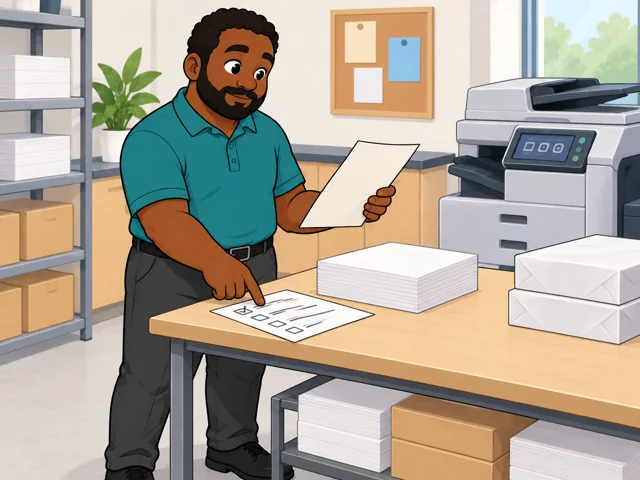
Confirm count and paper stock
From the job request, confirm how many copies and which paper are needed before loading the copier.
Career profile
Office machine operators run copiers, scanners and finishing machines, turning document requests into usable copies.
A job ends only when copies are readable, complete and in order. You set up machines and catch faults so they're fixed before anything leaves.
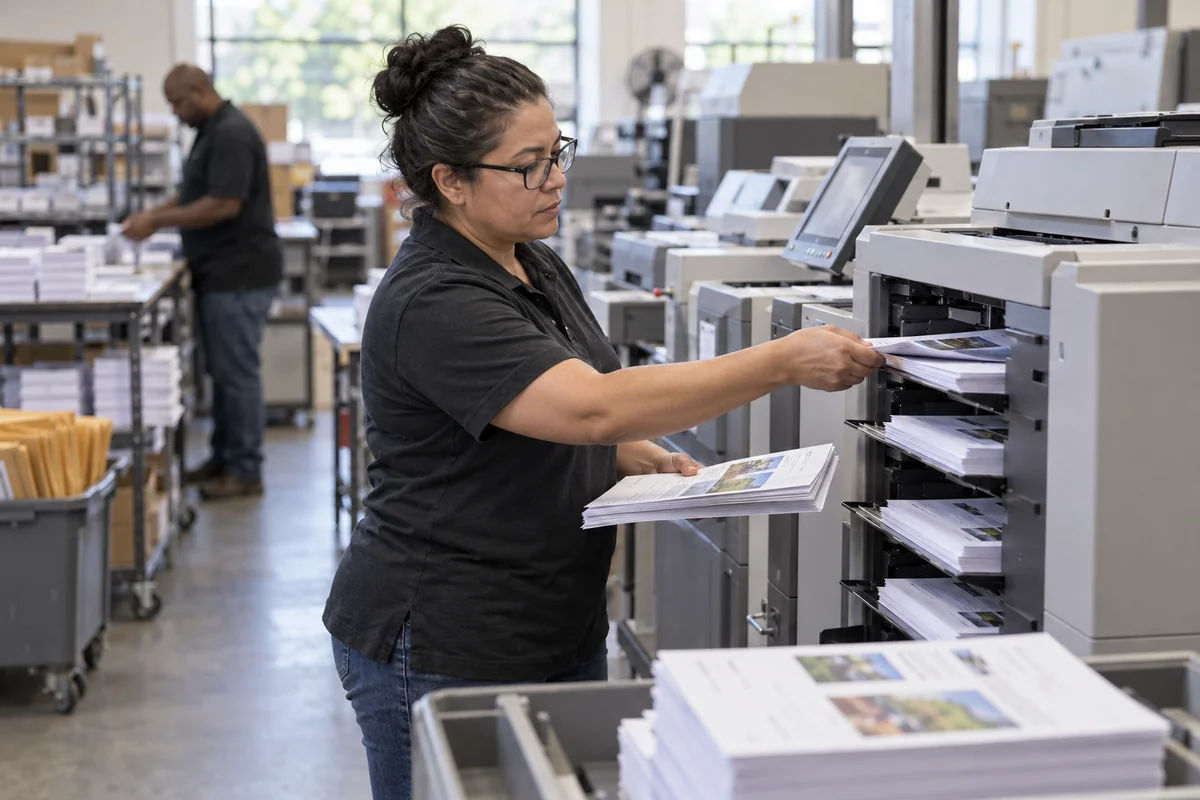
From the job request, confirm how many copies and which paper are needed before loading the copier.
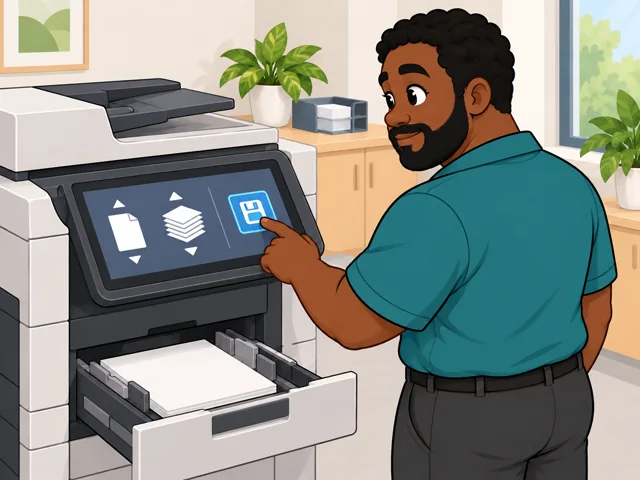
Adjust the copier's settings for the paper's size and thickness, and save them if the job will repeat.
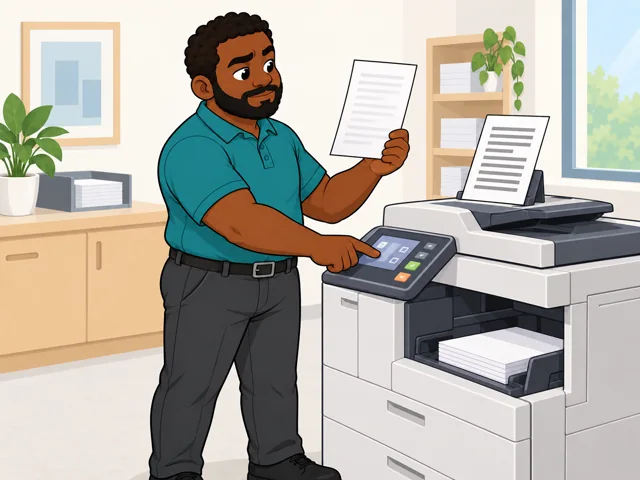
Watch pages come out, and if one prints pale, crooked or off-center, correct the settings before resuming.
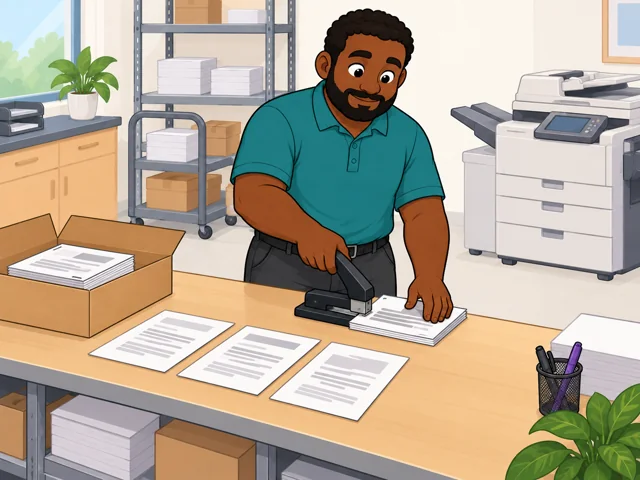
Put pages in order, fasten them with a binder or stapler, and ready the job for delivery.
United States · 2025
United States · 2025
United States · 2025–2035
Quick orientation
Typical entry is a high school diploma or equivalent, followed by short-term training at work.
National median in 2025, equivalent to $19.69 an hour.
Employment is projected to shrink from 2025 to 2035, with about 2,100 openings a year on average.
Digital copier software can save job settings and resize or combine text and images, reducing repeated setup.
You still clarify what the customer needs and work through problems when the finished pages do not match the request.
How much future equipment will take over setup and quality checking remains uncertain; some jobs may leave operators handling mainly unusual requests and failed runs.
Pay in context
The national midpoint is $40,960 a year, or $19.69 an hour. Use it as a comparison point when looking at an offer.
In 2025, the lowest-paid 10% earned $31,750 or less annually; the highest-paid 10% earned $57,960 or more. These are wage percentiles, not starting and senior salaries.
An older national comparison shows average annual pay of $38,760 in business support services and $51,690 in local government excluding schools and hospitals. These May 2023 averages describe different groups of workers, not what either workplace will offer you today.
The 2025–2035 projection averages about 2,100 openings each year despite a 14.9% employment decline. That is a national projection, not a count of vacancies near you.
A high school diploma or equivalent is the typical starting point. Check each job's requirements before paying for extra training.
After entry
This starts where the entry routes leave off: early work, growing capability, and advancement or specialization.
Learn how different papers feed, practice routine machine care, and package completed orders accurately.
Build skill with saved print programs and electronic image adjustments so you can handle orders with more demanding layouts.
A next step can be scheduling other operators, training assistants, and working with computer-support staff to resolve printer-network problems.
You work with faculty and staff on course packets and campus publications. The job can include explaining finishing options and recording charges against department accounts.
Some units run large batches and personalized documents whose text changes between copies. A print-and-mail lead coordinates the work, while operators manage copier programs and paper processing.
Try it
Make three identical four-page packets from scrap paper. Write a simple order stating page sequence and quantity, deliberately mix up one packet, then check every set against the order. Notice whether finding and fixing the mismatch feels satisfying or tedious.