
Career profile

Phlebotomist

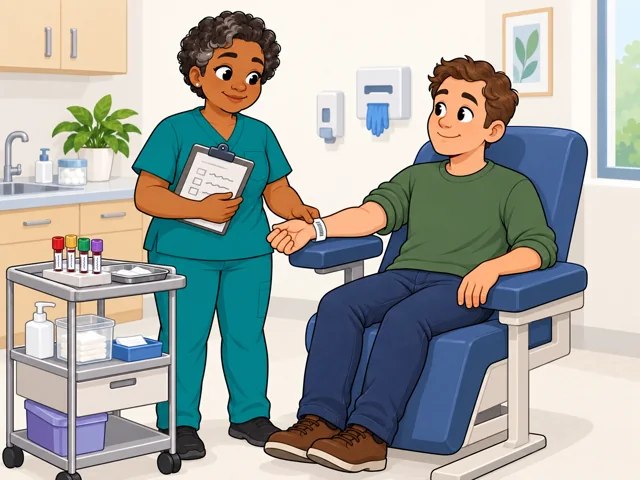
Phlebotomists draw blood and keep every sample tied to the person it came from.

Phlebotomy pairs careful handwork with short one-on-one talks. Sometimes you talk a nervous patient through the draw, then focus hard on needle and tubes.
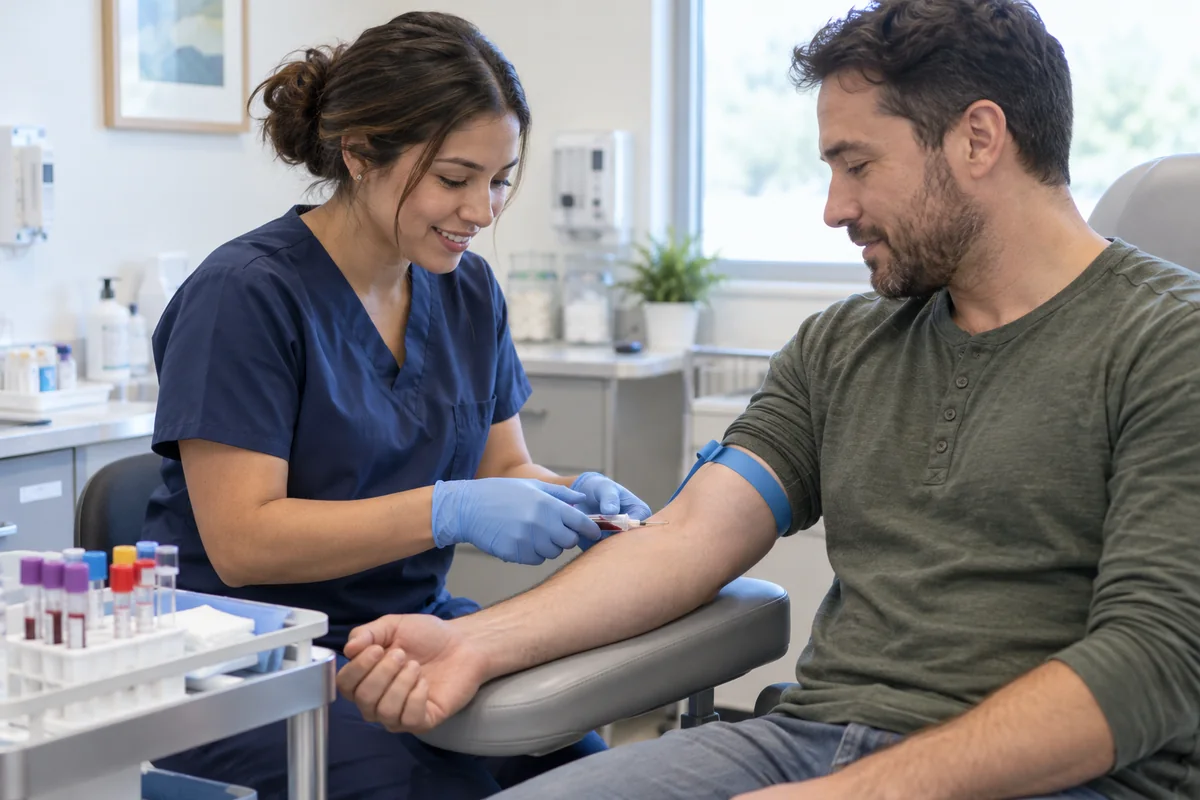
A phlebotomist draws blood from a patient in a clinic.

A day in the life

1A phlebotomist compares a seated man's wristband with a laboratory request beside a rack of unused collection tubes.

Match the patient to the order

Verify who the patient is from their personal details, then pair the lab order with matching collection tubes.
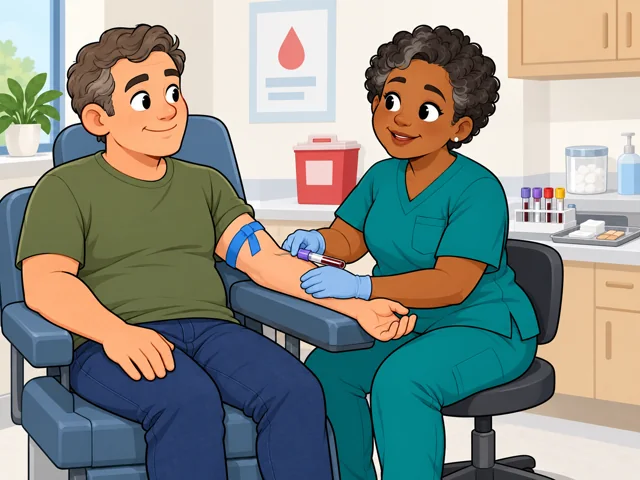
2A gloved phlebotomist collects blood from a calm man's supported arm while speaking reassuringly.

Explain, then draw the blood

First tell the patient what to expect, then use a needle to draw blood into the collection tubes.
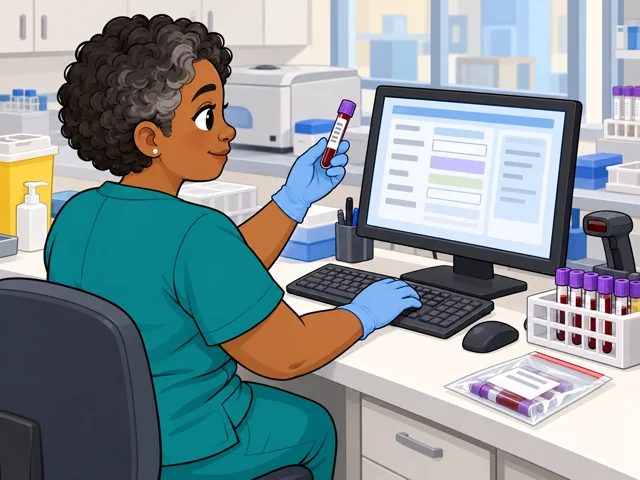
3A phlebotomist checks a capped blood sample's label while entering its information into a laboratory computer.

Label and log each specimen

Confirm labels, log specimens in the lab computer, and at some sites, prep them for storage or shipping.
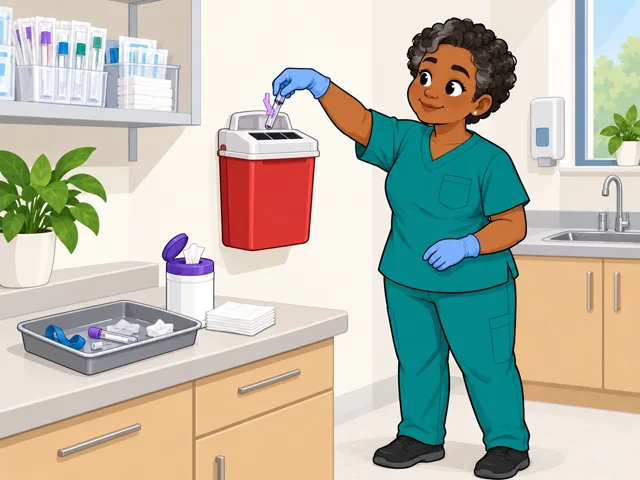
4A gloved phlebotomist drops a safety-shielded used needle assembly into a sharps container, with wipes ready for cleaning the tray and sealed supplies stored separately.

Clear and reset the tray

Drop used needles in the sharps container and clean the tray before you set out new supplies.

Quick facts

Preparation

Usually a certificate

United States

Pay

$45,230/year

United States · May 2025

Outlook

7% projected growth

United States · 2025–2035

Quick orientation

Preparation, pay & outlook

Preparation

Usually a certificate

Phlebotomy programs usually take under a year; some employers train new hires.

Geography
United States
Period
Not applicable

Pay

$45,230/year

National median, equivalent to $21.75 an hour.

Geography
United States
Period
May 2025

Outlook

7% projected growth

About 18,000 openings yearly, including replacements.

Geography
United States
Period
2025–2035

Fit, tradeoffs & changing tools

Things to weigh

  • Long periods on your feet are common. Hospital and laboratory shifts may include nights or holidays.
  • Blood and used needles are part of the work; careful disposal is a repeated responsibility.

Where AI may help

A robotic device called Aletta can locate a vein and carry out a blood draw. The Food and Drug Administration authorized it in 2026 for adults in outpatient settings, with oversight by a supervisor trained in phlebotomy.

What people still lead

With this device, a trained phlebotomist starts the session, checks the collection tubes, and stays available to respond to problems.

What we can’t predict yet

How widely clinics adopt robotic collection—and how much a shift moves from drawing blood to overseeing equipment—remains uncertain.

Pay in context

Earnings

Workplace type affects the pay picture.

The national range

The median was $45,230 a year, or $21.75 an hour. The 10th and 90th percentiles were $35,780 and $58,780. These describe the wage distribution, not starting and experienced pay.

Geography
United States
Period
May 2025
Pay basis
National annual and hourly wages for phlebotomists; median and annual 10th/90th percentiles.

Pay by workplace

Annual medians were $48,030 in outpatient care centers, $46,670 in medical and diagnostic laboratories, $44,500 in physicians' offices, and $44,220 in hospitals.

Geography
United States
Period
May 2025
Pay basis
Industry-specific annual median wages for phlebotomists; hospitals include state, local, and private employers.

Openings include replacement hiring

Employment is projected to grow 7%, with about 18,000 openings annually. Many replace people who leave the occupation or workforce.

Geography
United States
Period
2025–2035
Pay basis
Employment projection and average annual openings, not compensation.

Getting started

Complete a qualifying phlebotomy program

What the route involves
Finish high school or its equivalent, then complete a phlebotomy program accredited by the National Accrediting Agency for Clinical Laboratory Sciences.
What it can lead to
Completion within the past five years meets one eligibility route for the American Society for Clinical Pathology's Phlebotomy Technician certification examination. You must also pass the exam to earn that certification.

Enter through an employer that trains

What the route involves
Some employers hire high-school graduates and teach blood collection and sample tracking on the job.
What it can lead to
This provides an employment-based route into phlebotomy.
What to check
Availability depends on the employer and state requirements.

Check state requirements before choosing training. Some employers prefer professional certification.

After entry

Career paths

This starts where the entry routes leave off: early work, growing capability, and advancement or specialization.

  1. Get established

    Learn your workplace's specimen labels, computer system, and sample handoffs until you can follow a collection through to processing.

  2. Handle competing requests

    Build skill in prioritizing collections and resolving specimen problems when several requests arrive together.

  3. Move toward a lead role

    With experience, pursue lead positions that coordinate daily collection and processing while continuing hands-on phlebotomy.

Where you can work

Hospital laboratories

Some roles combine blood collection with specimen processing and shipping. You coordinate requests from physicians and other care staff, so priorities can shift as requests arrive.

  • Indoors
  • Lab
  • Physical demands
  • Safety-sensitive

Mobile blood drives

Your work location changes as the collection team travels. Alongside drawing blood, you may take donor health histories and help first-time donors feel at ease.

  • Indoors
  • Travel
  • Safety-sensitive

Try it

See whether the job clicks before you commit to the path.

Make three fictional patient cards and matching paper sample labels, with one deliberate mismatch. Ask a friend to play a nervous patient while you check the details. Notice whether you can stay warm in conversation without losing your place.

Stay safe: Use invented information and paper only; do not practice blood collection or use needles.

Explore more careers

Sources

  1. U.S. Bureau of Labor Statistics. Phlebotomists — Occupational Outlook Handbook. Accessed 2026-10-03.
  2. O*NET OnLine / U.S. Bureau of Labor Statistics. National Wages: 31-9097.00 — Phlebotomists. Accessed 2026-10-03.
  3. O*NET OnLine. 31-9097.00 — Phlebotomists. Accessed 2026-10-03.
  4. American Society for Clinical Pathology Board of Certification. Phlebotomy Technician — PBT. Accessed 2026-10-03.
  5. Mayo Clinic. Lab Service Tech — Phlebotomist, Job 391054. Accessed 2026-10-03.
  6. Mayo Clinic. Lead — Lab Support Service Tech, Job 387985. Accessed 2026-10-03.
  7. American Red Cross. Red Cross Phlebotomists Recognition Week spotlights. Accessed 2026-10-03.
  8. U.S. Food and Drug Administration. FDA Authorizes First-Of-Its-Kind Robotic Blood Draw Device. Accessed 2026-10-03.

Your message goes to the Great Jobs team. How we use your information