
Career profile

Physical Medicine and Rehabilitation Physician

Physiatrists find what limits movement and daily tasks, then lead medical care toward more independence.

Physiatrists, or physical medicine and rehabilitation physicians, link diagnoses to goals like dressing or working, then choose therapies and merge team findings into one plan.
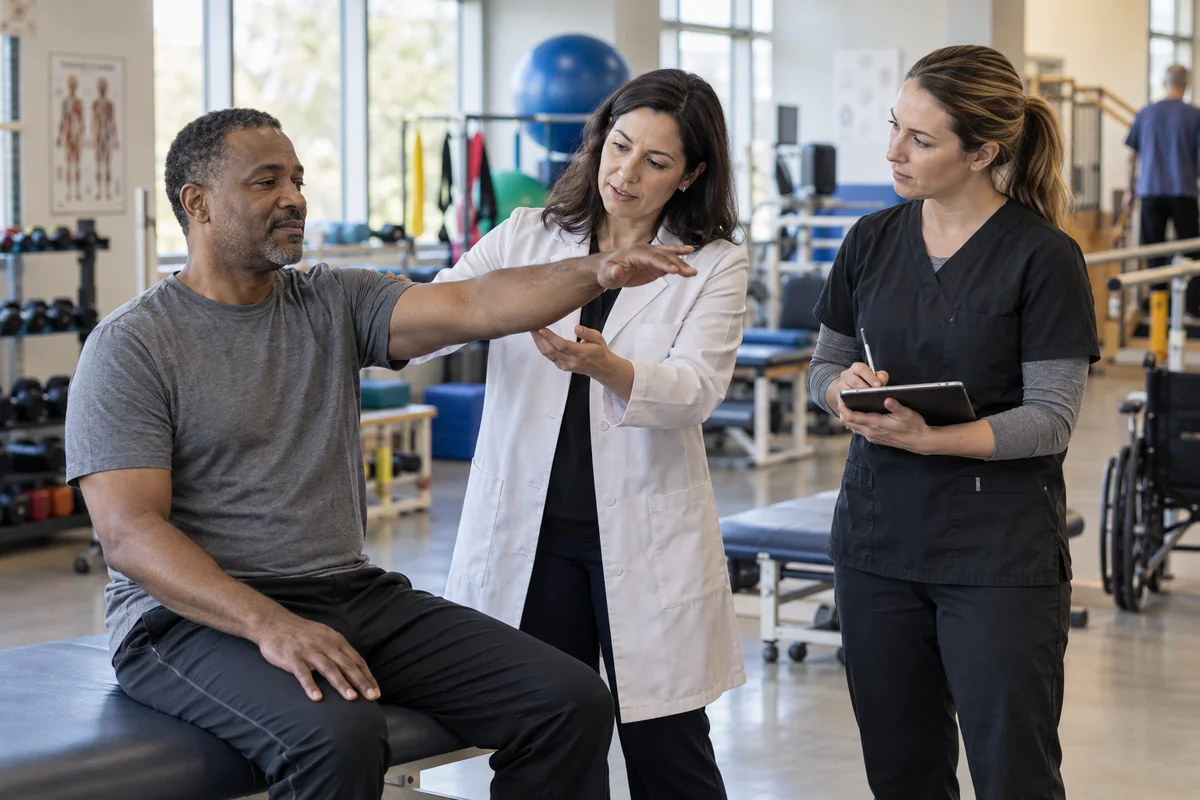
Rehabilitation physician assesses a patient’s arm movement with a care colleague.

A day in the life

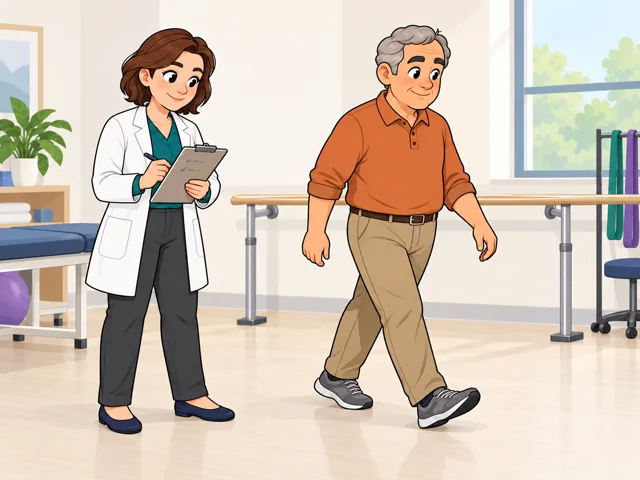
1A rehabilitation physician watches an older man walk, studying his stride and foot placement.

Find what's limiting a patient's movement

You watch the patient walk, test their muscle strength, and match the results to tasks they struggle with.

2A physician and a woman review her response to pain treatment while discussing a change to the treatment plan.

Rethink a plan that's falling short

Weigh the patient's pain ratings and response to a medication or injection, then decide whether to change course.

3A rehabilitation physician, nurse, and therapist compare progress and plan a patient's next goal and support needs at home.

Set the patient's next goal

Meet with nurses and therapists about progress, barriers and the support the patient needs after leaving rehab.
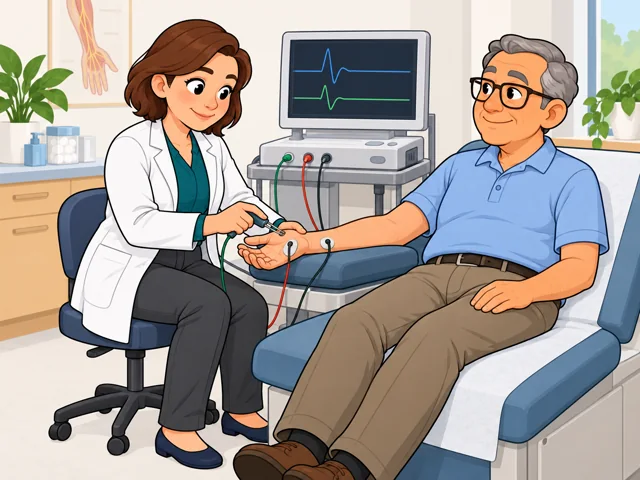
4A physician performs a nerve conduction study on an older man's supported hand and wrist while a connected monitor displays waveforms.

Locate a nerve or muscle problem

Depending on your position, you run electromyography and nerve conduction tests, electrical methods that locate the problem.

Quick facts

Preparation

Medical school + 4 years

United States

Pay

$376,234 average

United States · 2025

Outlook

Not displayed

Hospital and clinic jobs can combine different patient groups, teaching duties, and call schedules.

Quick orientation

Preparation, pay & outlook

Preparation

Medical school + 4 years

After medical school, the usual specialty training includes one general clinical year and three rehabilitation medicine years.

Geography
United States
Period
Not applicable

Pay

$376,234 average

Annual compensation in a 2025 survey of full-time physicians in this specialty; this is an average, not a median or starting salary.

Geography
United States
Period
2025

Outlook

Not displayed

Hospital and clinic jobs can combine different patient groups, teaching duties, and call schedules.

Geography
United States
Period
Not applicable

Fit, tradeoffs & changing tools

Things to weigh

  • You commit to medical school and several more years of specialty training before establishing your own practice.
  • Some hospital jobs include weekend call, so your work can extend beyond scheduled clinic visits.

Where AI may help

Emerging software can help draft clinical notes, while remote-monitoring tools can bring information about recovery at home into a visit.

What people still lead

You still need to interpret those observations, examine the patient, and choose goals and treatment with the patient and rehabilitation team.

What we can’t predict yet

How much follow-up can move out of the clinic remains unsettled: tools must work for different disabilities, fit clinical systems, and show that they support useful care.

Pay in context

Earnings

Compare compensation alongside the patient mix, schedule, and benefits. A national survey average and a particular job's salary range answer different questions.

A national specialty benchmark

Average annual compensation was $376,234 in the 2025 full-time physician survey. That is about $181 an hour if divided by 2,080 hours, purely for comparison; actual physician hours vary. It is not a median or an entry-level offer.

Geography
United States
Period
2025
Pay basis
Self-reported annual compensation; full-time physicians working at least 40 hours per week

Academic hospital work in New York

A mixed inpatient, consultation, and outpatient role lists $230,000–$240,000 for full-time work, excluding incentives and benefits. Actual salary may fall outside the range depending on experience, training, and hospital needs.

Geography
New York, New York
Period
2026 posting
Pay basis
Advertised full-time salary for a specific position; excludes incentive compensation and benefits

Veterans health work in Dallas

A brain injury physiatrist role lists $200,000–$290,000 a year in base plus market pay. Education and length of practice affect pay setting. These job ranges illustrate offers in different settings; they do not establish which workplace type pays more.

Geography
Dallas, Texas
Period
2026 posting
Pay basis
Advertised annual base pay plus market pay for a specific full-time position

Getting started

Choose a residency with the first year included

Four years after medical school.
What the route involves
In a categorical residency, complete the general clinical year and then train in hospital and outpatient rehabilitation within the integrated program.
What it can lead to
You complete the standard specialty training without arranging a separate preliminary-year position.

Pair a preliminary year with an advanced residency

One preliminary year plus three specialty years after medical school.
What the route involves
Apply separately for an acceptable general clinical year and an advanced rehabilitation residency. Complete the preliminary year before starting specialty training.
What it can lead to
You can enter programs whose rehabilitation training starts in the second postgraduate year; you must secure both parts of the sequence.
What to check
For either route, board certification is separate from your medical license. The American Board of Physical Medicine and Rehabilitation requires eligible candidates to pass Part I, then the Part II oral examination. Finishing residency alone does not make you board certified.

Usually, you complete a bachelor's degree and then a Doctor of Medicine (MD) or Doctor of Osteopathic Medicine (DO) degree. The residency options below are supervised physician training after medical school. State licensure also requires qualifying training and national licensing exams: the United States Medical Licensing Examination or Comprehensive Osteopathic Medical Licensing Examination of the United States. Exact state requirements vary.

After entry

Career paths

This starts where the entry routes leave off: early work, growing capability, and advancement or specialization.

  1. Get established

    Learn your workplace's handoffs and build a reliable way to follow each patient's goals across medical visits and therapy sessions.

  2. Deepen your practice

    Build experience with a patient group, such as people recovering from stroke or managing spine pain. Use follow-up results to refine your treatment choices.

  3. Specialize further

    Brain injury medicine is one option. Board-certified physiatrists with an unrestricted license can pursue a 12-month accredited fellowship; program-director recommendation and passing the subspecialty exam are also required for certification.

Where you can work

Inpatient rehabilitation hospital

Your patients stay in the facility while receiving medical care and intensive rehabilitation. Frequent exchanges with nurses and therapists shape decisions about progress and leaving the hospital.

  • Indoors
  • Safety-sensitive

Outpatient musculoskeletal clinic

You see people with spine pain or orthopaedic injuries during appointments and follow their response over time. A shared practice may include surgeons, while your own treatment focuses on nonsurgical care.

  • Indoors
  • Office

Veterans health service

Some roles combine brain injury care with general rehabilitation clinics, resident teaching, and coverage for hospitalized patients. A weekday clinic schedule may also include weekend call.

  • Indoors
  • On call
  • Safety-sensitive

Try it

See whether the job clicks before you commit to the path.

Choose an everyday goal, such as getting dressed. On paper, imagine someone has difficulty with it after an injury. Write the questions a rehabilitation physician would need answered about symptoms, movement, and home needs before choosing treatment. Mark which questions would need input from a therapist or nurse. Notice whether connecting medical questions with daily life interests you.

Stay safe: Keep this a paper exercise; do not examine someone or recommend treatment.

Explore more careers

Sources

  1. O*NET OnLine. Physical Medicine and Rehabilitation Physicians. Accessed 2026-10-06.
  2. American Academy of Physical Medicine and Rehabilitation. About Physical Medicine & Rehabilitation. Accessed 2026-10-06.
  3. American Academy of Physical Medicine and Rehabilitation. FAQs About Physiatry. Accessed 2026-10-06.
  4. American Academy of Physical Medicine and Rehabilitation. Rehabilitation Patient Care Teams and Their Functioning. Accessed 2026-10-06.
  5. American Academy of Physical Medicine and Rehabilitation. Technology in PM&R. Accessed 2026-10-06.
  6. Doximity. 2026 Physician Compensation Report. Accessed 2026-10-06.
  7. NYU Langone Health. Physical Medicine and Rehabilitation Physiatrist at RUSK Rehabilitation, Job 136212. Accessed 2026-10-06.
  8. Veterans Health Administration. Physician (TBI Physiatrist), Dallas, Announcement 883682100. Accessed 2026-10-06.
  9. Federation of State Medical Boards. About Physician Licensure. Accessed 2026-10-06.
  10. American Academy of Physical Medicine and Rehabilitation. What is a Residency in PM&R Like. Accessed 2026-10-06.
  11. American Academy of Physical Medicine and Rehabilitation. A Step by Step Guide to Applying for a PM&R Residency. Accessed 2026-10-06.
  12. American Board of Physical Medicine and Rehabilitation. Primary Certification Overview. Accessed 2026-10-06.
  13. American Board of Physical Medicine and Rehabilitation. Brain Injury Medicine. Accessed 2026-10-06.

Your message goes to the Great Jobs team. How we use your information