

Career profile

Physical Therapist

Physical therapists ease pain and improve control of movement after injury, illness, or chronic conditions.

Watching how someone stands, walks, and reaches tells you where to start. You build a plan, coach each movement, and switch tactics if progress stalls.

A physical therapist helps a patient stretch on a treatment table in a bright clinic.

A day in the life

1A physical therapist watches a very-light-skinned adult man walk across a clear clinic floor, studying his stride.

Watch how a patient moves

Read medical records, hear the patient's concerns, and watch them stand, walk, balance, or use the injured area.

2The therapist and the same adult man select illustrated exercise cards while discussing a stair-climbing goal.

Set goals for everyday tasks

Pick exercises, hands-on techniques, or devices that suit the person's health and the things their day requires.

3The therapist cues knee alignment as the adult man practices stepping onto a low platform while holding a rail.

Coach each attempt at a move

Demonstrate the move, guide their position, and adjust cue or difficulty if the first try does not work.
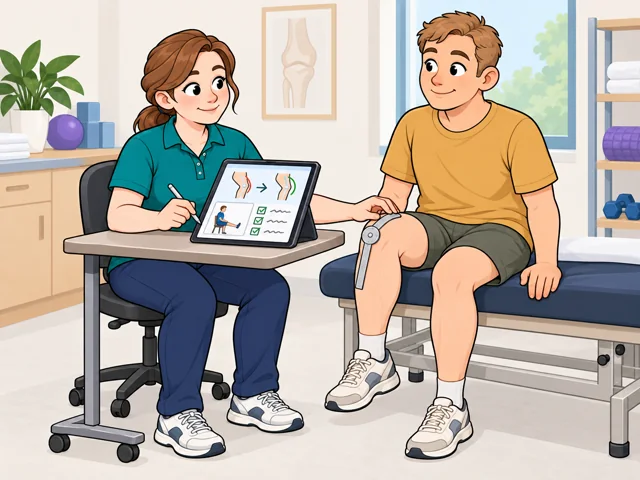
4With the adult man seated on a treatment plinth, the therapist records a knee reassessment and reviews paired movement diagrams.

Track progress against the goals

Record changes, check results against the goals, and revise care if progress, pain, or ability signals a change.

5The adult man demonstrates a supported standing exercise at a stable counter while the therapist checks his setup for home practice.

Teach safe practice between visits

Show the patient or caregivers how to exercise safely between visits and what to watch for during recovery.

Quick facts

Preparation

DPT + state license

United States

Pay

$102,760 median

United States · May 2025

Outlook

12% growth

United States · 2025–2035

Quick orientation

Preparation, pay & outlook

Preparation

DPT + state license

Entry requires a Doctor of Physical Therapy degree from an accredited program and a license. DPT study includes supervised clinical work; licensing details vary by jurisdiction.

Geography
United States
Period
Not applicable

Pay

$102,760 median

National median annual wage for physical therapists; this is not a starting salary.

Geography
United States
Period
May 2025

Outlook

12% growth

Projected employment growth from 2025 to 2035, with about 13,400 openings per year on average nationally. Local hiring may differ.

Geography
United States
Period
2025–2035

Fit, tradeoffs & changing tools

Things to weigh

  • The route is long: undergraduate preparation is followed by professional DPT education, clinical work, an exam, and state licensure.
  • You may stand for much of the day and help move patients. Poor lifting technique can put your back at risk.
  • Most therapists work full time, but some jobs include evenings or weekends, and documentation must fit around patient care.

Where AI may help

Some practices now use telehealth and remote monitoring. Apps or motion-capture tools can send information about home exercise, symptoms, or performance between visits.

What people still lead

The therapist decides whether remote or in-person care fits, interprets the information, examines movement, and changes the treatment plan.

What we can’t predict yet

Remote care will not fit every patient or task. Patient needs, safety, privacy, evidence, and state rules can limit when a tool belongs in the plan.

Pay in context

Earnings

These national figures describe employed physical therapists. An individual offer can vary with location, setting, experience, schedule, and employer.

National midpoint

The median was $102,760: half of employed physical therapists earned more and half earned less. The median hourly wage was $49.40.

Geography
United States
Period
May 2025
Pay basis
Median annual wage from OEWS; self-employed workers are excluded

The national spread

In May 2025, the 10th-percentile annual wage was $77,140 and the 90th-percentile wage was $135,140. These are wage percentiles, not starting and senior salaries.

Geography
United States
Period
May 2025
Pay basis
National annual wage percentiles

Setting can matter

Among major industries listed by BLS, median annual wages ranged from $97,160 in therapy offices to $114,740 in home healthcare.

Geography
United States
Period
May 2025
Pay basis
Median annual wage by selected employing industry

Getting started

Bachelor's, then DPT

A bachelor's degree followed by professional DPT study, which typically lasts three years; exact schedules vary
What the route involves
Choose an undergraduate major that lets you finish the prerequisites for your target programs, then complete a CAPTE-accredited DPT with clinical education.
What it can lead to
Graduation from the accredited professional program makes you eligible to pursue the licensing exam and your jurisdiction's remaining requirements.
What to check
Prerequisites, observation expectations, admission standards, cost, and licensing requirements vary. Finishing prerequisites does not guarantee DPT admission.

Combined or freshman-entry DPT

In a 3+3 program, three years of specified undergraduate study lead into a three-year professional DPT phase
What the route involves
Enter a 3+3 or freshman-entry program and complete its required undergraduate courses and progression conditions before advancing into professional DPT study.
What it can lead to
If you meet the program's conditions, you can follow its planned progression into the professional DPT phase without applying through the usual post-bachelor route.
What to check
Few programs offer freshman entry, and progression may depend on requirements such as specified courses or a minimum GPA. Confirm accreditation, total cost, and licensing rules.

Two education formats can lead toward the same requirement: a CAPTE-accredited DPT followed by state licensure.

After entry

Career paths

This starts where the entry routes leave off: early work, growing capability, and advancement or specialization. This path also has a credential or licensing boundary; see the requirements and limits.

  1. Get established

    In early roles, turn school skills into consistent practice: examine movement, set useful goals, document response, and adjust plans across a caseload.

  2. Deepen your practice

    A clinical residency can add about a year of advanced training in a specialty area; a fellowship may follow for narrower advanced practice.

    • Build broader experience by working with different patient groups or moving among common practice settings.
  3. Specialize or take responsibility

    After gaining work experience, you may pursue board certification in an area such as orthopedics, sports, or geriatrics, or take on more supervision within a care team.

Where you can work

Outpatient clinic

Move through scheduled visits with people who arrive for treatment. Clinics employ the largest share of physical therapists, and the pace can require quick shifts between patients and documentation.

  • Indoors
  • Physical demands

Hospital

Work with inpatients whose illness, injury, or recovery affects basic movement. Coordination with physicians and other healthcare workers is a regular part of the setting.

  • Indoors
  • Physical demands
  • Safety-sensitive

Home healthcare

Travel to patients and deliver care in their homes, where available space, equipment, and caregiver support shape each session.

  • Field work
  • Travel
  • Physical demands

Nursing or residential care

Support residents whose mobility may be affected by age, chronic conditions, or recovery needs, often within a continuing-care environment.

  • Indoors
  • Physical demands

Try it

See whether the job clicks before you commit to the path.

With permission, observe part of a licensed physical therapist's visit—or watch one public clinical demonstration. Write down what the therapist notices, how an instruction changes the movement, and whether you enjoy that mix of observation and coaching.

Stay safe: Do not assess, diagnose, stretch, lift, or treat anyone. Protect patient privacy and follow the clinic's visitor, age, and safety rules.

Explore more careers

Sources

  1. U.S. Bureau of Labor Statistics. Physical Therapists. Accessed 2026-09-15.
  2. O*NET OnLine. 29-1123.00 - Physical Therapists. Accessed 2026-09-15.
  3. American Physical Therapy Association. The Digitally Enabled Physical Therapist: An APTA Foundational Paper. Accessed 2026-09-15.
  4. Commission on Accreditation in Physical Therapy Education. Importance of CAPTE Accreditation. Accessed 2026-09-15.
  5. American Physical Therapy Association. Admissions Process for Doctor of Physical Therapy Education Programs. Accessed 2026-09-15.
  6. American Physical Therapy Association. Becoming a Physical Therapist. Accessed 2026-09-15.
  7. Federation of State Boards of Physical Therapy. Licensing Authorities Contact Information. Accessed 2026-09-15.
  8. Federation of State Boards of Physical Therapy. Exam Candidates: NPTE Eligibility Requirements. Accessed 2026-09-15.

Your message goes to the Great Jobs team. How we use your information