
Career profile

Physicist

Physicists work out how energy and matter behave, using math and lab tests.

When a measurement disagrees with your prediction, you decide whether to revise your explanation or the test itself.
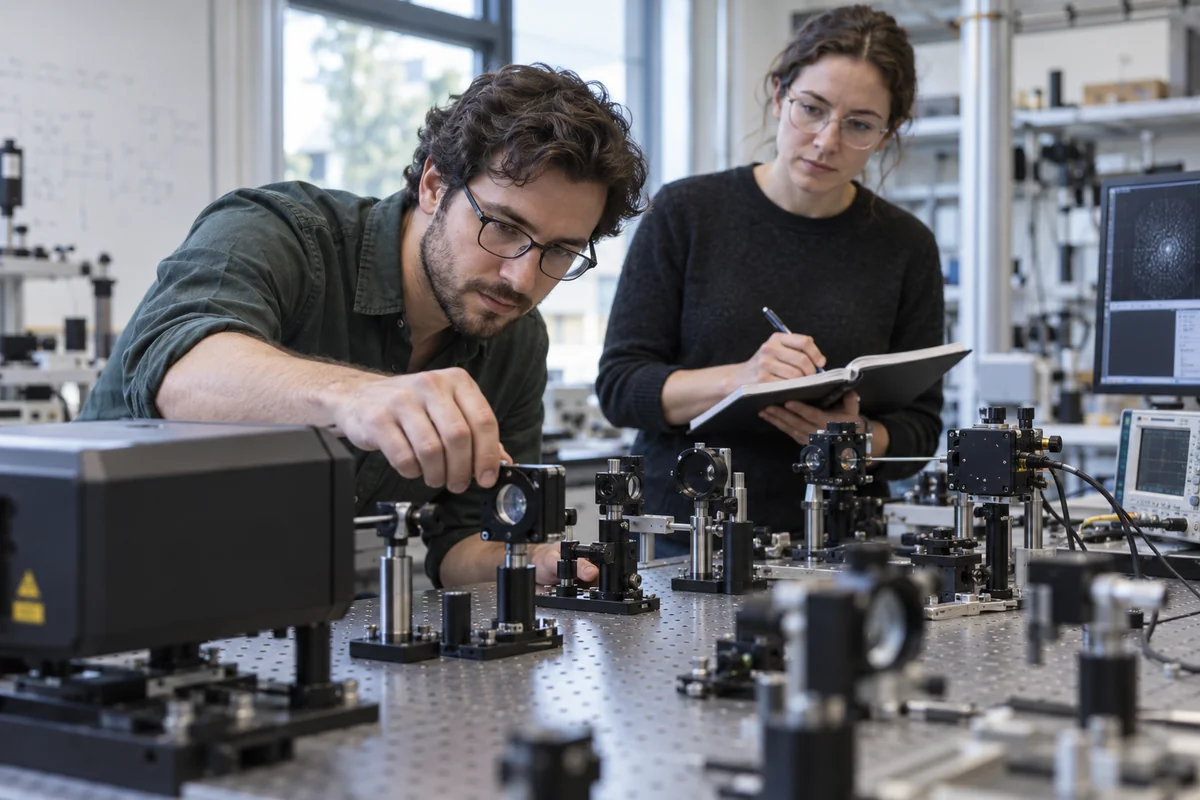
Physicist adjusts an optical experiment in a laboratory.

A day in the life

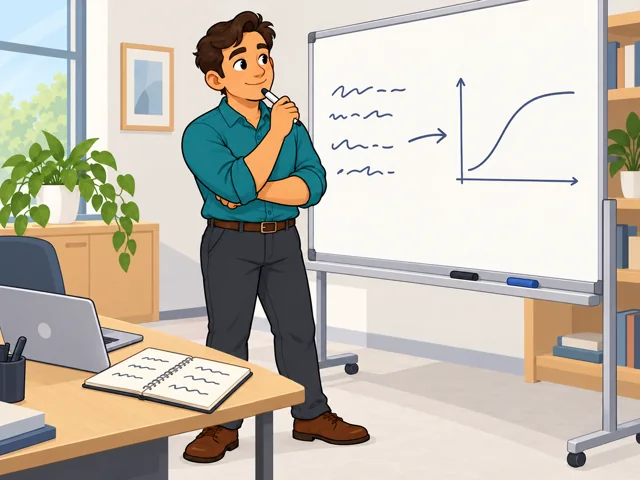
1A physicist works through a calculation on a whiteboard and connects it to a curve predicting a measurement.

Write out the prediction

Write equations that turn an idea into a specific result you expect a measurement to show.
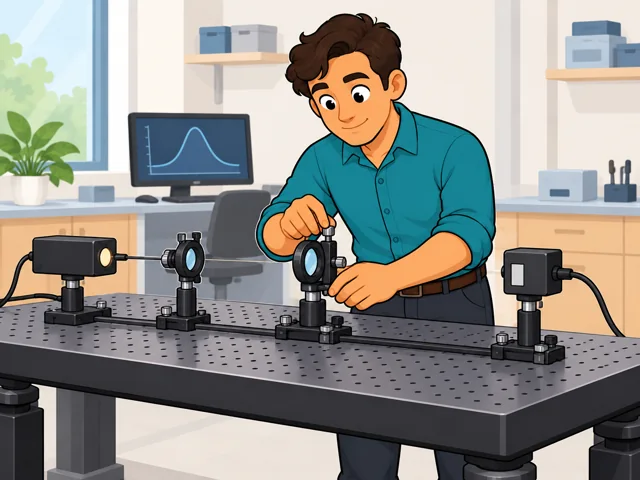
2A physicist adjusts a mounted lens on an optical table to direct light toward a detector.

Position lenses and detectors

In optics research, you set lenses and detectors in place to collect measurements of how light behaves.
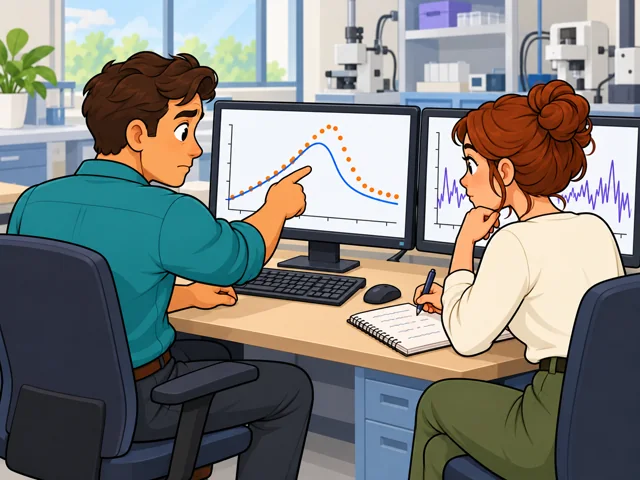
3A seated physicist points out a mismatch between simulation and measured data while a coworker checks a measurement trace.

Compare the model with data

Graph both the simulation and the real data, and investigate any gap before you change the model.
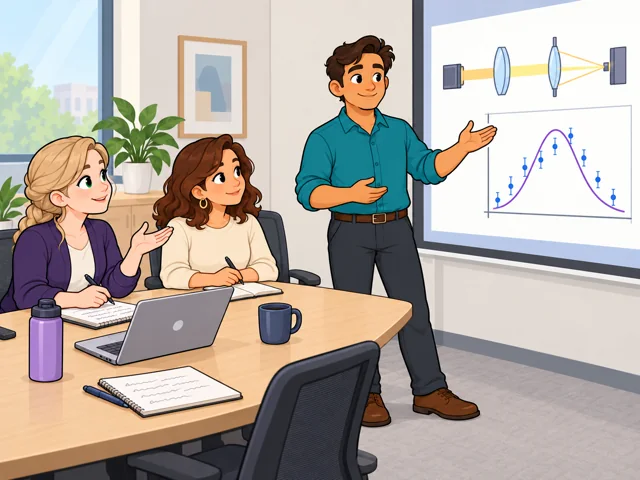
4A physicist explains an optical experiment and its results to two coworkers, one of whom raises a hand to question the reasoning.

Share results with other scientists

Put your results into a paper or a talk so other scientists can check your reasoning.

Quick facts

Preparation

Usually a doctorate

United States

Pay

$172,250/year

United States · May 2025

Outlook

7.2% projected growth

United States · 2025–2035

Quick orientation

Preparation, pay & outlook

Preparation

Usually a doctorate

Research jobs typically require a Doctor of Philosophy (PhD). Some federal entry jobs accept a bachelor's degree.

Geography
United States
Period
Not applicable

Pay

$172,250/year

Median physicist wage; about $82.81/hour using 2,080 hours per year.

Geography
United States
Period
May 2025

Outlook

7.2% projected growth

About 1,300 physicist openings annually, including replacement openings.

Geography
United States
Period
2025–2035

Fit, tradeoffs & changing tools

Things to weigh

  • An unsuccessful experiment can mean rethinking your approach.
  • Some jobs run beyond a 40-hour week.

Where AI may help

In some accelerator labs, software learns from data to correct changes in particle beams and lasers. This is machine learning.

What people still lead

You choose the scientific question and judge whether a result supports the explanation.

What we can’t predict yet

How much of an experiment software can reliably plan and run remains an open engineering challenge, especially when conditions change.

Pay in context

Earnings

The median covers the occupation, not starting salaries.

The spread is wide

The lowest 10% earned below $82,110; the highest 10% earned above $274,110.

Geography
United States
Period
May 2025
Pay basis
Annual employee wages; physicists

Workplace matters

Annual medians were $176,170 in scientific research services, $146,900 in the federal government excluding postal service, and $84,600 in state colleges and universities.

Geography
United States
Period
May 2025
Pay basis
Industry median annual employee wages; physicists

Openings include replacements

The projected 1,300 annual openings include people leaving the occupation as well as growth. They are not a count of vacancies today.

Geography
United States
Period
2025–2035
Pay basis
Employment projection, not compensation

Getting started

Study through a research doctorate

What the route involves
Build on undergraduate study with advanced physics, doctoral examinations, and original thesis research with a faculty adviser.
What it can lead to
The usual preparation for research and academic physicist roles.

Meet federal physicist qualifications

What the route involves
Earn a physics degree, or a related degree with at least 24 semester hours of physics. Another route combines equivalent physics coursework with appropriate experience or additional education.
What it can lead to
You can meet the basic qualifications for federal Physics Series 1310 positions; each vacancy has additional requirements.
What to check
Coursework must include general physics and two of these areas: electricity and magnetism, heat, light, mechanics, modern physics, or sound.

Research and federal entry offer different education routes.

After entry

Career paths

This starts where the entry routes leave off: early work, growing capability, and advancement or specialization.

  1. Get established

    A postdoctoral research role can help you build independence after your doctorate.

  2. Own a piece of the research

    Become the person colleagues rely on for a measurement method or simulation.

  3. Lead a research direction

    Senior roles can bring responsibility for colleagues' work and research funding.

Where you can work

University research groups

Work alongside faculty and doctoral students. Advising thesis research makes explaining methods part of the setting.

  • Office
  • Lab

Accelerator laboratories

Your experiment depends on a large shared instrument. Beam stability and control systems can matter as much as the sample you want to study.

  • Lab
  • Office

Try it

See whether the job clicks before you commit to the path.

Make a small pendulum with string and a soft object. Predict whether a longer string changes its swing time, then time several swings at two lengths and repeat. Compare the results with your prediction. Notice whether investigating measurement differences interests you.

Stay safe: Use a small swing and keep the area clear.

Explore more careers

Sources

  1. O*NET OnLine. Physicists, 19-2012.00. Accessed 2026-10-04.
  2. U.S. Bureau of Labor Statistics. Physicists and Astronomers: Occupational Outlook Handbook. Accessed 2026-10-04.
  3. U.S. Bureau of Labor Statistics. Occupational projections and worker characteristics, 2025–2035. Accessed 2026-10-04.
  4. U.S. Office of Personnel Management. Physics Series 1310. Accessed 2026-10-04.
  5. Massachusetts Institute of Technology. Guidelines for Physics Doctoral Candidates. Accessed 2026-10-04.
  6. Lawrence Berkeley National Laboratory. AI/ML in the BACI Program. Accessed 2026-10-04.
  7. Lawrence Berkeley National Laboratory. Machine Learning for Science: Projects. Accessed 2026-10-04.

Your message goes to the Great Jobs team. How we use your information