
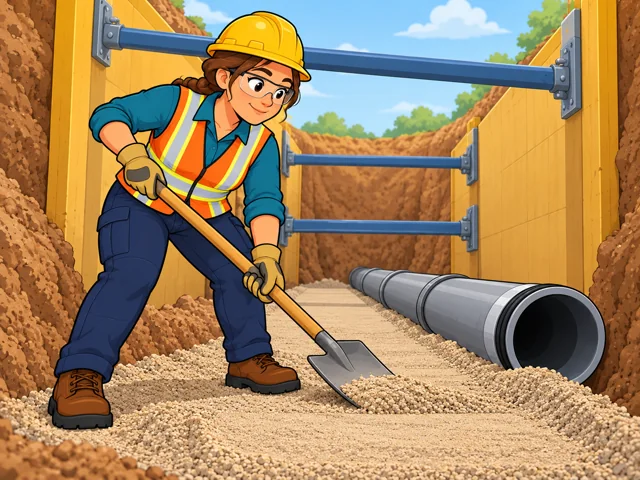
Shape the trench bed
Shovel the dirt at the bottom of the trench into a bed where the next pipe will rest.
Career profile
Pipelayers install the buried pipes that carry sewage, water, and storm runoff.
Working alongside a crew, you help place each length of pipe, check its slope, and join it to the next before it disappears underground.
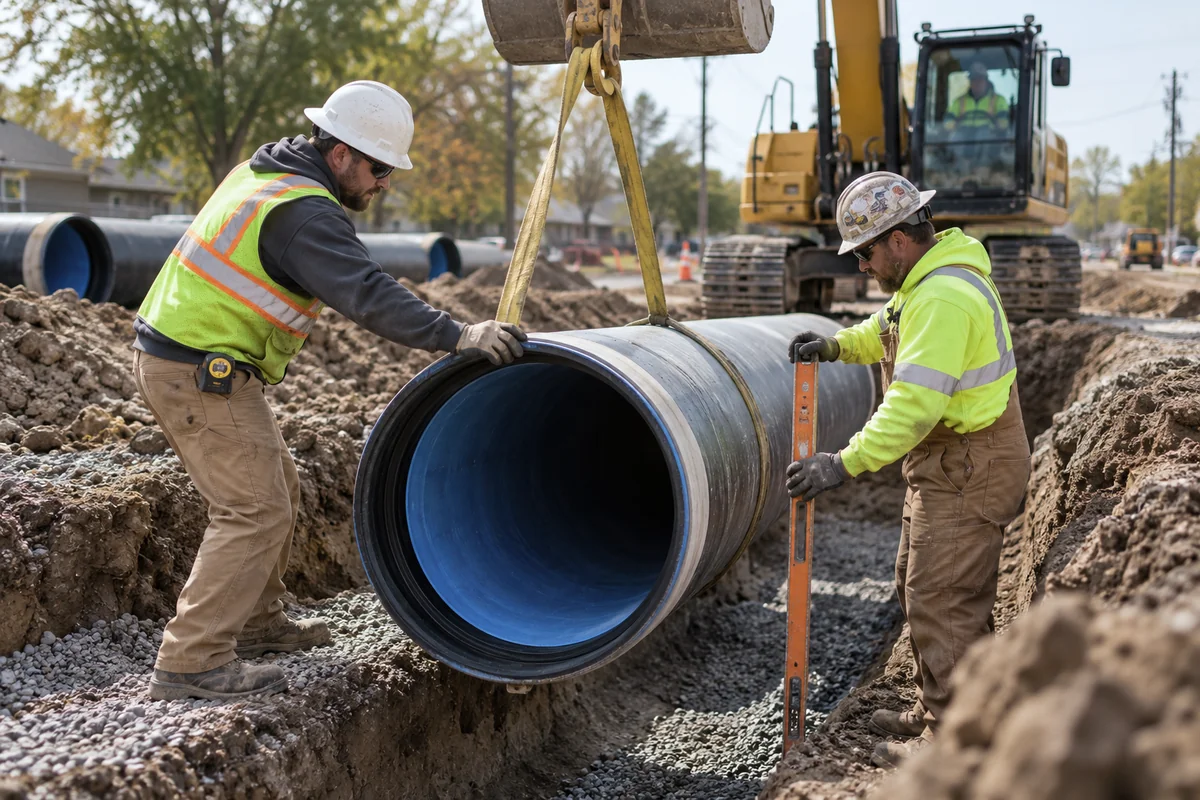
Shovel the dirt at the bottom of the trench into a bed where the next pipe will rest.
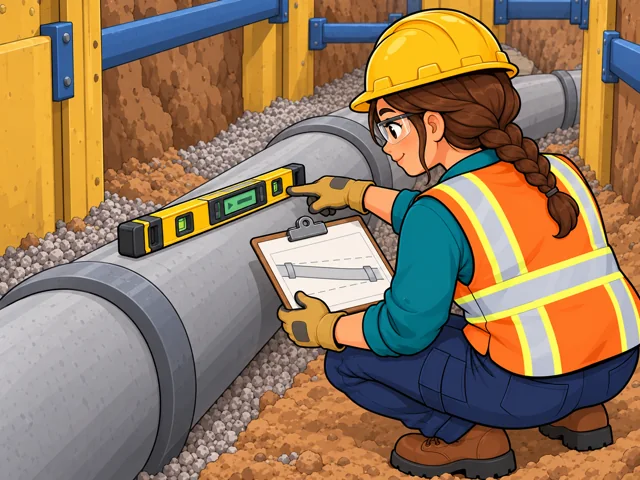
Take a laser or level reading, then move any pipe sitting off plan and measure again.
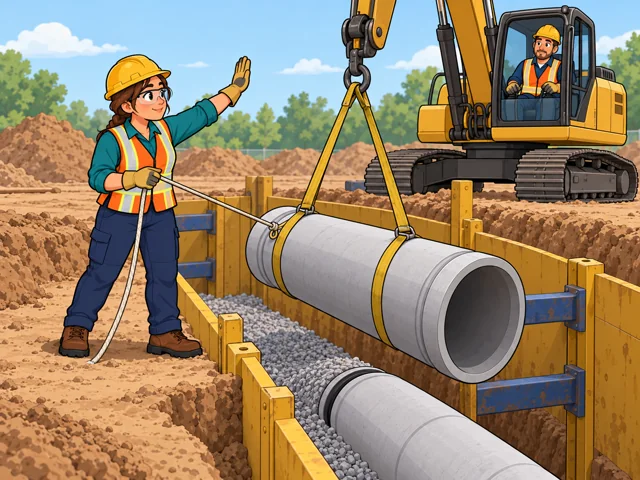
Signal or talk the equipment operator through lowering the pipe, then align it with the last piece laid.
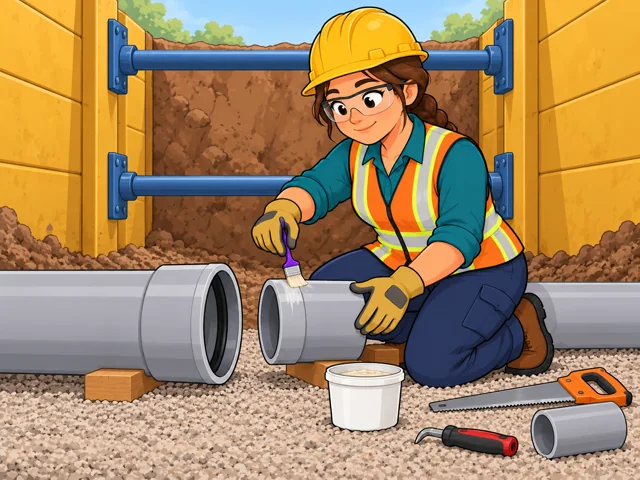
Cut the pipe to length, then join the ends with the fittings or sealant that system calls for.
United States · 2025
United States · 2025
United States · 2025–2035
Quick orientation
Typically no formal educational credential; employers set their own hiring requirements.
National annual median for pipelayers in 2025, equivalent to $23.56 an hour.
Employment is projected to decline during 2025–2035, with about 2,100 openings a year.
Some pipe lasers automatically level their beam and find a target, reducing manual setup.
You still position the pipe and make its joints; a correct laser reading alone does not finish the installation.
How much future equipment will take over pipe placement and joining remains uncertain, especially as site conditions change.
Pay in context
Use the national median as a reference when comparing actual offers.
Pipelayers' median pay was $49,000 a year, or $23.56 an hour, in 2025. Half earned more and half less; this is not a starting rate.
In 2025, the lowest-paid 10% of pipelayers earned $37,730 a year or less, while the highest-paid 10% earned $80,170 or more. The hourly thresholds were $18.14 and $38.55. These describe the wage spread, not starting and senior rates.
For a historical comparison, pipelayers averaged $25.52 an hour in utility system construction and $24.06 in local government in May 2023, excluding schools and hospitals. These national averages are not current offers or a guarantee that a contractor will pay more.
National projections show 3.1% fewer pipelayer jobs over 2025–2035, alongside about 2,100 openings annually. Openings and net job growth measure different things; these are not counts of local vacancies.
Learning at work is the usual starting point. Some jobs accept beginners; others require related experience first.
After entry
This starts where the entry routes leave off: early work, growing capability, and advancement or specialization.
Learn to prepare the trench bottom and communicate clearly with the equipment operator.
Build skill with plans, lasers, and slope checks so you can catch placement errors.
Work toward crew leadership: teach newer workers and coordinate installation work.
You may move between project sites and help highway or utility crews. Work can include barricades and cleanup as well as pipe installation.
You work on a city's network. Some roles combine pipe installation with repairs to hydrants, meters, and valves, plus coordination with other utilities.
Try it
On a table, line up three cardboard tubes against a straightedge. Raise one end of the row slightly with folded paper, then adjust the supports so the sections stay aligned. Notice whether you enjoy checking and correcting small placement errors.
Stay safe: Keep this a tabletop model; do not enter a trench or construction site.