
Gather mail and run sorters
Gather the mail and supplies you need, then run the sorting machines that split incoming or outgoing pieces.
Career profile
United States Postal Service (USPS) sorters separate letters and parcels and run mail-moving machines.
Like hands-on work where every piece has a set destination? Imagine turning a jumbled heap of mail into tidy groups ready to ship out.
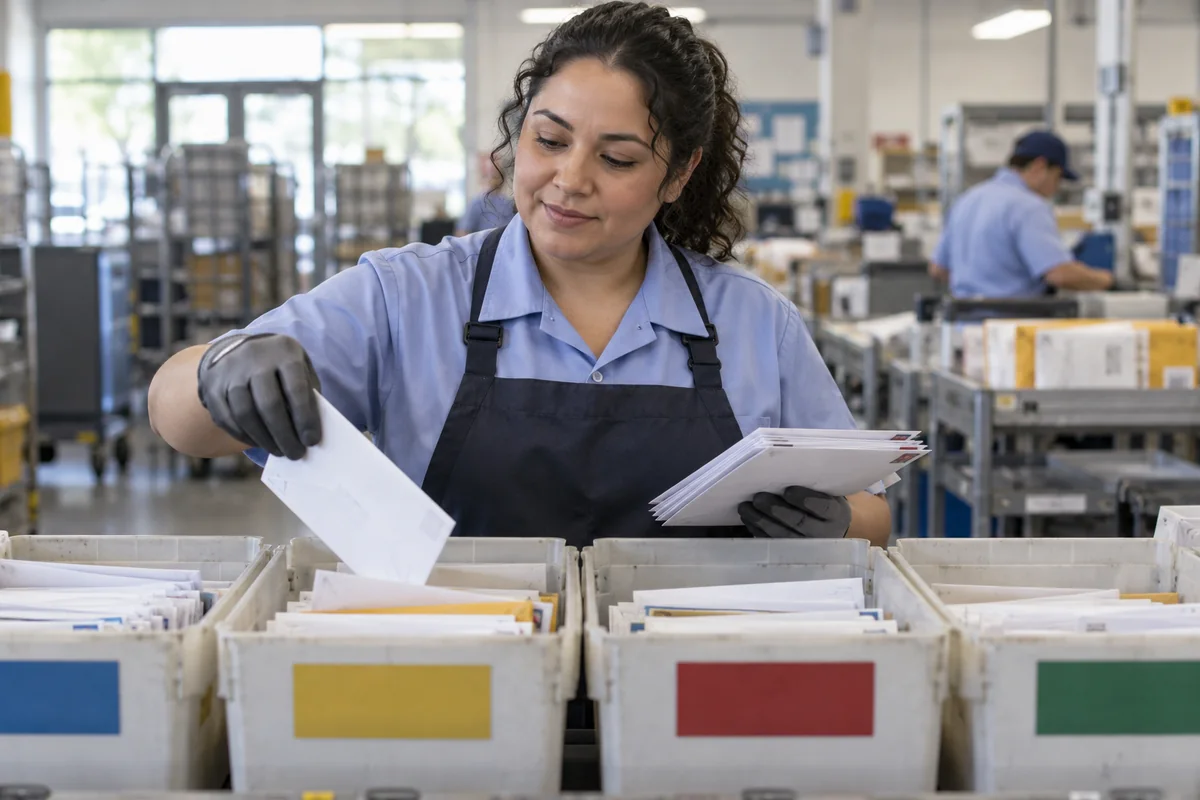
Gather the mail and supplies you need, then run the sorting machines that split incoming or outgoing pieces.
You sort odd-sized mail and items that need extra care into their correct groups by hand.
Confirm any hard-to-read address before you send the item on, and examine parcels with damaged wrapping.
Bundle the sorted mail, tag bundles with their destinations, and take them to dispatch before the cutoff.
United States · 2025
United States · May 2025
United States · 2025–2035
Quick orientation
Typically no formal educational credential or related experience; short-term workplace training. Employer hiring requirements still apply.
National median for postal mail sorters, processors, and processing machine operators; the hourly median is $28.11.
About 7,300 openings a year are projected nationally for this occupation despite declining employment.
Machines read addresses and automatically sort and forward mail, reducing the number of pieces you must route individually.
People still handle awkward pieces and address problems and keep mail moving between operations.
As equipment and facilities change, the balance between hand sorting, machine operation, and moving containers may shift at your workplace.
Pay in context
The national median was $58,470 a year, or $28.11 an hour, in May 2025. That describes the occupation, not your starting offer.
The lowest-paid 10% earned $45,530 or less annually; the highest-paid 10% earned $75,280 or more. Hourly thresholds were $21.89 and $36.19. These are wage percentiles, not beginner and experienced-worker rates.
USPS career clerk pay uses job grades and pay steps under a union agreement. Negotiated wage increases and cost-of-living adjustments can change the schedule. Check the appointment type, grade, and step in an offer.
Employment is projected to fall 5.3% from 2025 to 2035, with about 7,300 openings annually. Openings can exist while total employment falls; this is not a count of vacancies available today.
For either USPS route, you generally must be 18, or 16 with a high school diploma; meet citizenship or residency rules; provide employment history; and pass required screening. Selective Service registration applies when required, and overseas residence can affect background-check eligibility. Applications and exams are free. Follow the posting's examination requirements.
After entry
This starts where the entry routes leave off: early work, growing capability, and advancement or specialization.
During initial workplace training, learn the sorting routine and how to handle mail and equipment safely.
Use hands-on training to become comfortable with more of the equipment used in your processing operation.
If coordinating other people's work appeals to you, explore supervisor openings. USPS provides training for new supervisors; advancement requires selection.
These centers combine outgoing letters and larger flat mail with package processing. Your operation sits within a wider flow of mail entering and leaving the region.
The focus is letters and flat mail arriving for local delivery, plus packages transferring onward. Some local operations share a building with a regional center.
Try it
Make 20 cards with fictional addresses and sort them into five destination bins. Include two unclear addresses to set aside for checking. Repeat, then inspect every bin. Notice whether you enjoy maintaining accuracy as the task becomes repetitive.